

Best Buy (BBY) Is Down 8.2% After Return To Positive Comps And Reaffirmed 2027 Outlook - Has The Bull Case Changed?
Best Buy Co.,Inc. BBY | 0.00 |
- In late May 2026, Best Buy Co., Inc. reported first-quarter sales of US$8,936 million and net income of US$276 million, reaffirmed its full-year fiscal 2027 revenue outlook of US$41.2–US$42.1 billion, maintained a regular quarterly dividend of US$0.96 per share, and confirmed no share repurchases during the period.
- The combination of the company’s first positive comparable sales growth in several years, improved margins across emerging tech categories, and a steady dividend profile has renewed attention on how its evolving mix of AI-driven products, services, and higher-margin businesses could reshape its long-term earnings profile.
- Now we’ll examine how Best Buy’s return to positive comparable sales growth and reaffirmed full-year outlook influence the existing investment narrative.
Find 49 companies with promising cash flow potential yet trading below their fair value.
Best Buy Investment Narrative Recap
To own Best Buy, you generally need to believe it can turn modest sales growth in core electronics into higher-margin earnings through services, marketplace, and advertising, while managing intense online and in-store competition. The latest quarter’s return to positive comparable sales and reaffirmed US$41.2–US$42.1 billion revenue outlook support that near-term catalyst, but rising costs and shifting category mix remain the biggest risks to sustaining margins.
The most relevant recent announcement is management’s decision to reaffirm full-year fiscal 2027 revenue guidance alongside Q1 results. Holding that US$41.2–US$42.1 billion outlook after delivering 2% comparable sales growth suggests the early lift from AI-driven computing upgrades, gaming, and higher-margin marketplace and ad businesses is at least tracking internal expectations, which matters if you are focused on the upcoming PC upgrade cycle and service attach rates as key drivers.
Yet investors should also be aware that if stronger growth leans too heavily on lower margin hardware rather than services and newer profit streams, then...
Best Buy’s narrative projects $43.1 billion revenue and $1.5 billion earnings by 2029. This requires 1.1% yearly revenue growth and about a $0.4 billion earnings increase from $1.1 billion today.
Uncover how Best Buy's forecasts yield a $72.50 fair value, in line with its current price.
Exploring Other Perspectives
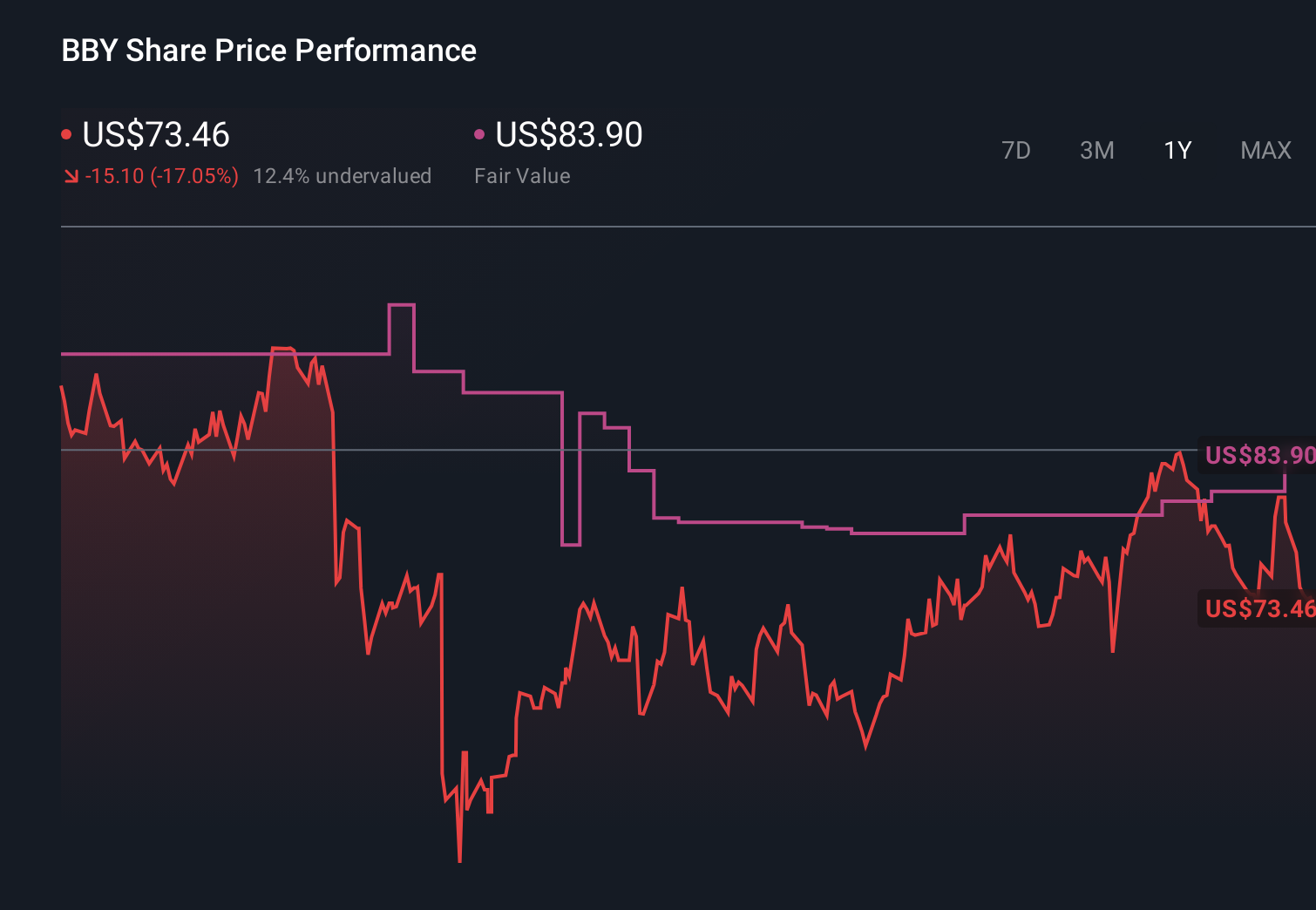
Some of the most optimistic analysts were already assuming revenue of about US$44.3 billion and earnings near US$1.7 billion by 2029, so if you think Q1’s better margins and early AI-driven demand confirm that kind of upside, you are closer to their view, while others may see the same results and still worry that tariffs and softer categories could easily derail that path.
Explore 5 other fair value estimates on Best Buy - why the stock might be worth as much as 84% more than the current price!
Decide For Yourself
Don't just follow the ticker - dig into the data and build a conviction that's truly your own.
- A great starting point for your Best Buy research is our analysis highlighting 5 key rewards and 1 important warning sign that could impact your investment decision.
- Our free Best Buy research report provides a comprehensive fundamental analysis summarized in a single visual - the Snowflake - making it easy to evaluate Best Buy's overall financial health at a glance.
Searching For A Fresh Perspective?
Every day counts. These free picks are already gaining attention. See them before the crowd does:
- Invest in the nuclear renaissance through our list of 88 elite nuclear energy infrastructure plays powering the global AI revolution.
- We've uncovered the 9 dividend fortresses yielding 5%+ that don't just survive market storms, but thrive in them.
- The future of work is here. Discover the 33 top robotics and automation stocks leading the charge in AI-driven automation and industrial transformation.
This article by Simply Wall St is general in nature. We provide commentary based on historical data and analyst forecasts only using an unbiased methodology and our articles are not intended to be financial advice. It does not constitute a recommendation to buy or sell any stock, and does not take account of your objectives, or your financial situation. We aim to bring you long-term focused analysis driven by fundamental data. Note that our analysis may not factor in the latest price-sensitive company announcements or qualitative material. Simply Wall St has no position in any stocks mentioned.