

Best Buy (BBY) Is Up 6.2% After Securing Nationwide Exclusivity On RGB LED TVs
Best Buy Co.,Inc. BBY | 0.00 |
- Best Buy recently launched RGB LED TVs nationwide through exclusive partnerships with Samsung, Sony, LG, TCL and Hisense, supported by more than 15,000 specially trained staff and bundled with free delivery, installation, mounting and haul-away services.
- This move temporarily makes Best Buy the only national retailer where shoppers can experience and purchase RGB LED TVs across a wide range of sizes, reinforcing its home theater differentiation at a time when many households are considering their next TV upgrade.
- Next, we’ll examine how this exclusive RGB LED TV rollout, combined with recent leadership changes, could influence Best Buy’s existing investment narrative.
The future of work is here. Discover the 31 top robotics and automation stocks leading the charge in AI-driven automation and industrial transformation.
Best Buy Investment Narrative Recap
To own Best Buy, you have to believe its stores, services and vendor relationships can still matter in an increasingly online, promotion-heavy electronics market. The near term catalyst is whether the upcoming upgrade cycles in TVs and computing translate into healthier mix and margins, while the biggest risk is that higher costs and intense price competition keep pressuring profitability. The RGB LED launch and leadership changes do not yet appear to materially change that risk reward balance.
The RGB LED TV rollout is most closely tied to Best Buy’s vendor partnership catalyst, since it deepens exclusive relationships with Samsung, Sony, LG, TCL and Hisense and showcases a differentiated in store experience. At the same time, the announced CFO transition adds a layer of execution risk around capital allocation and margin management just as Best Buy is leaning into high touch, service heavy initiatives like RGB LED and its broader home theater offering.
Yet while the RGB LED opportunity looks compelling, investors should be aware that the risk of lower margin mix and intense pricing pressure could still...
Best Buy's narrative projects $43.1 billion revenue and $1.5 billion earnings by 2029. This requires 1.1% yearly revenue growth and about a $0.4 billion earnings increase from $1.1 billion today.
Uncover how Best Buy's forecasts yield a $72.50 fair value, a 7% downside to its current price.
Exploring Other Perspectives
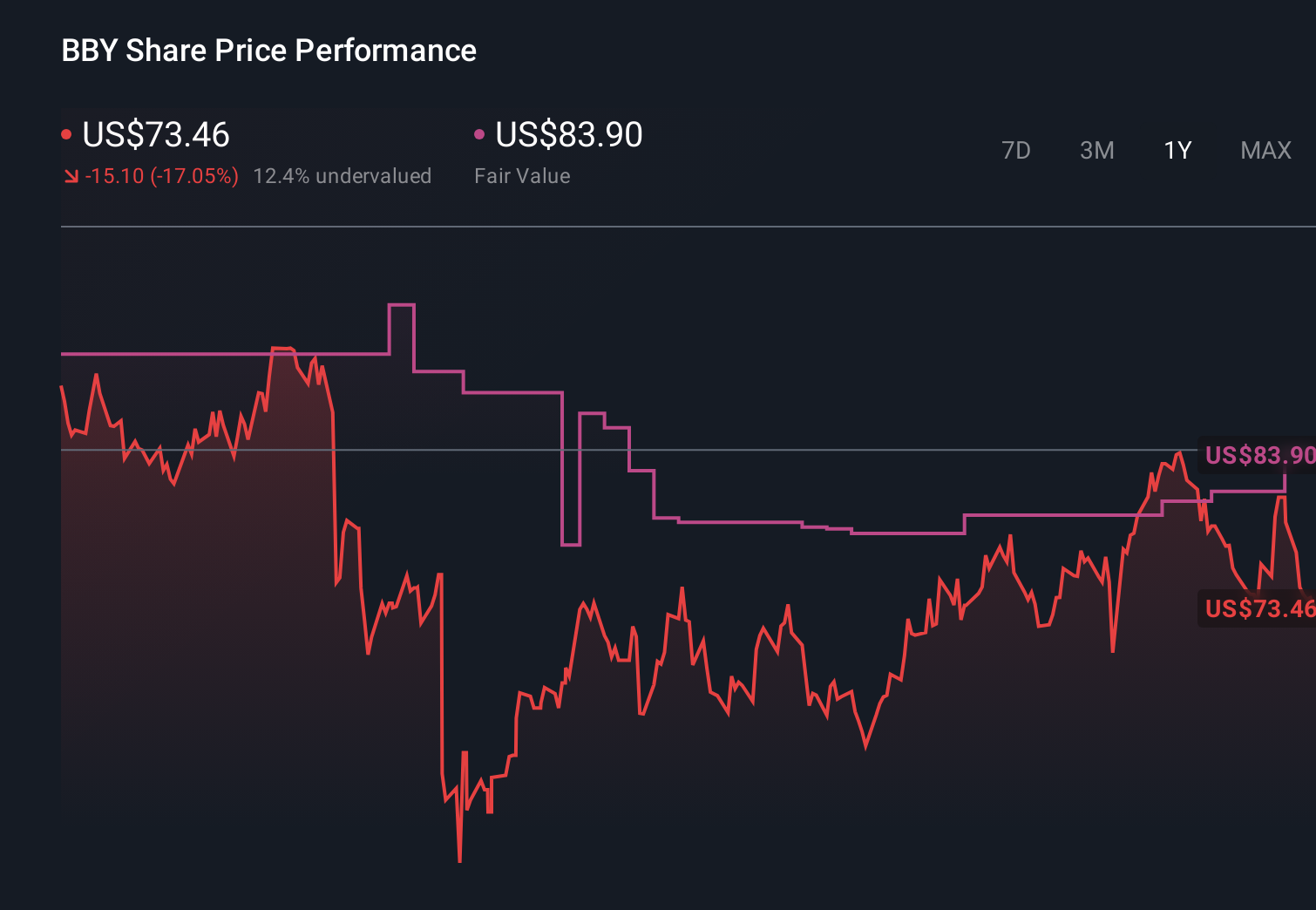
Some of the lowest analysts on Best Buy paint a very different picture, assuming revenues stay near US$42.6 billion and earnings around US$1.5 billion by 2029, with tariffs and weaker big ticket demand weighing on margins even if initiatives like RGB LED and the U.S. Marketplace gain traction.
Explore 6 other fair value estimates on Best Buy - why the stock might be worth over 2x more than the current price!
Reach Your Own Conclusion
Don't just follow the ticker - dig into the data and build a conviction that's truly your own.
- A great starting point for your Best Buy research is our analysis highlighting 5 key rewards and 1 important warning sign that could impact your investment decision.
- Our free Best Buy research report provides a comprehensive fundamental analysis summarized in a single visual - the Snowflake - making it easy to evaluate Best Buy's overall financial health at a glance.
Contemplating Other Strategies?
Opportunities like this don't last. These are today's most promising picks. Check them out now:
- Find 44 companies with promising cash flow potential yet trading below their fair value.
- The best AI stocks today may lie beyond giants like Nvidia and Microsoft. Find the next big opportunity with these 14 smaller AI-focused companies with strong growth potential through early-stage innovation in machine learning, automation, and data intelligence that could fund your retirement.
- Explore 30 top quantum computing companies leading the revolution in next-gen technology and shaping the future with breakthroughs in quantum algorithms, superconducting qubits, and cutting-edge research.
This article by Simply Wall St is general in nature. We provide commentary based on historical data and analyst forecasts only using an unbiased methodology and our articles are not intended to be financial advice. It does not constitute a recommendation to buy or sell any stock, and does not take account of your objectives, or your financial situation. We aim to bring you long-term focused analysis driven by fundamental data. Note that our analysis may not factor in the latest price-sensitive company announcements or qualitative material. Simply Wall St has no position in any stocks mentioned.