
Blue Owl’s Liquidity Crackdown and ESOP Shelf Might Change The Case For Investing In OWL
Blue Owl Capital Inc. Class A Common Stock OWL | 8.47 8.67 | +0.24% +2.36% Post |
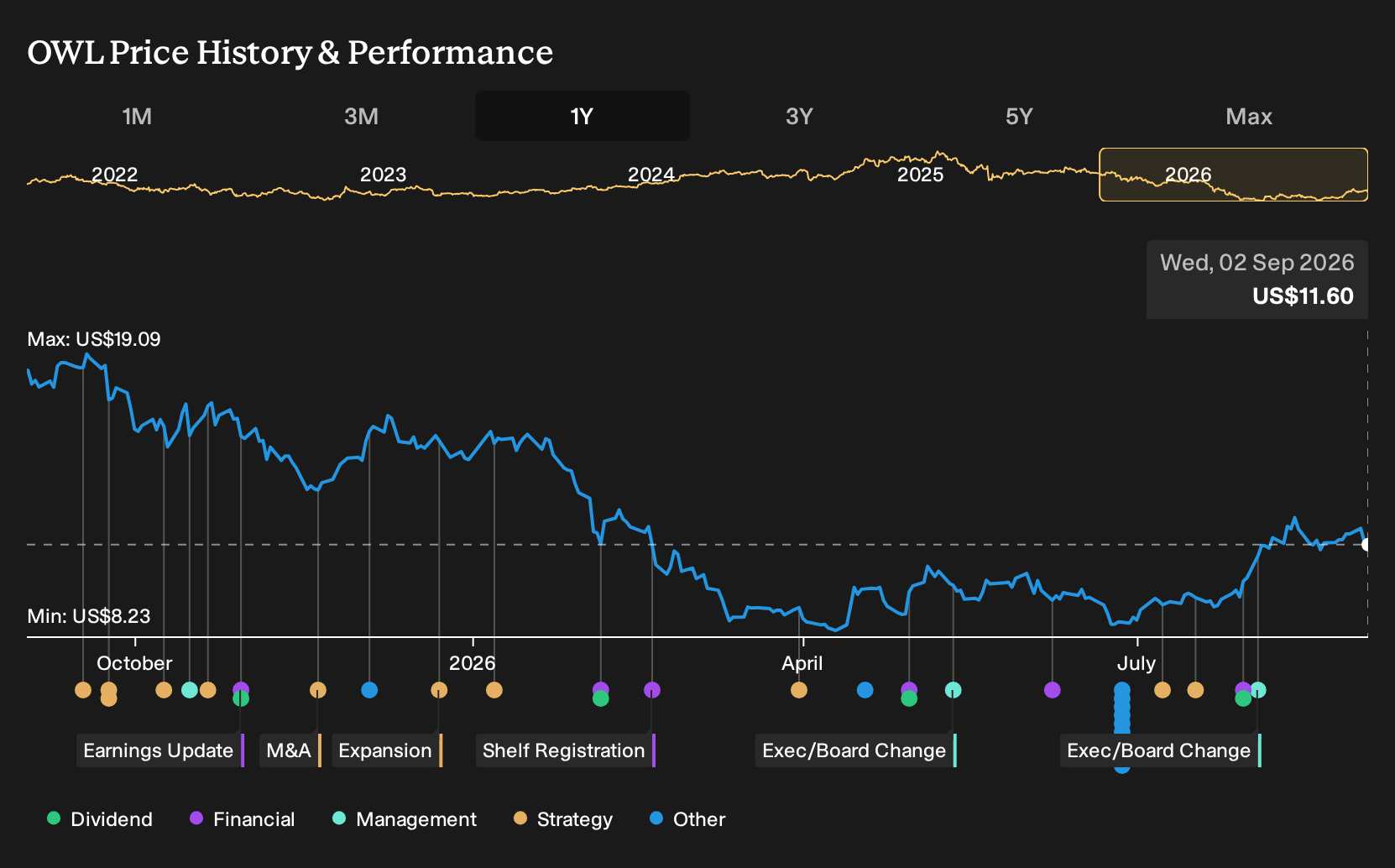
- In February 2026, Blue Owl Capital Inc. filed a US$615.5 million shelf registration for 50,000,000 Class A shares linked to an employee stock ownership plan, shortly after restricting withdrawals from a fund and planning to sell US$1.40 billion of assets across three funds to repay debt and return capital to investors.
- These moves, including the permanent removal of a quarterly withdrawal option in its smallest vehicle, highlight how Blue Owl is balancing growth ambitions with tighter liquidity management in a private credit market already under pressure.
- We’ll now examine how Blue Owl’s tighter fund withdrawal limits and liquidity actions might influence its pre-existing, growth-focused investment narrative.
Rare earth metals are the new gold rush. Find out which 31 stocks are leading the charge.
Blue Owl Capital Investment Narrative Recap
To own Blue Owl today, you need to believe in the long term appeal of private credit, permanent capital and fee-based earnings, despite near term fund-level stress. The key short term catalyst remains whether Blue Owl can keep fundraising and fee revenues on track while tightening withdrawals. The biggest risk is that liquidity curbs and asset sales dent confidence and slow new inflows. The new shelf registration itself does not appear to materially alter that risk-reward balance.
The most relevant recent announcement is Blue Owl’s plan to sell US$1.40 billion of assets across three funds, using proceeds to repay debt and return capital. In the context of record 2025 fundraising and a fixed US$0.92 annual dividend for 2026, this move puts a spotlight on how well Blue Owl can match its growth ambitions with liquidity discipline at the vehicle level, which may prove critical for sustaining its growth-focused story.
Yet beneath the appeal of permanent capital and a generous dividend, investors should be aware of the growing tension around liquidity, withdrawal limits and...
Blue Owl Capital's narrative projects $4.2 billion revenue and $5.1 billion earnings by 2028. This requires 17.5% yearly revenue growth and about a $5.0 billion increase in earnings from $75.4 million.
Uncover how Blue Owl Capital's forecasts yield a $17.47 fair value, a 64% upside to its current price.
Exploring Other Perspectives
Before this news, the most optimistic analysts were baking in revenue of about US$4.2 billion and US$3.3 billion in earnings by 2028, which is a far more upbeat story than the consensus view, yet both sets of expectations may need a rethink if liquidity pressures or fee compression start to bite more than expected.
Explore 7 other fair value estimates on Blue Owl Capital - why the stock might be worth less than half the current price!
Reach Your Own Conclusion
Don't just follow the ticker - dig into the data and build a conviction that's truly your own.
- A great starting point for your Blue Owl Capital research is our analysis highlighting 1 key reward and 4 important warning signs that could impact your investment decision.
- Our free Blue Owl Capital research report provides a comprehensive fundamental analysis summarized in a single visual - the Snowflake - making it easy to evaluate Blue Owl Capital's overall financial health at a glance.
Ready For A Different Approach?
Don't miss your shot at the next 10-bagger. Our latest stock picks just dropped:
- Find 45 companies with promising cash flow potential yet trading below their fair value.
- Invest in the nuclear renaissance through our list of 84 elite nuclear energy infrastructure plays powering the global AI revolution.
- AI is about to change healthcare. These 28 stocks are working on everything from early diagnostics to drug discovery. The best part - they are all under $10b in market cap - there's still time to get in early.
This article by Simply Wall St is general in nature. We provide commentary based on historical data and analyst forecasts only using an unbiased methodology and our articles are not intended to be financial advice. It does not constitute a recommendation to buy or sell any stock, and does not take account of your objectives, or your financial situation. We aim to bring you long-term focused analysis driven by fundamental data. Note that our analysis may not factor in the latest price-sensitive company announcements or qualitative material. Simply Wall St has no position in any stocks mentioned.