

BNY (BNY) Stock Could Be 15% Overvalued Despite Record Earnings
Bank of New York Mellon Corp BNY | 0.00 |
After a very strong three year share price run of 277.6%, Bank of New York Mellon Corporation now faces a valuation debate, with its intrinsic value estimate from the Excess Returns model pointing to the stock trading at a premium, while market multiples suggest pricing that is closer to about right.
- BNY has delivered a very large 277.6% total return over three years, which means a lot of optimism is already reflected in the share price.
- Recent earnings momentum, supported by fees, interest income and technology initiatives such as AI and digital assets, can support higher profit expectations. However, capital needs and execution risks around these investments may cap how much investors are willing to pay.
- With a valuation score of 2 out of 6 checks, BNY does not screen as a clear bargain on the broader set of valuation measures.
The issue now is whether the recent re rating of Bank of New York Mellon Corporation has already used up most of the upside that the intrinsic value and multiples can reasonably support.
Has Bank of New York Mellon Run Too Far on Excess Returns?
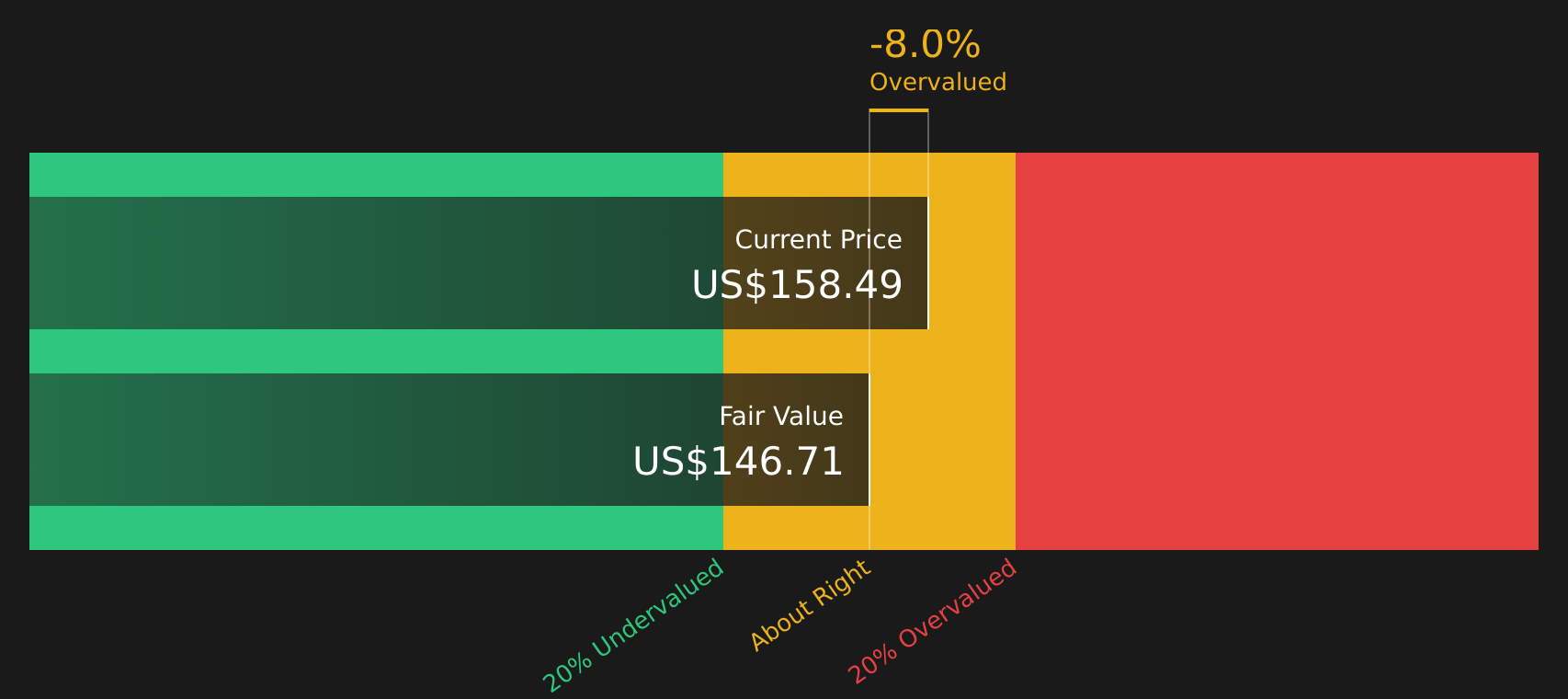
The Excess Returns model for Bank of New York Mellon Corporation looks at what BNY can earn on its equity above the return that shareholders require. Based on the inputs used, BNY is expected to generate stable earnings of $10.51 per share on a stable book value base of $65.74 per share. This implies an average return on equity of 15.98% against an estimated equity cost of $6.26 per share. That gap drives an excess return of $4.25 per share, which is capitalised to reach an intrinsic value estimate of $136.84 per share.
Compared with the current market price, this points to BNY trading about 14.8% above the Excess Returns estimate, so the stock screens as overvalued on this framework. The recent record Q2 2026 earnings and raised guidance help explain why investors are willing to pay a premium to the model’s output.
On the Excess Returns model, Bank of New York Mellon Corporation currently looks overvalued relative to its estimated intrinsic value.
Our Excess Returns analysis suggests Bank of New York Mellon may be overvalued by 14.8%. Discover 47 high quality undervalued stocks or create your own screener to find better value opportunities.
Where Does Bank of New York Mellon Sit on Earnings?
The P/E ratio suits Bank of New York Mellon Corporation because earnings are a core yardstick for mature financial institutions. BNY trades on a P/E of 17.7x, compared with an industry average of 39.6x for Capital Markets and a peer average of 21.8x, so the stock sits at a discount to both those benchmarks.
The Fair Ratio, which reflects what investors might typically pay for BNY given its size, margins and risk profile, is 16.8x. That is close to the current 17.7x, implying only a small premium to this tailored benchmark despite strong recent earnings headlines and raised guidance. On this P/E framework, Bank of New York Mellon Corporation does not screen as either clearly cheap or expensive.
Overall, Bank of New York Mellon Corporation looks priced roughly in line with what its P/E multiple would suggest is fair.

The Bank of New York Mellon Narrative: What Would Justify Today's Price?
Simply Wall St Narratives pick up where the valuation puzzle for Bank of New York Mellon Corporation leaves off by spelling out which paths for its growth, margins and earnings would need to play out for the stock to be worth materially more or less than today’s price. Each narrative links its number to a clear view on how Bank of New York Mellon's growth, profitability and risk profile might evolve, giving you something concrete to revisit as new information comes through.
Be one of the first voices in the Simply Wall St community to set out a number driven Narrative on Bank of New York Mellon Corporation, weighing in on whether its record recent earnings, raised outlook and push into AI and digital assets ultimately justify today's valuation.
Share a clear, data based view that others can track against future results to see how your thesis on BNY holds up over time.
Do you think there's more to the story for Bank of New York Mellon? Head over to our Community to see what others are saying!
The Bottom Line
For Bank of New York Mellon Corporation, the Excess Returns intrinsic value estimate points to the stock trading at a premium, while the P/E and Fair Ratio view suggest pricing that is roughly in line with peers. That split mainly reflects how the intrinsic value framework treats funding needs and capital intensity versus how the market is weighing recent earnings news and sentiment. With a low value score, the broader checks do not flag Bank of New York Mellon Corporation as a clear bargain. The real swing factor from here is whether earnings and capital deployment justify maintaining, or expanding, the current valuation premium.
This article by Simply Wall St is general in nature. We provide commentary based on historical data and analyst forecasts only using an unbiased methodology and our articles are not intended to be financial advice. It does not constitute a recommendation to buy or sell any stock, and does not take account of your objectives, or your financial situation. We aim to bring you long-term focused analysis driven by fundamental data. Note that our analysis may not factor in the latest price-sensitive company announcements or qualitative material. Simply Wall St has no position in any stocks mentioned.