
btc/gold ratio sends rare signal: is capital set to shift massively from gold to bitcoin?
Valkyrie ETF Trust II Valkyrie Bitcoin Futures Leveraged Strategy ETF BTFX | 33.71 | 0.00% |
2x Bitcoin Strategy ETF BITX | 14.74 | +3.88% |
ProShares Ultra Bitcoin ETF BITU | 11.64 | +3.93% |
Invesco Galaxy Bitcoin ETF BTCO | 67.47 | +1.96% |
Franklin Bitcoin ETF EZBC | 39.19 | +1.90% |
As capital allocators attempt to make sense of the global landscape, all eyes are on gold and Bitcoin.
Bitcoin, a decentralized asset, is positioned as "digital gold," or as I previously called it, "gold with wings." The core logic is that Bitcoin possesses the robust monetary properties of precious metals and, with its unique advantages (including limited supply, halving mechanism, and relatively short development history), it is expected to consistently outperform gold.
However, this expectation did not materialize in 2025.
In fact, gold rose by about 60% this year, marking its best performance in nearly half a century. Creative Planning's Chief Market Strategist Charlie Bilello noted, "Gold has become the best-performing major asset class of the past 20 years, with an annualized return exceeding 11%."
This performance, especially over the past 11 months, has significantly increased the proportion of gold in central bank reserves. Charlie wrote, "Gold now accounts for over 20% of global central bank reserves, the highest share in nearly thirty years."
The significance of central bank demand lies in its ability to offset the continuous net selling of gold and silver by U.S. retail investors since the sharp price increase in March 2024.
What puzzles many investors is the historically close correlation between Bitcoin and gold: typically, when gold prices rise, Bitcoin follows suit about 100 days later.
Both assets benefit from macroeconomic factors such as rising national debt, erratic monetary policy, and geopolitical uncertainty. In response to these challenges, investors often prefer to allocate a larger portion of their portfolios to robust monetary assets—those that exist outside traditional systems and cannot be inflated.
So why has gold reacted to recent global events while Bitcoin lags behind? Is it merely because central banks have substantial funds and have yet to allocate to Bitcoin, thereby driving up gold prices?
This is indeed part of the reason. However, there are more nuanced factors at play. Most people focus too much on gold's strong performance and overlook Bitcoin's relative weakness.
Joe Carlasare points out that the current Bitcoin bull market has seen much smaller gains compared to previous ones. We haven't witnessed the expected dramatic surge, indicating a lack of retail-driven mania pushing the market to new heights.
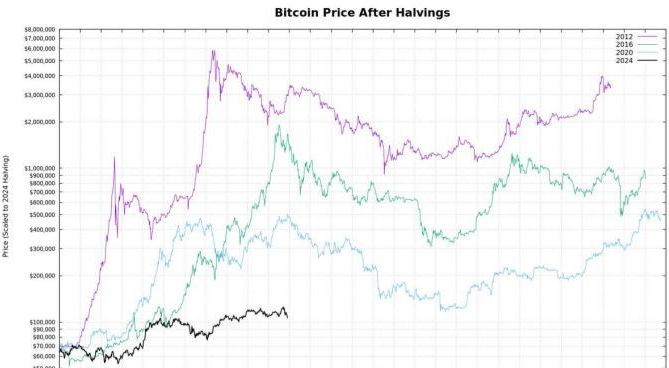
If you once bought Bitcoin for speculative reasons—especially if its seemingly asymmetric return potential was most appealing—you are almost certainly disappointed right now. I completely understand this feeling. In this cycle so far, Bitcoin has indeed failed to deliver on that promise.
However, if you see Bitcoin as a defensive asset against currency debasement and runaway inflation, you should be satisfied with its performance. Since January 2020, Bitcoin is up about 1,500%, and it's up more than 18% so far in 2025.
Bitcoin's previous asymmetric returns stemmed from the high risks investors were taking. Risk and reward always go hand in hand. But today, Bitcoin is no longer a high-risk asset: clearly, it isn't going to disappear, governments won’t ban it, and it will eventually be integrated into every sophisticated investor's portfolio.
Therefore, you should expect Bitcoin returns to be lower than in past bull markets. This by no means weakens its appeal; in fact, it means Bitcoin’s rise is now inevitable. It may take some time, but Bitcoin will eventually become a top global store-of-value asset. Gold will develop alongside Bitcoin; the two are not competitors, but "allies" fighting against currency debasement.
Coexistence will benefit both assets.
In the short term, however, this past weekend may have been a turning point. By year-end, we could see a major rotation of capital from gold to Bitcoin.
As Joao Wedson points out: “BTC/gold ratio bottom signals are extremely rare and usually appear during periods of high volatility and sharp Bitcoin corrections—we are currently at such a juncture. The blue signal indicates the current bottom, with the standardized oscillators essentially shouting: 'It's time to sell gold and buy Bitcoin.' The green signal is even stronger, appearing when both indicators reach their lows simultaneously. Historically, these moments have provided the best BTC/gold allocation opportunities. To institutional gold holders, I would say: if I were you, I'd study this chart closely. Bitcoin’s risk-reward is more attractive than ever, especially with gold at feverish highs. Feel free to use this chart for your analysis, but remember this moment: it could be an historic turning point between gold and Bitcoin.”
In summary: Gold is performing exceptionally well in 2025, but past performance is not indicative of future results. We may be on the brink of a major rotation from gold to Bitcoin. If this plays out, Bitcoin could end the year with a spectacular rally.