

Can Enphase Energy (ENPH) Hold Its Premium After Manufacturing Push?
Enphase Energy, Inc. ENPH | 0.00 |
Enphase Energy stock has delivered a steep decline of about 75.6% over the past five years, yet current valuation checks suggest the shares now trade close to an intrinsic value estimate from a Discounted Cash Flow (DCF) model and look roughly in line with market multiples rather than clearly cheap or clearly expensive.
- Over the past five years the share price has fallen about 75.6%, which puts long term holders deep in the red and makes today’s pricing more relevant for new capital than past highs.
- Recent moves to expand U.S. manufacturing for power electronics and support AI data center infrastructure can help underpin long term cash flow expectations, while execution risk around new platforms and international home energy rollouts may still weigh on how much investors are willing to pay.
- Enphase Energy scores 3 out of 6 on Simply Wall St’s broader valuation checks, which is a mixed picture rather than a clear bargain or clear overvaluation 3.
The issue now is whether Enphase Energy’s current share price already reflects a fair assessment of its cash flow potential or still leaves room for mispricing.
Where Does Enphase Energy Sit on Cash Flow?
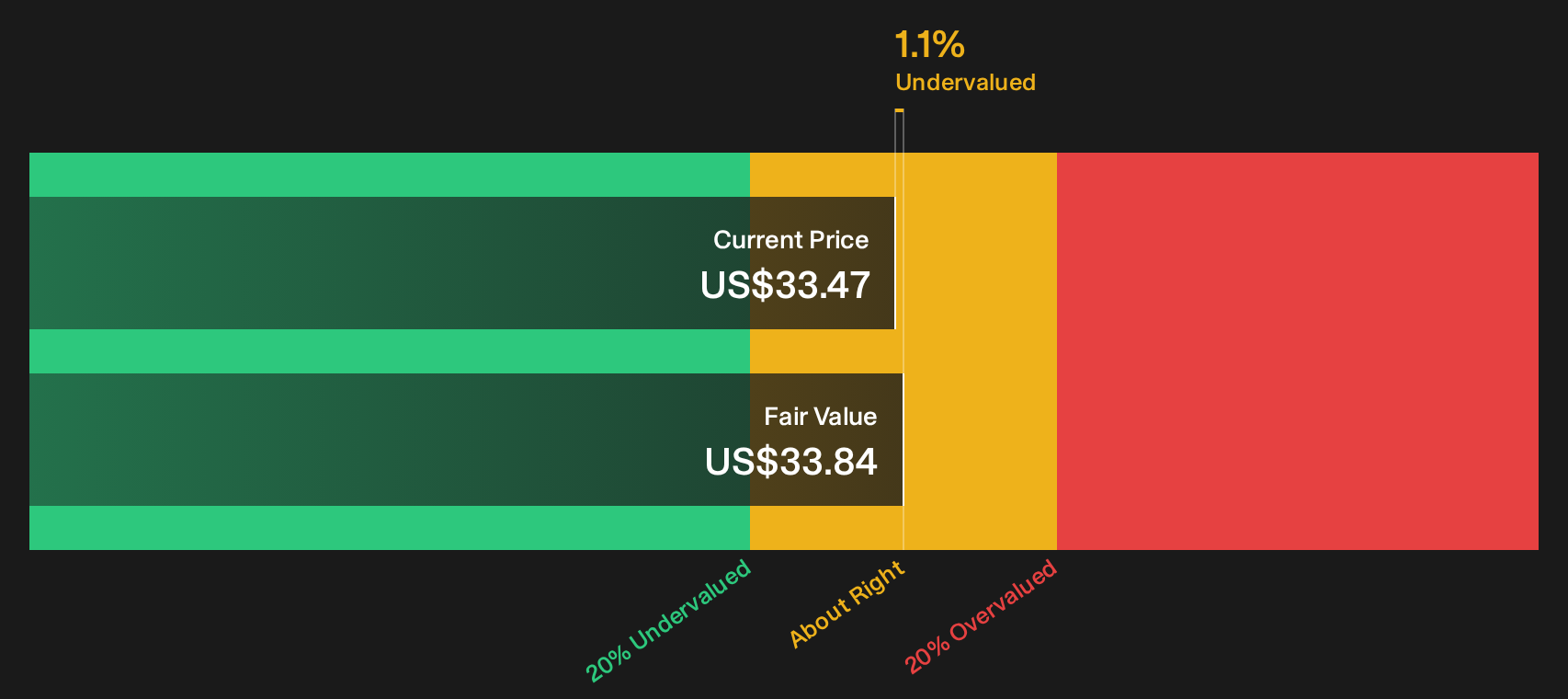
The Discounted Cash Flow (DCF) model here projects what Enphase Energy’s future cash generation could be worth in today’s dollars. On the latest twelve month numbers, Enphase Energy produced free cash flow of about $156.8 million, and the model assumes that cash flows continue growing from this base rather than shrinking. Rolling those projections through a 2 Stage Free Cash Flow to Equity framework gives an estimated intrinsic value of about $40.95 per share.
That compares to a current share price that implies the stock trades only about 1.1% below this intrinsic value estimate, which points to Enphase Energy being roughly in line with what its cash flows support. The recent push to reinforce U.S. manufacturing for power electronics and AI related infrastructure helps explain why the market is not heavily discounting the long term cash flow profile.
Overall, the DCF workup suggests Enphase Energy stock appears to be trading around fair value at current levels.
Enphase Energy is fairly valued according to our Discounted Cash Flow (DCF), but this can change at a moment's notice. Track the value in your watchlist or portfolio and be alerted on when to act.
Where Does Enphase Energy Sit on Earnings?
The P/E ratio is a useful reference here because Enphase Energy is already generating earnings, so you can compare what the market pays per dollar of profit against peers.
Enphase Energy trades on a P/E of about 39.9x. That sits below the broader semiconductor industry average of roughly 53.1x and also below the peer average near 66.6x. On Simply Wall St’s fair P/E estimate of about 37.4x, which blends the company’s growth profile, profitability, size, and risk into a single reference point, the current multiple is only slightly higher.
This small premium to the fair P/E suggests the market is pricing Enphase Energy close to what its earnings profile supports rather than assigning a clear discount or a heavy premium when lined up against other semiconductor stocks.
Overall, Enphase Energy appears to be trading close to its estimated fair value based on its current P/E multiple.

The Enphase Energy Narrative: What Would Justify Today's Price?
Simply Wall St Narratives for Enphase Energy pick up where the valuation work above leaves off and explain what would need to happen to Enphase Energy's growth, margins and earnings for the stock to appear meaningfully cheaper or more expensive than it does today on the Community page. Each narrative links its number to a clear view on how growth, profitability and risks could change, which you can revisit as new information becomes available.
Community views on Enphase Energy sit far apart, with one side focused on product and policy upside and the other on policy risk and competition.
Bull case: 14% undervalued
"Upcoming launches of next-generation products including the IQ9 microinverter with gallium nitride technology, the fifth-generation high-density battery, and bidirectional EV chargers position Enphase to capture new commercial, multi-phase, and EV oriented market segments..."
Bear case: 50% overvalued
"The expected expiration of the 25D homeowner tax credit and an ensuing 20% reduction in the U.S. total addressable market for residential solar in 2026 signal declining installation volumes, disproportionately hurting Enphase's core revenue base and threatening sustained top-line growth..."
Do you think there's more to the story for Enphase Energy? Head over to our Community to see what others are saying!
The Bottom Line
For Enphase Energy, both the Discounted Cash Flow (DCF) work and the P/E based view point to a stock that currently screens as about right rather than clearly undervalued or overvalued. The key question now is whether future cash flows and earnings justify holding that valuation as product launches, U.S. manufacturing plans and policy shifts play out. The bull and bear cases largely turn on how resilient demand is for residential solar and related home energy solutions once current incentives change. Your own view on those demand and policy assumptions is likely to drive whether Enphase Energy looks like a reasonable hold or a risk to avoid at this price.
This article by Simply Wall St is general in nature. We provide commentary based on historical data and analyst forecasts only using an unbiased methodology and our articles are not intended to be financial advice. It does not constitute a recommendation to buy or sell any stock, and does not take account of your objectives, or your financial situation. We aim to bring you long-term focused analysis driven by fundamental data. Note that our analysis may not factor in the latest price-sensitive company announcements or qualitative material. Simply Wall St has no position in any stocks mentioned.