
Can indie Semiconductor’s (INDI) New Laser Diode Redefine Its Role in Quantum and Automotive Markets?
indie Semiconductor, Inc. Class A INDI | 3.33 | +3.26% |
- Earlier this month, indie Semiconductor launched a new gallium nitride-based distributed feedback (DFB) laser diode from its Photonics business unit, designed for next-generation quantum, automotive LiDAR, sensing, and industrial Raman applications.
- This product enables ultra-stable, sub-MHz linewidths and high-volume manufacturability, potentially opening new opportunities in automotive and quantum markets where precision and scalability are essential.
- We'll explore how the launch of this advanced GaN laser diode could strengthen indie Semiconductor's position in photonics and quantum technology markets.
The latest GPUs need a type of rare earth metal called Neodymium and there are only 36 companies in the world exploring or producing it. Find the list for free.
indie Semiconductor Investment Narrative Recap
For shareholders of indie Semiconductor, the core idea to believe in is that long-term growth will be driven by next-generation automotive and quantum technologies, where the company's differentiated photonics and sensing solutions could carve out a defensible niche. The recent launch of the GaN-based DFB laser diode looks promising for supporting these ambitions, but it does not materially change the short-term risks tied to profitability and cash flow, nor is it likely to immediately accelerate the primary revenue catalysts around automotive content per vehicle.
Earlier this year, indie Semiconductor also reported rising industry adoption of its photonics portfolio, highlighted by the launch of ultra-low noise LXM-U lasers for quantum applications. Together with the latest product, these efforts underscore ongoing attempts to strengthen the company’s foothold in emerging quantum and sensing markets, which are among the most anticipated sources of incremental revenue growth in future periods.
However, it’s important for investors to keep in mind that, despite technological wins, the company’s persistent operating losses and negative cash flow remain a key area of concern...
indie Semiconductor's narrative projects $421.4 million revenue and $59.5 million earnings by 2028. This requires 24.6% yearly revenue growth and a $215.3 million increase in earnings from -$155.8 million.
Uncover how indie Semiconductor's forecasts yield a $6.50 fair value, a 21% upside to its current price.
Exploring Other Perspectives
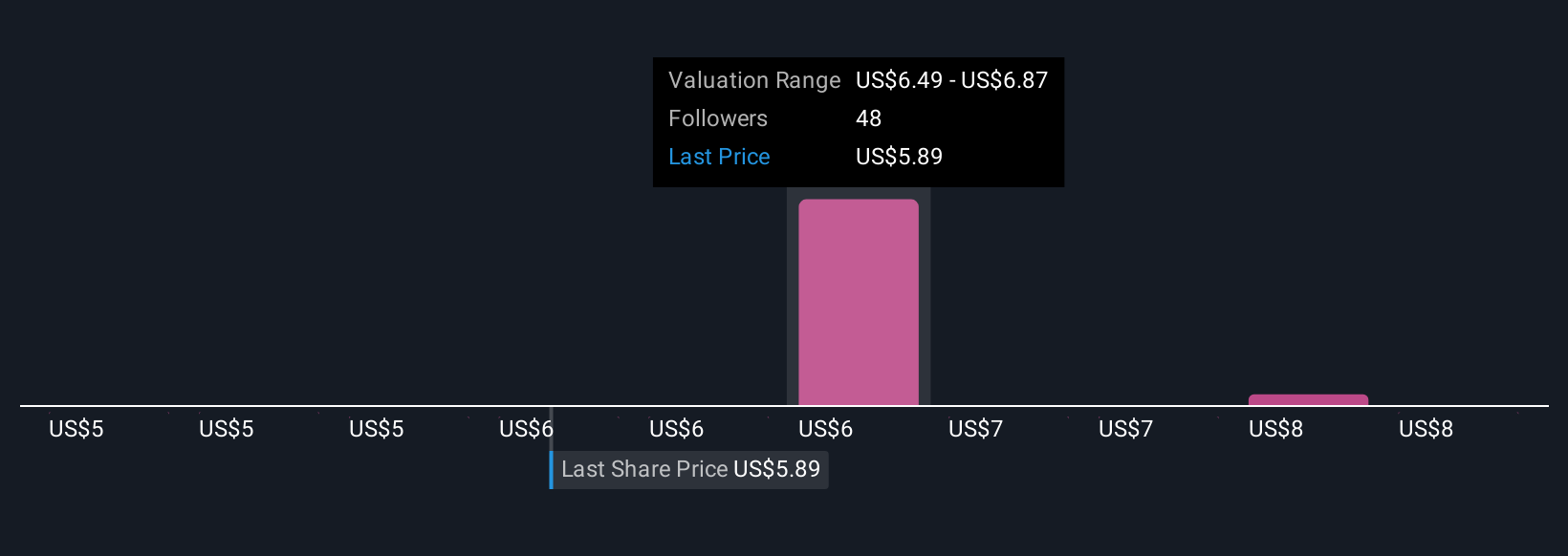
Simply Wall St Community members put indie Semiconductor’s fair value between US$5.05 and US$8.42, based on five different analyses. While these numbers show a wide spectrum of expectations, current unprofitability could weigh on future confidence, making it valuable to compare multiple viewpoints.
Explore 5 other fair value estimates on indie Semiconductor - why the stock might be worth 6% less than the current price!
Build Your Own indie Semiconductor Narrative
Disagree with existing narratives? Create your own in under 3 minutes - extraordinary investment returns rarely come from following the herd.
- A great starting point for your indie Semiconductor research is our analysis highlighting 1 key reward and 2 important warning signs that could impact your investment decision.
- Our free indie Semiconductor research report provides a comprehensive fundamental analysis summarized in a single visual - the Snowflake - making it easy to evaluate indie Semiconductor's overall financial health at a glance.
Curious About Other Options?
Don't miss your shot at the next 10-bagger. Our latest stock picks just dropped:
- Find companies with promising cash flow potential yet trading below their fair value.
- This technology could replace computers: discover 27 stocks that are working to make quantum computing a reality.
- Uncover the next big thing with financially sound penny stocks that balance risk and reward.
This article by Simply Wall St is general in nature. We provide commentary based on historical data and analyst forecasts only using an unbiased methodology and our articles are not intended to be financial advice. It does not constitute a recommendation to buy or sell any stock, and does not take account of your objectives, or your financial situation. We aim to bring you long-term focused analysis driven by fundamental data. Note that our analysis may not factor in the latest price-sensitive company announcements or qualitative material. Simply Wall St has no position in any stocks mentioned.