

Carvana (CVNA) Is Down 9.7% After Refinancing 2030 Notes And Investor Focus On Major Shareholder
Carvana CVNA | 0.00 |
- In August 2026, Carvana entered a US$1.66 billion senior secured Term Loan B maturing in 2033 to refinance its 9.0% /11.0% /13.0% cash/PIK senior secured notes due 2030, extend its debt maturity profile, and reduce annual cash interest expense by about US$45 million over the next four years.
- At the same time, investor concern mounted over major shareholder Mark Walter’s exposure to a federal investigation and the possibility he could sell his roughly 4% Carvana stake, raising questions about how concentrated ownership and funding choices intersect with the company’s improved profitability and balance sheet.
- Next, we’ll examine how refinancing the 2030 secured notes with longer-dated, lower-cost debt may reshape Carvana’s investment narrative.
Capitalize on the AI infrastructure supercycle with our selection of the 56 best 'picks and shovels' of the AI gold rush converting record-breaking demand into massive cash flow.
Carvana Investment Narrative Recap
To own Carvana today, you need to believe its online model and ADESA-backed infrastructure can keep translating into profitable growth while balance sheet risk stays contained. The new US$1.66 billion Term Loan B looks supportive of that near term, as it pushes out Carvana’s nearest maturity and cuts cash interest, while the Mark Walter overhang highlights how shareholder concentration and potential forced selling remain a key stock-specific risk.
The refinancing itself is the most relevant recent announcement. Replacing the high-cost 2030 secured notes with longer-dated, lower-rate debt directly supports the current catalyst: proving Carvana can compound earnings with a less burdensome capital structure. With net debt running at roughly 1.0x trailing Adjusted EBITDA, this move may give the company more room to focus on execution in reconditioning, logistics, and marketing efficiency rather than near-term refinancing questions.
But even with a stronger balance sheet, investors should still be aware of how concentrated ownership and elevated leverage could interact if operating trends...
Carvana's narrative projects $47.3 billion revenue and $2.2 billion earnings by 2029. This requires 23.6% yearly revenue growth and an earnings increase of about $0.6 billion from $1.6 billion today.
Uncover how Carvana's forecasts yield a $82.82 fair value, a 27% upside to its current price.
Exploring Other Perspectives
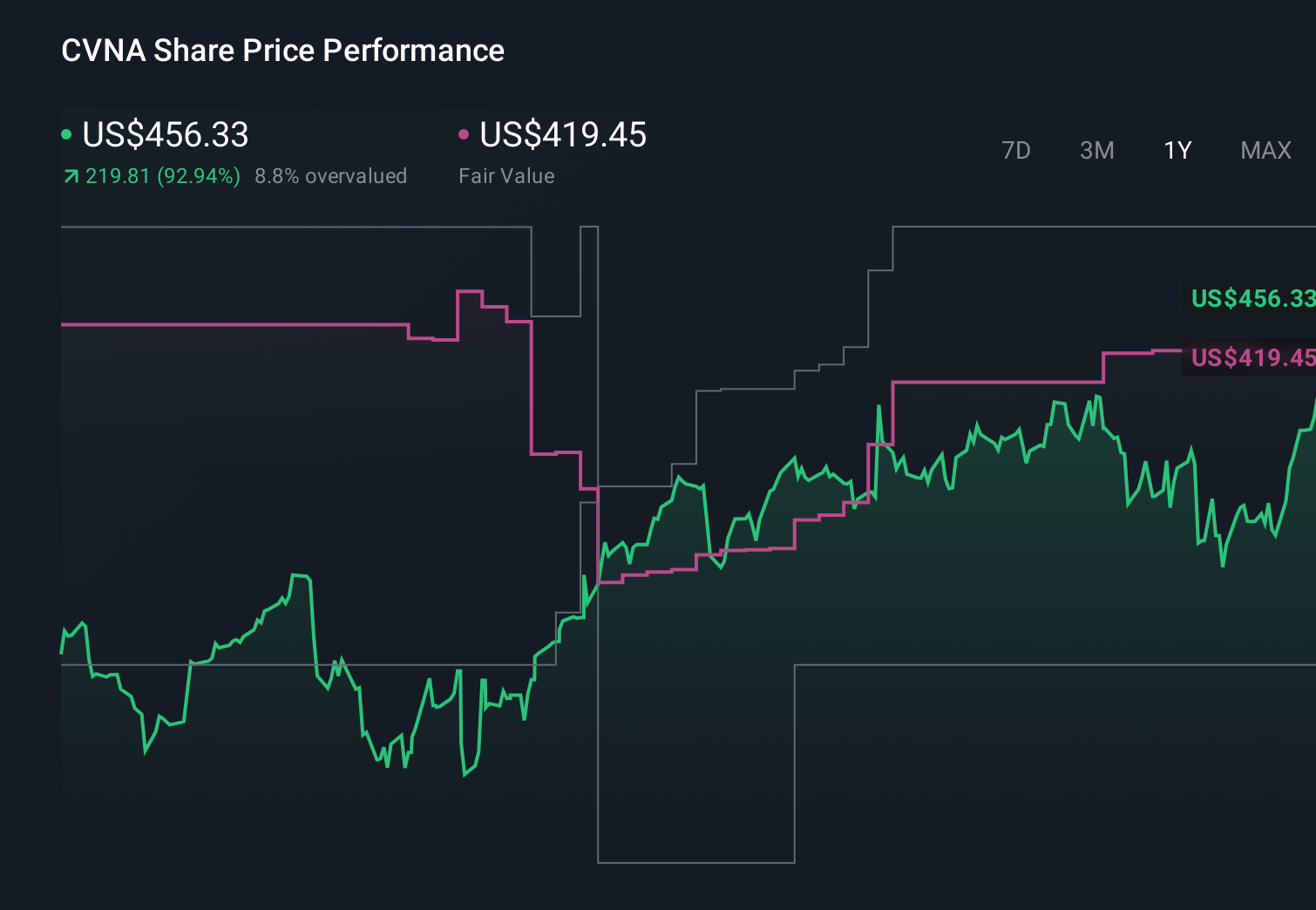
More bullish analysts were assuming Carvana could reach about US$50.0 billion in revenue and US$3.7 billion in earnings, which paints a far more optimistic picture than consensus. If you worry about ongoing leverage, that optimism can feel stretched, and this latest refinancing plus governance headlines may push both camps to reassess how realistic those pre news assumptions really are.
Explore 6 other fair value estimates on Carvana - why the stock might be worth less than half the current price!
Reach Your Own Conclusion
Disagree with existing narratives? Extraordinary investment returns rarely come from following the herd, so go with your instincts.
- A great starting point for your Carvana research is our analysis highlighting 2 key rewards and 1 important warning sign that could impact your investment decision.
- Our free Carvana research report provides a comprehensive fundamental analysis summarized in a single visual - the Snowflake - making it easy to evaluate Carvana's overall financial health at a glance.
Curious About Other Options?
These stocks are moving-our analysis flagged them today. Act fast before the price catches up:
- We've uncovered the 11 dividend fortresses yielding 5%+ that don't just survive market storms, but thrive in them.
- The latest GPUs need a type of rare earth metal called Neodymium and there are only 28 companies in the world exploring or producing it. Find the list for free.
- Explore 24 top quantum computing companies leading the revolution in next-gen technology and shaping the future with breakthroughs in quantum algorithms, superconducting qubits, and cutting-edge research.
This article by Simply Wall St is general in nature. We provide commentary based on historical data and analyst forecasts only using an unbiased methodology and our articles are not intended to be financial advice. It does not constitute a recommendation to buy or sell any stock, and does not take account of your objectives, or your financial situation. We aim to bring you long-term focused analysis driven by fundamental data. Note that our analysis may not factor in the latest price-sensitive company announcements or qualitative material. Simply Wall St has no position in any stocks mentioned.