

Costco (COST) Stock Still Looks Above Fair Value Following Weight Loss Drug Push
Costco Wholesale COST | 0.00 |
Costco Wholesale has delivered a strong 120.3% total return over the past 5 years, yet the stock now screens as expensive on broad valuation checks, which raises questions about how much of the story is already priced into the current US$944.32 share price.
- That 120.3% 5 year gain points to a stock that has already rewarded patient shareholders, so fresh buyers need to think carefully about what they expect from here.
- Investor focus on new revenue streams such as Costco Wholesale’s move into weight loss drug customers may support growth expectations, while intensifying competition in that same area can introduce execution risk that affects how much investors are willing to pay for the stock.
- Costco Wholesale currently passes 0 of 6 valuation checks, which means the broader review of metrics leans toward the stock not being a clear bargain for new capital according to our valuation summary.
The issue now is whether Costco Wholesale’s premium pricing can be justified by its future cash flow and earnings path, or if recent returns have already done most of the work for long term investors.
Is Costco Wholesale Getting Expensive on Earnings?
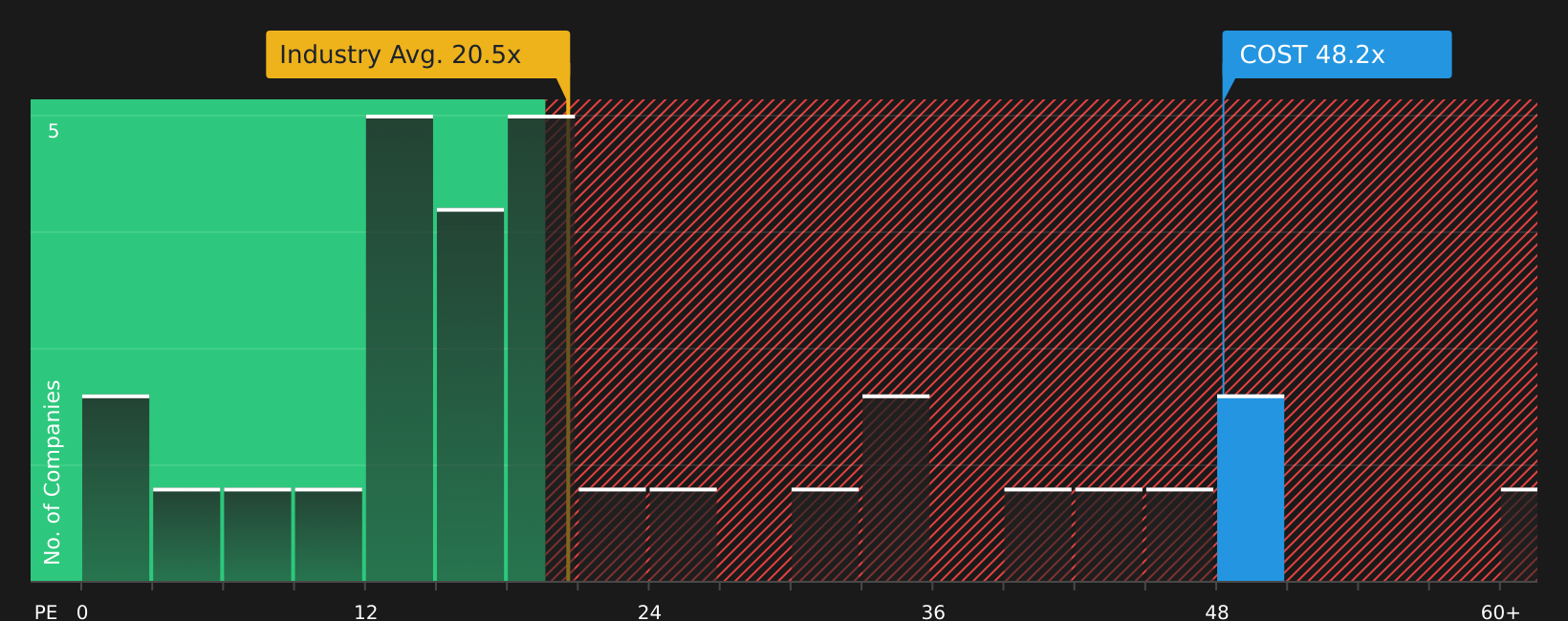
The P/E ratio is a useful way to see what you are paying today for each dollar of Costco Wholesale earnings. Costco Wholesale currently trades on a P/E of about 47.4x, which is more than double the Consumer Retailing industry average of roughly 20.0x and also well above the peer group average of about 24.0x.
The fair P/E ratio implied by the broader model is around 39.9x, which is lower than where Costco Wholesale trades today. Despite the attention on new revenue opportunities such as weight loss drug customers, the current valuation still stands at a premium to both this tailored fair level and to sector peers. On this framework, the stock appears to be pricing in a lot of optimism already.
On the P/E multiple, Costco Wholesale stock currently looks overvalued compared with both its fair ratio and the wider Consumer Retailing group.
The Costco Wholesale Narrative: What Would Justify Today's Price?
Simply Wall St Narratives for Costco Wholesale pick up where the valuation puzzle leaves off. They spell out which paths for Costco Wholesale's revenue growth, margins and earnings would need to play out for the stock to be worth materially more or less than its current price, and they sit on Simply Wall St's Community page. Where a single ratio or model gives you one figure, these narratives set out the future that figure relies on so you can monitor whether it remains reasonable.
Community views on Costco Wholesale sit far apart, with one side leaning into the membership model and the other focused on what current pricing already assumes.
Bull case: 13% undervalued
"Positive commentary points to Costco's warehouse format as having one of the deeper moats in retail, with low prices, distribution efficiency on a relatively small SKU count, and recurring membership revenue all cited as reasons the business can justify premium valuation multiples…"
Bear case: 30% overvalued
"Based on my projections through 2031, Costco is "priced for perfection." My Base Case (Mid) suggests an Annualized Return (IRR) of just 5.6%, largely because valuation compression is likely to offset operational growth…"
Do you think there's more to the story for Costco Wholesale? Head over to our Community to see what others are saying!
The Bottom Line
Costco Wholesale now screens as overvalued on market multiples, with the current P/E sitting well above both sector averages and the tailored fair ratio. That does not rule the stock out for long term holders. However, it does mean the margin for error on execution looks thin for new capital. The key question from here is whether Costco Wholesale can deliver the revenue growth and margin profile that keeps investors comfortable paying this kind of premium, or whether the valuation multiple eventually settles closer to peers.
This article by Simply Wall St is general in nature. We provide commentary based on historical data and analyst forecasts only using an unbiased methodology and our articles are not intended to be financial advice. It does not constitute a recommendation to buy or sell any stock, and does not take account of your objectives, or your financial situation. We aim to bring you long-term focused analysis driven by fundamental data. Note that our analysis may not factor in the latest price-sensitive company announcements or qualitative material. Simply Wall St has no position in any stocks mentioned.