

Coursera (COUR) Stock Looks Cheap On Fair Value While Returns Stay Weak
Coursera Inc COUR | 0.00 |
Coursera stock has had a difficult run over the past few years, yet current valuation checks suggest it may now sit in territory that screens as cheap on some measures rather than clearly overvalued. For investors, the tension is between a long stretch of weak share price performance and a market multiple that points to potential undervaluation.
- Coursera has declined 85.1% over the past 5 years, which puts the current debate squarely on whether the market has become too pessimistic about its long term prospects.
- Future revenue growth from its online learning platform can support the current valuation, but ongoing uncertainty around profitability and cash flow timing may weigh on how much investors are willing to pay for the stock.
- The broader checks present a mixed picture, with Coursera screening as undervalued on some metrics but achieving only 3 out of 6 on the value score, rather than looking like a clear bargain across the board.
The stock's next move may depend on whether that combination of weak long term returns and only partially supportive valuation checks signals a value opportunity in Coursera or a fair reflection of its risks.
Does Coursera Look Undervalued on Sales?
P/S is often a useful way to look at Coursera because the business is still focused on scaling revenue while profitability remains a secondary consideration for many investors.
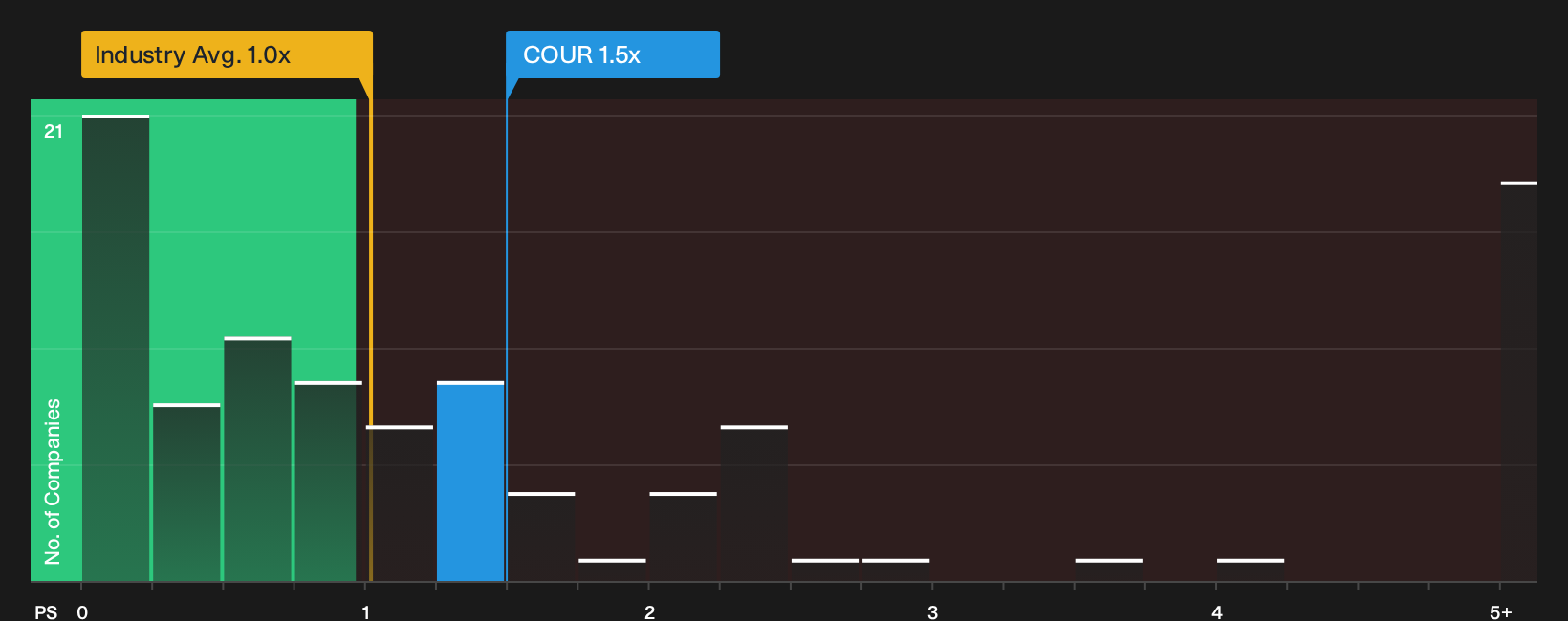
Coursera trades on a P/S ratio of 2.0x, compared with a Consumer Services industry average of 1.0x and a peer average of 1.7x. On raw comparison, that puts the stock at a premium to its sector and slightly above similar companies. However, the fair P/S ratio implied by the model, which reflects Coursera's specific mix of growth potential, margin profile, size and risk factors, is 5.2x, leaving the current market multiple below that tailored benchmark.
The difference between the current 2.0x P/S and the 5.2x fair ratio indicates that investors are not paying as much for Coursera as the model would indicate based on its characteristics.
On the P/S multiple, Coursera stock currently appears undervalued relative to the level implied by its fair ratio.
The Coursera Narrative: What Would Justify Today's Price?
For Coursera, Simply Wall St Narratives give you a structured way to connect today’s valuation puzzle with explicit assumptions about future growth, margins and earnings. They sit on the Community page so you can see different views in context. Rather than focusing on a single multiple or model output, each narrative lays out the key drivers behind its view of fair value, so you can track how those assumptions hold up as Coursera's results are reported over time.
One of the top community narratives on Coursera: roughly fairly valued
"Accelerating regulatory scrutiny and mounting legal uncertainties across global markets threaten to increase compliance costs and create barriers to entry for expansion into key international regions..."
Do you think there's more to the story for Coursera? Head over to our Community to see what others are saying!
The Bottom Line
For Coursera, the current set of checks points to a stock that screens as undervalued on key market multiples, yet not convincingly cheap across every metric. That mix leaves the burden on future execution, particularly how revenue growth and eventual margin progression line up with what the current P/S ratio implies. The key question for you is whether the discount flagged by those multiples reflects an overly cautious view of Coursera's long term earnings power or a reasonable price for a business that still has to prove it can translate its scale into durable profitability.
This article by Simply Wall St is general in nature. We provide commentary based on historical data and analyst forecasts only using an unbiased methodology and our articles are not intended to be financial advice. It does not constitute a recommendation to buy or sell any stock, and does not take account of your objectives, or your financial situation. We aim to bring you long-term focused analysis driven by fundamental data. Note that our analysis may not factor in the latest price-sensitive company announcements or qualitative material. Simply Wall St has no position in any stocks mentioned.