

Deeper AI Breast Imaging Integration With RadNet’s DeepHealth Could Be A Game Changer For GE HealthCare Technologies (GEHC)
GE Healthcare Technologies Inc. GEHC | 0.00 |
- In April 2026, GE HealthCare and RadNet’s DeepHealth expanded their global collaboration to integrate DeepHealth’s AI-powered Breast Suite and new second-reader workflows into GE HealthCare’s Senographe Pristina and Pristina Via mammography platforms, while also showcasing advanced breast imaging technologies at the SBI 2026 Breast Cancer Imaging Symposium.
- This move deepens GE HealthCare’s role in AI-enabled breast cancer screening by pairing cloud-based, modular applications with its mammography hardware to support higher-volume, more consistent screening programs across diverse patient populations.
- We’ll now examine how GE HealthCare’s deeper AI breast imaging integration with DeepHealth may influence its broader investment narrative.
Invest in the nuclear renaissance through our list of 93 elite nuclear energy infrastructure plays powering the global AI revolution.
GE HealthCare Technologies Investment Narrative Recap
To own GE HealthCare, I think you need to believe its scale, installed base, and growing digital tools can support steady, healthcare-driven demand despite trade and regulatory pressures. The expanded DeepHealth collaboration reinforces the near term catalyst around higher value, AI-enabled imaging workflows, but it does not materially change the biggest current risk, which is external pressure on margins from tariffs and broader global policy uncertainty.
Among recent announcements, the bkActiv integration with Medtronic’s Stealth AXiS system stands out alongside the DeepHealth news, as both highlight GE HealthCare’s push to embed its hardware in AI and software rich clinical workflows. If these kinds of integrations gain traction, they may help the company deepen relationships with hospitals and health systems, which is central to the thesis that its imaging and digital ecosystem can support more resilient demand.
Yet even with these AI advances, investors should still be aware that...
GE HealthCare Technologies' narrative projects $23.7 billion revenue and $2.7 billion earnings by 2029. This requires 4.8% yearly revenue growth and about a $0.6 billion earnings increase from $2.1 billion today.
Uncover how GE HealthCare Technologies' forecasts yield a $91.74 fair value, a 27% upside to its current price.
Exploring Other Perspectives
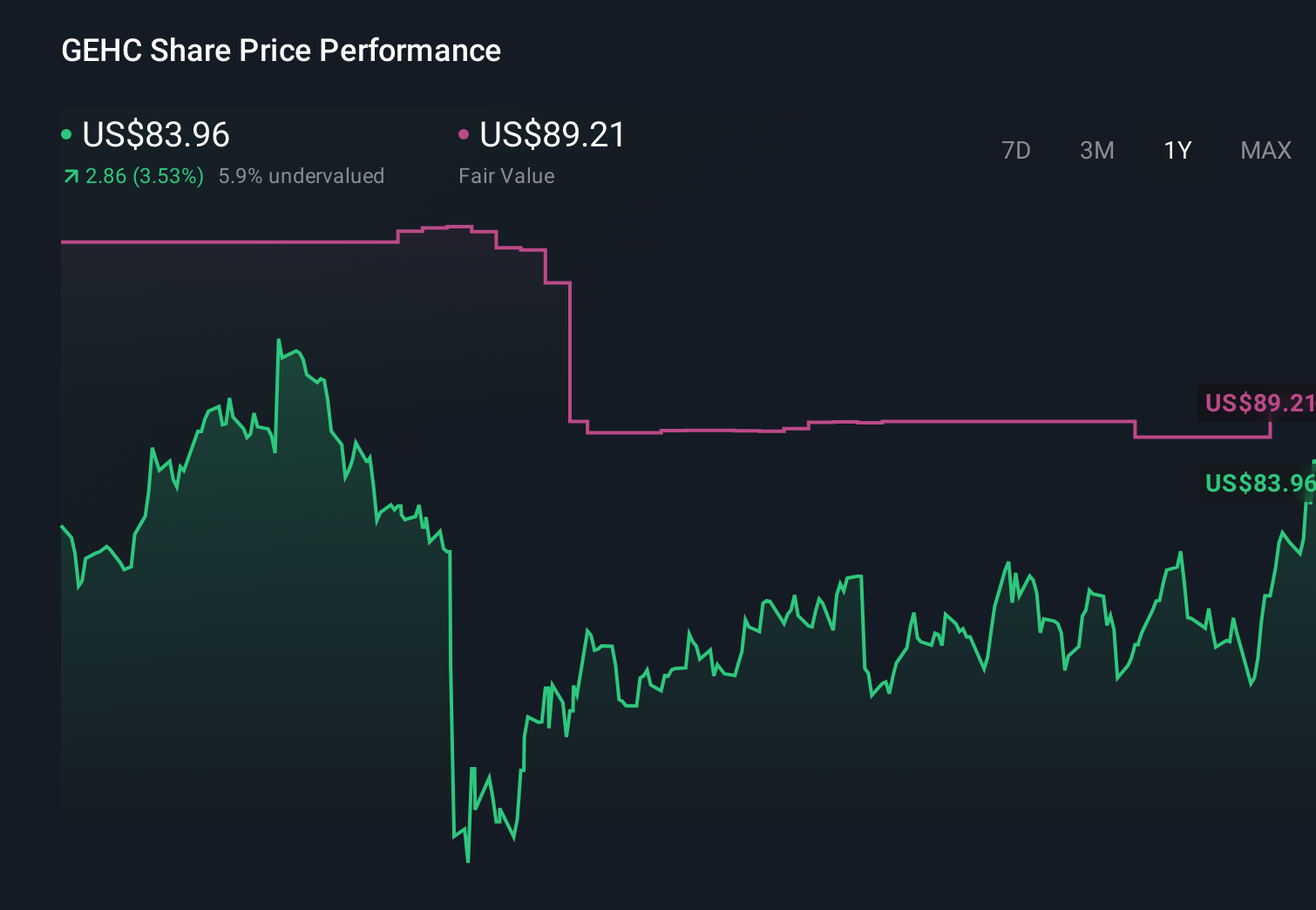
Three members of the Simply Wall St Community currently see fair value for GE HealthCare between US$90.74 and US$110.67, highlighting a wide spread of expectations. Against that backdrop, the growing focus on AI enabled imaging workflows sits alongside ongoing risks around tariffs and global trade policy that could influence how the business actually performs over time.
Explore 3 other fair value estimates on GE HealthCare Technologies - why the stock might be worth as much as 53% more than the current price!
Reach Your Own Conclusion
Disagree with existing narratives? Extraordinary investment returns rarely come from following the herd, so go with your instincts.
- A great starting point for your GE HealthCare Technologies research is our analysis highlighting 5 key rewards and 1 important warning sign that could impact your investment decision.
- Our free GE HealthCare Technologies research report provides a comprehensive fundamental analysis summarized in a single visual - the Snowflake - making it easy to evaluate GE HealthCare Technologies' overall financial health at a glance.
Seeking Other Investments?
Every day counts. These free picks are already gaining attention. See them before the crowd does:
- We've uncovered the 13 dividend fortresses yielding 5%+ that don't just survive market storms, but thrive in them.
- This technology could replace computers: discover 26 stocks that are working to make quantum computing a reality.
- Find 59 companies with promising cash flow potential yet trading below their fair value.
This article by Simply Wall St is general in nature. We provide commentary based on historical data and analyst forecasts only using an unbiased methodology and our articles are not intended to be financial advice. It does not constitute a recommendation to buy or sell any stock, and does not take account of your objectives, or your financial situation. We aim to bring you long-term focused analysis driven by fundamental data. Note that our analysis may not factor in the latest price-sensitive company announcements or qualitative material. Simply Wall St has no position in any stocks mentioned.