

Did Insulin Rebate Settlements and a US$3 Billion AI Bet Just Shift UnitedHealth Group's (UNH) Investment Narrative?
UnitedHealth Group Incorporated UNH | 0.00 |
- In recent weeks, UnitedHealth Group subsidiaries OptumRx and Emisar Pharma Services agreed to settle Federal Trade Commission allegations over past insulin rebating practices, while the parent company outlined a planned US$3.00 billion artificial intelligence investment for 2026 and 2027 aimed at improving efficiency and cutting operating costs.
- This combination of resolving a regulatory overhang and committing substantial capital to AI-driven automation and cost reduction could reshape how investors view UnitedHealth’s risk profile and long-term efficiency plans.
- We’ll now explore how UnitedHealth’s US$3.00 billion AI push may influence its existing investment narrative around technology, margins, and Medicare.
Find 44 companies with promising cash flow potential yet trading below their fair value.
UnitedHealth Group Investment Narrative Recap
To own UnitedHealth Group, you need to believe its diversified health platform can manage Medicare volatility while improving margins through technology and disciplined pricing. The key short term catalyst remains how effectively it reshapes its Medicare Advantage book for 2026, while the biggest risk is further pressure from utilization and regulatory scrutiny. The FTC insulin rebating settlement helps clear one regulatory issue, but does not materially change those core near term drivers.
The planned US$3.00 billion AI investment in 2026 and 2027 is the announcement most tied to this news, given management has already cited AI as helping automate manual work and reduce operating costs. For investors watching Medicare margin repair, this AI push sits alongside plan redesign and membership cuts as a potential support for future profitability, even as policy, reimbursement and care intensity remain key uncertainties.
Yet while technology investments are encouraging, investors should also be aware of rising regulatory scrutiny around Medicare Advantage and how it could affect...
UnitedHealth Group’s narrative projects $492.0 billion revenue and $21.4 billion earnings by 2029. This requires 3.0% yearly revenue growth and about a $9.4 billion earnings increase from $12.0 billion today.
Uncover how UnitedHealth Group's forecasts yield a $399.73 fair value, in line with its current price.
Exploring Other Perspectives
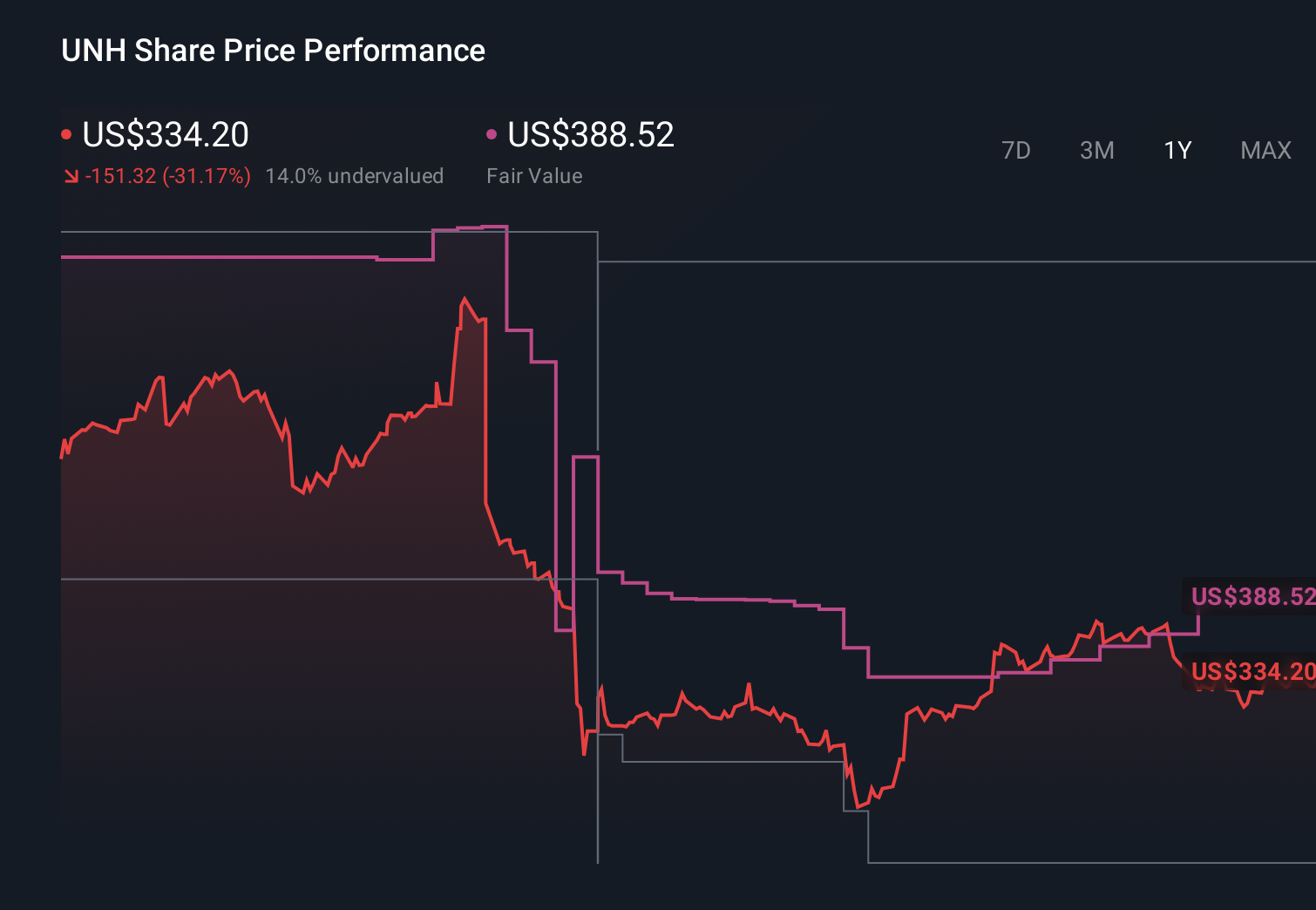
Some of the most optimistic analysts were already assuming earnings could reach about US$24.0 billion by 2029, but this latest AI and regulatory news could either reinforce that optimism or highlight how uncertain those forecasts really are, so it is worth comparing these upbeat expectations with more cautious views before deciding which narrative you find more convincing.
Explore 59 other fair value estimates on UnitedHealth Group - why the stock might be worth over 2x more than the current price!
Decide For Yourself
Disagree with existing narratives? Extraordinary investment returns rarely come from following the herd, so go with your instincts.
- A great starting point for your UnitedHealth Group research is our analysis highlighting 3 key rewards and 2 important warning signs that could impact your investment decision.
- Our free UnitedHealth Group research report provides a comprehensive fundamental analysis summarized in a single visual - the Snowflake - making it easy to evaluate UnitedHealth Group's overall financial health at a glance.
Searching For A Fresh Perspective?
Every day counts. These free picks are already gaining attention. See them before the crowd does:
- Rare earth metals are the new gold rush. Find out which 30 stocks are leading the charge.
- We've uncovered the 7 dividend fortresses yielding 5%+ that don't just survive market storms, but thrive in them.
- Uncover the next big thing with 23 elite penny stocks that balance risk and reward.
This article by Simply Wall St is general in nature. We provide commentary based on historical data and analyst forecasts only using an unbiased methodology and our articles are not intended to be financial advice. It does not constitute a recommendation to buy or sell any stock, and does not take account of your objectives, or your financial situation. We aim to bring you long-term focused analysis driven by fundamental data. Note that our analysis may not factor in the latest price-sensitive company announcements or qualitative material. Simply Wall St has no position in any stocks mentioned.