

Did Phillips Edison’s (PECO) Russell Index Exit Quietly Reshape Its Investment Narrative and Risk Profile?
Phillips Edison & Company, Inc. PECO | 0.00 |
- On 27 June 2026, Phillips Edison & Company, Inc. (NasdaqGS: PECO) was removed from multiple Russell growth and small-cap benchmarks, including the Russell 2000 Growth and Russell 3000 Growth indices.
- This broad index removal can influence how passive funds and benchmark-focused investors view and trade Phillips Edison, potentially affecting liquidity and ownership mix.
- We’ll now examine how Phillips Edison’s removal from several Russell growth indices might influence its existing investment narrative and risk profile.
Capitalize on the AI infrastructure supercycle with our selection of the 52 best 'picks and shovels' of the AI gold rush converting record-breaking demand into massive cash flow.
Phillips Edison Investment Narrative Recap
To own Phillips Edison, you need to believe in the staying power of necessity-based, grocery-anchored centers and their ability to keep occupancy and rents resilient despite structural pressure on brick and mortar retail. The broad removal from Russell growth and small-cap indices may alter trading flows and near term liquidity, but it does not fundamentally change the key catalyst around leasing and same center NOI, nor the main risk from evolving grocery and omnichannel retail formats.
Against this backdrop, the most relevant recent update is management’s April decision to raise 2026 net income guidance to US$0.79 to US$0.81 per share, alongside a reaffirmed same center NOI growth target. For investors, this ties directly into the core catalyst of steady, necessity-driven cash flows while also sharpening focus on whether portfolio concentration in grocery anchored and everyday retail assets could magnify any future tenant or format disruptions.
Yet while the story centers on everyday essentials, investors should still be aware that concentrated exposure to grocery anchored centers could...
Phillips Edison's narrative projects $856.7 million revenue and $121.4 million earnings by 2029.
Uncover how Phillips Edison's forecasts yield a $43.08 fair value, a 3% upside to its current price.
Exploring Other Perspectives
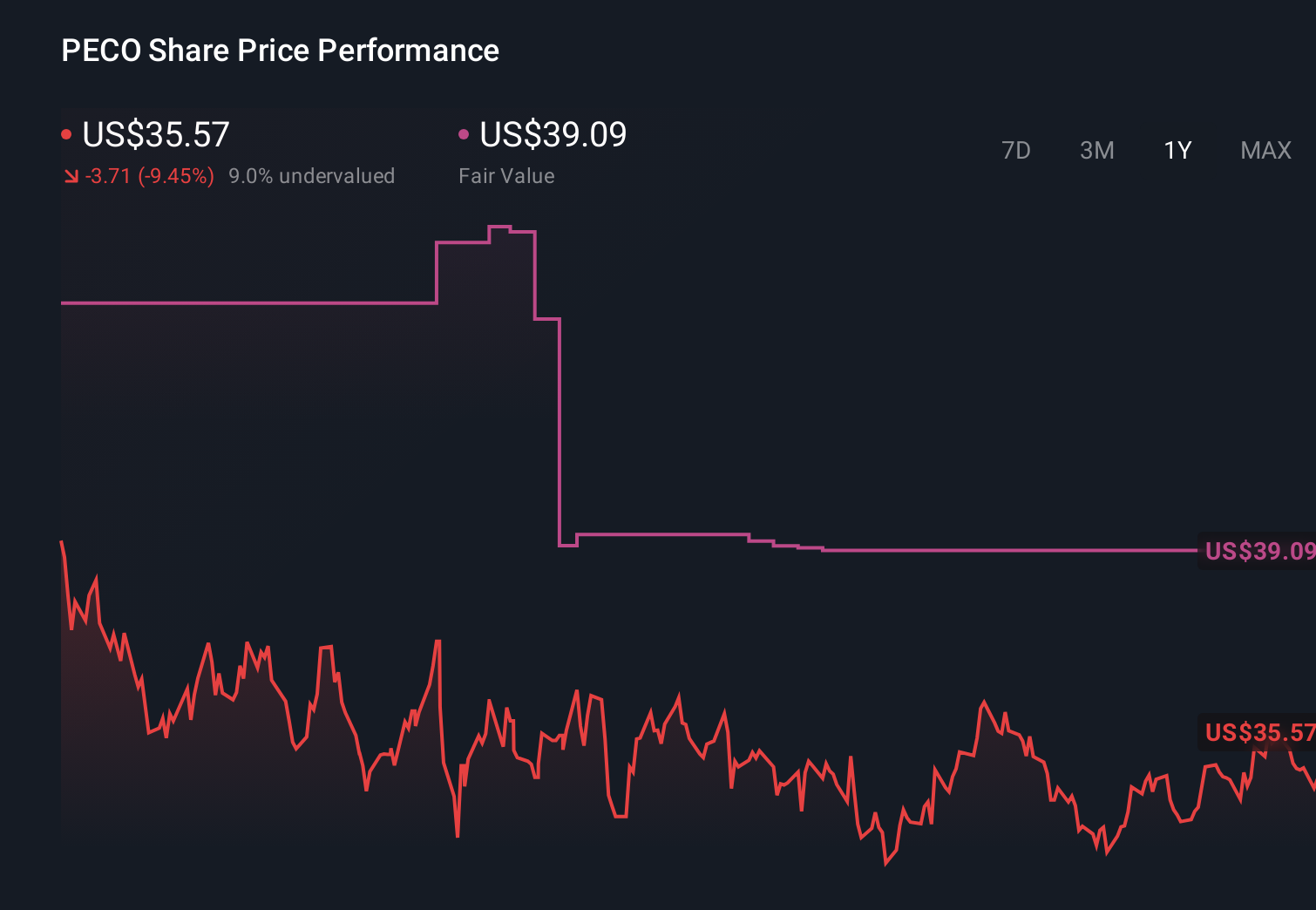
The single fair value estimate from the Simply Wall St Community sits at US$43.08 per share, underscoring how individual views can be quite specific. You can weigh that against the index removals and concentration risk in grocery anchored retail, then compare several alternative viewpoints before deciding how this might shape Phillips Edison’s longer term performance.
Explore another fair value estimate on Phillips Edison - why the stock might be worth just $43.08!
Reach Your Own Conclusion
Don't just follow the ticker - dig into the data and build a conviction that's truly your own.
- A great starting point for your Phillips Edison research is our analysis highlighting 2 key rewards and 2 important warning signs that could impact your investment decision.
- Our free Phillips Edison research report provides a comprehensive fundamental analysis summarized in a single visual - the Snowflake - making it easy to evaluate Phillips Edison's overall financial health at a glance.
Curious About Other Options?
Don't miss your shot at the next 10-bagger. Our latest stock picks just dropped:
- Invest in the nuclear renaissance through our list of 89 elite nuclear energy infrastructure plays powering the global AI revolution.
- AI is about to change healthcare. These 40 stocks are working on everything from early diagnostics to drug discovery. The best part - they are all under $10b in market cap - there's still time to get in early.
- Explore 27 top quantum computing companies leading the revolution in next-gen technology and shaping the future with breakthroughs in quantum algorithms, superconducting qubits, and cutting-edge research.
This article by Simply Wall St is general in nature. We provide commentary based on historical data and analyst forecasts only using an unbiased methodology and our articles are not intended to be financial advice. It does not constitute a recommendation to buy or sell any stock, and does not take account of your objectives, or your financial situation. We aim to bring you long-term focused analysis driven by fundamental data. Note that our analysis may not factor in the latest price-sensitive company announcements or qualitative material. Simply Wall St has no position in any stocks mentioned.