

Did Pitney Bowes’ Profit Jump, Buybacks, and New Dealmaker Just Shift PBI’s Investment Narrative?
Pitney Bowes Inc. PBI | 0.00 |
- Pitney Bowes Inc. recently reported that for the second quarter of 2026 its revenue slipped to US$451.5 million while net income rose to US$49.91 million, alongside reaffirmed full-year revenue guidance, a US$0.10 per-share quarterly dividend, and completion of a large share repurchase tranche.
- Together with the appointment of experienced dealmaker and former CFO La Vonda Williams to the Board’s new Strategic Review Committee, these results highlight both improving profitability and an intensified focus on evaluating options to enhance shareholder value.
- Next, we’ll examine how Pitney Bowes’ stronger profitability, despite lower revenue, may reshape the existing investment narrative around its transformation and capital returns.
Capitalize on the AI infrastructure supercycle with our selection of the 56 best 'picks and shovels' of the AI gold rush converting record-breaking demand into massive cash flow.
Pitney Bowes Investment Narrative Recap
To own Pitney Bowes today, you need to believe that management can keep improving profitability and cash generation even as physical mail and certain shipping volumes come under pressure. The latest quarter supports that case, with higher net income and earnings per share despite modestly lower revenue, and with 2026 guidance reaffirmed. In the near term, a key catalyst is how the ongoing strategic review translates into disciplined capital allocation, while execution missteps and high leverage remain central risks.
The most relevant development for that catalyst is the appointment of La Vonda Williams to the new Strategic Review Committee. Her background in evaluating transaction opportunities, capital markets and corporate assessments adds financial skill to a relatively new board just as Pitney Bowes completes a sizable buyback program and continues returning cash through a US$0.10 per share quarterly dividend. How this committee balances repurchases, debt management and any deal activity could shape the next phase of the equity story.
Yet despite stronger earnings today, the risk that mail volume decline and rising competition blunt these gains is something investors should be aware of...
Pitney Bowes’ narrative projects $1.8 billion revenue and $282.5 million earnings by 2029.
Uncover how Pitney Bowes' forecasts yield a $17.14 fair value, a 5% downside to its current price.
Exploring Other Perspectives
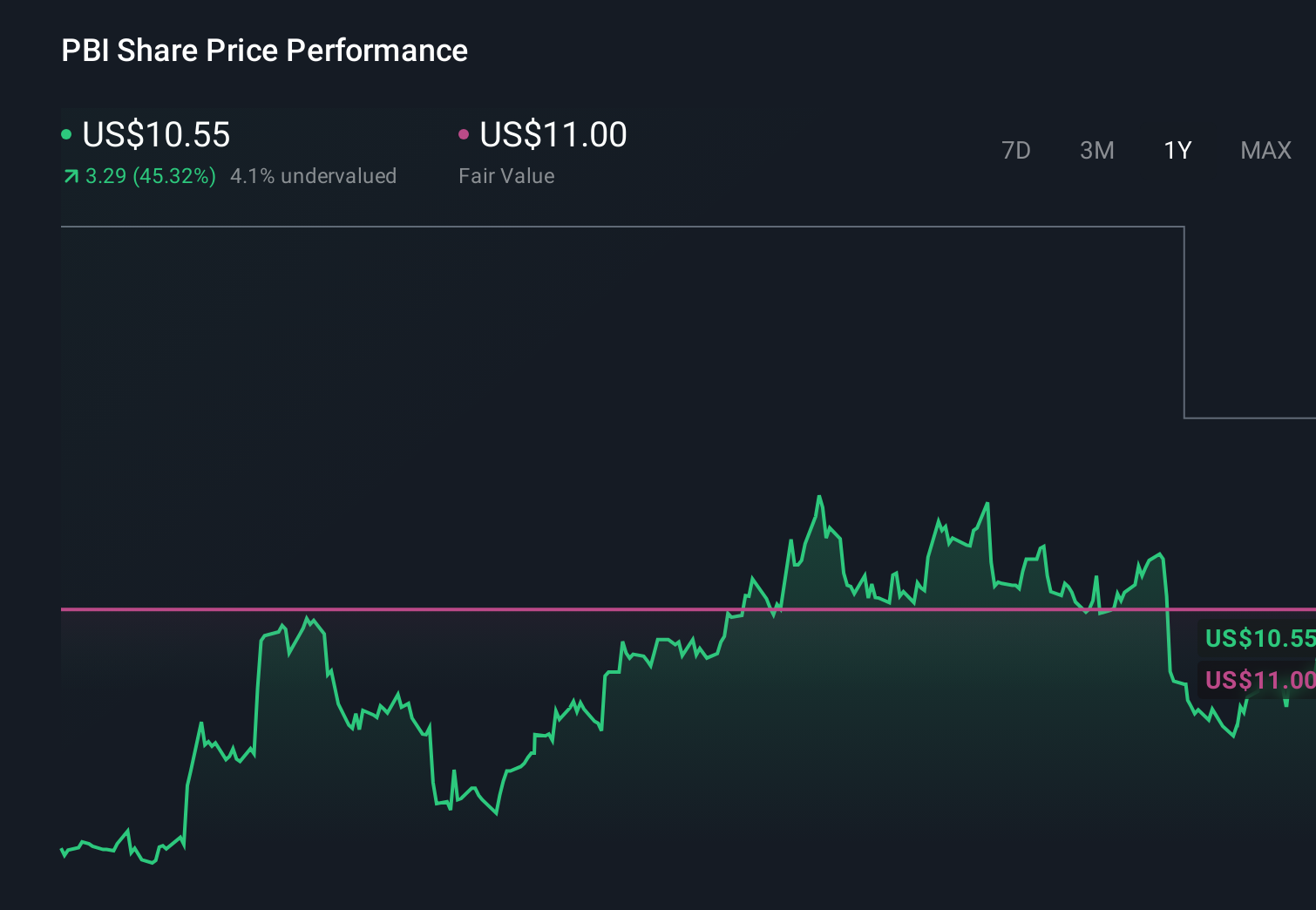
Before this earnings release, the most pessimistic analysts were penciling in roughly US$1.7 billion of revenue and about US$276 million of earnings by 2029, so if you worry about reliance on acquisitions and cost cuts to carry the story, it is worth comparing that more cautious view with the latest profitability surprise.
Explore 4 other fair value estimates on Pitney Bowes - why the stock might be worth 19% less than the current price!
Reach Your Own Conclusion
Disagree with existing narratives? Extraordinary investment returns rarely come from following the herd, so go with your instincts.
- A great starting point for your Pitney Bowes research is our analysis highlighting 4 key rewards and 2 important warning signs that could impact your investment decision.
- Our free Pitney Bowes research report provides a comprehensive fundamental analysis summarized in a single visual - the Snowflake - making it easy to evaluate Pitney Bowes' overall financial health at a glance.
Searching For A Fresh Perspective?
These stocks are moving-our analysis flagged them today. Act fast before the price catches up:
- Find 51 companies with promising cash flow potential yet trading below their fair value.
- Uncover the next big thing with 20 elite penny stocks that balance risk and reward.
- We've uncovered the 9 dividend fortresses yielding 5%+ that don't just survive market storms, but thrive in them.
This article by Simply Wall St is general in nature. We provide commentary based on historical data and analyst forecasts only using an unbiased methodology and our articles are not intended to be financial advice. It does not constitute a recommendation to buy or sell any stock, and does not take account of your objectives, or your financial situation. We aim to bring you long-term focused analysis driven by fundamental data. Note that our analysis may not factor in the latest price-sensitive company announcements or qualitative material. Simply Wall St has no position in any stocks mentioned.