

Did Rising Institutional Ownership Amid Softer Results Just Shift Patrick Industries' (PATK) Investment Narrative?
Patrick Industries, Inc. PATK | 0.00 |
- In recent days, Patrick Industries reported weaker financial health with year-over-year declines in quarterly revenue and net profit, while technical indicators turned mixed with a short-term sell signal.
- Despite this softer operational picture, institutional investors have increased their holdings to a level exceeding the company’s share float, suggesting strong professional interest even as efficiency remains only average.
- Next, we’ll examine how this surge in institutional ownership, alongside weakening financial metrics, could influence Patrick Industries’ investment narrative.
The future of work is here. Discover the 31 top robotics and automation stocks leading the charge in AI-driven automation and industrial transformation.
Patrick Industries Investment Narrative Recap
To own Patrick Industries today, you need to be comfortable with its exposure to cyclical RV, marine and housing end markets while believing that content-per-unit gains, automation and aftermarket initiatives can support earnings over time. The latest data showing weaker financial health and year over year revenue and profit declines heightens near term sensitivity to any slowdown in OEM demand, but does not clearly alter the main short term catalyst, which remains how quickly shipments and dealer restocking trends stabilize.
The most relevant recent announcement here is the reported merger discussions with LCI Industries, which, if pursued, could reshape Patrick’s scale, product breadth and cost structure. Set against rising institutional ownership above 100 percent of the float and only average efficiency, this potential combination could be an important swing factor for margins and earnings power, even as the company manages ongoing pressure from cyclicality and input costs.
Yet beneath this institutional buying, one risk investors should be aware of is the company’s reliance on highly cyclical RV and marine demand, which...
Patrick Industries' narrative projects $4.4 billion revenue and $285.5 million earnings by 2029. This requires 4.0% yearly revenue growth and a $149.2 million earnings increase from $136.3 million today.
Uncover how Patrick Industries' forecasts yield a $119.50 fair value, a 38% upside to its current price.
Exploring Other Perspectives
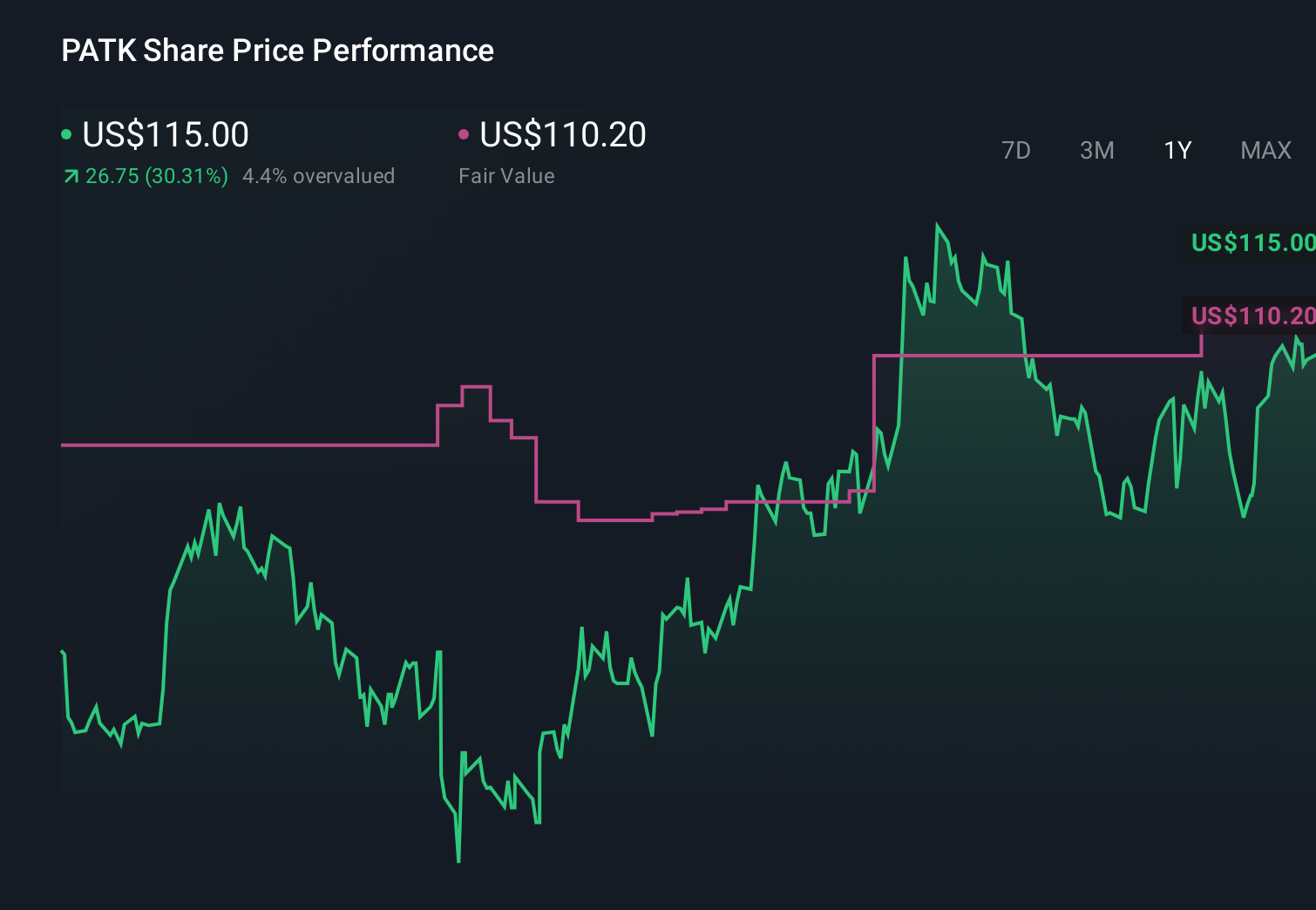
Before this weaker quarter, the most pessimistic analysts already projected only about 4.8 percent annual revenue growth and US$274.8 million of earnings by 2029, so today’s softness could push that more cautious view even further, reminding you that reasonable people can look at the same stock and reach very different conclusions.
Explore 2 other fair value estimates on Patrick Industries - why the stock might be worth over 2x more than the current price!
Form Your Own Verdict
Disagree with existing narratives? Extraordinary investment returns rarely come from following the herd, so go with your instincts.
- A great starting point for your Patrick Industries research is our analysis highlighting 3 key rewards and 1 important warning sign that could impact your investment decision.
- Our free Patrick Industries research report provides a comprehensive fundamental analysis summarized in a single visual - the Snowflake - making it easy to evaluate Patrick Industries' overall financial health at a glance.
Want Some Alternatives?
The market won't wait. These fast-moving stocks are hot now. Grab the list before they run:
- Uncover the next big thing with 23 elite penny stocks that balance risk and reward.
- Capitalize on the AI infrastructure supercycle with our selection of the 49 best 'picks and shovels' of the AI gold rush converting record-breaking demand into massive cash flow.
- We've uncovered the 7 dividend fortresses yielding 5%+ that don't just survive market storms, but thrive in them.
This article by Simply Wall St is general in nature. We provide commentary based on historical data and analyst forecasts only using an unbiased methodology and our articles are not intended to be financial advice. It does not constitute a recommendation to buy or sell any stock, and does not take account of your objectives, or your financial situation. We aim to bring you long-term focused analysis driven by fundamental data. Note that our analysis may not factor in the latest price-sensitive company announcements or qualitative material. Simply Wall St has no position in any stocks mentioned.