

Did Robinhood’s (HOOD) New Ventures Fund and Revenue Jump Just Shift Its Investment Narrative?
Robinhood HOOD | 0.00 |
- In recent days, Robinhood Markets reported strong Q1 2026 results, including a double-digit year-over-year increase in total net revenues, and announced it will release April 2026 operating metrics on May 13.
- At the same time, Robinhood confidentially filed for its second listed venture vehicle, Robinhood Ventures Fund II, aiming to widen retail access to early- and growth-stage private companies and further reduce reliance on transaction-based trading.
- Next, we’ll examine how Robinhood Ventures Fund II could reshape Robinhood’s investment narrative around diversification and private-market access.
This technology could replace computers: discover 26 stocks that are working to make quantum computing a reality.
Robinhood Markets Investment Narrative Recap
To own Robinhood, you have to believe its shift from volatile trading revenues toward broader financial services and private-market access can support the current premium valuation. The strong Q1 2026 revenue growth and upcoming April metrics matter most for confidence in near term engagement, while the steep drop in crypto transaction revenue and ongoing regulatory and legal pressures remain the clearest short term risks. The Ventures expansion does not materially change those core drivers yet.
The most relevant recent development here is Robinhood’s confidential filing for Robinhood Ventures Fund II, which extends its push into listed venture vehicles after Ventures Fund I. For investors focused on catalysts, RVII sits at the intersection of two key themes: reducing dependence on transaction-based trading and deepening customer engagement through differentiated private-market access. How successfully Robinhood can scale these funds, alongside its existing trading and banking products, could influence how durable its growth story looks.
Yet beneath the growth story, investors should also be aware of the rising regulatory scrutiny around payment for order flow and tokenized assets, which could...
Robinhood Markets' narrative projects $6.9 billion revenue and $2.8 billion earnings by 2029.
Uncover how Robinhood Markets' forecasts yield a $101.15 fair value, a 32% upside to its current price.
Exploring Other Perspectives
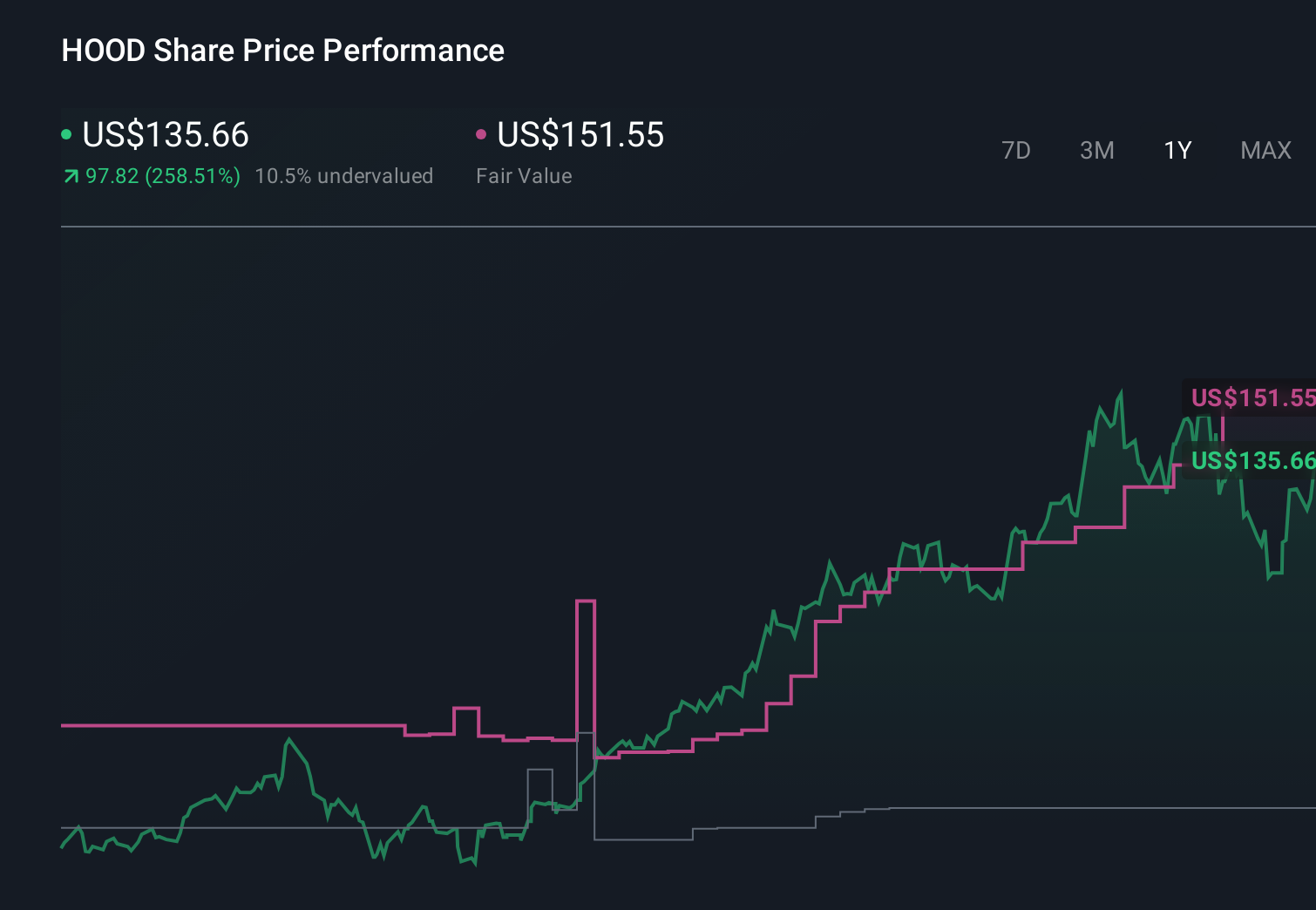
Before this news, the most bullish analysts expected revenue to grow about 22% annually and earnings to reach roughly US$4.0 billion, far above consensus. Compared with concerns about regulation and trading fatigue, that is a much more optimistic story, and the launch of Ventures Fund II may ultimately push expectations either closer to that upside case or back toward the more cautious view.
Explore 34 other fair value estimates on Robinhood Markets - why the stock might be worth 40% less than the current price!
Form Your Own Verdict
Don't just follow the ticker - dig into the data and build a conviction that's truly your own.
- A great starting point for your Robinhood Markets research is our analysis highlighting 3 key rewards that could impact your investment decision.
- Our free Robinhood Markets research report provides a comprehensive fundamental analysis summarized in a single visual - the Snowflake - making it easy to evaluate Robinhood Markets' overall financial health at a glance.
Ready To Venture Into Other Investment Styles?
Our daily scans reveal stocks with breakout potential. Don't miss this chance:
- Uncover the next big thing with 28 elite penny stocks that balance risk and reward.
- AI is about to change healthcare. These 33 stocks are working on everything from early diagnostics to drug discovery. The best part - they are all under $10b in market cap - there's still time to get in early.
- The latest GPUs need a type of rare earth metal called Neodymium and there are only 33 companies in the world exploring or producing it. Find the list for free.
This article by Simply Wall St is general in nature. We provide commentary based on historical data and analyst forecasts only using an unbiased methodology and our articles are not intended to be financial advice. It does not constitute a recommendation to buy or sell any stock, and does not take account of your objectives, or your financial situation. We aim to bring you long-term focused analysis driven by fundamental data. Note that our analysis may not factor in the latest price-sensitive company announcements or qualitative material. Simply Wall St has no position in any stocks mentioned.