

Did Shopify’s Expanded US$5 Billion Buyback Plan Just Shift Shopify's (SHOP) Investment Narrative?
Shopify, Inc. Class A SHOP | 0.00 |
- Earlier this month, Shopify expanded its share repurchase authorization by US$3.00 billion to a total of US$5.00 billion, after completing US$1.45 billion of buybacks representing 12,297,571 shares or 0.94% of its share count.
- Management framed the enlarged program as a way to balance ongoing investment in merchant-focused product development and AI initiatives with returning capital to shareholders, signaling confidence in the company’s business durability and cash generation.
- We’ll now examine how Shopify’s expanded US$5.00 billion buyback authorization shapes the existing investment narrative around growth, margins, and AI.
Uncover the next big thing with 24 elite penny stocks that balance risk and reward.
Shopify Investment Narrative Recap
To own Shopify today, you need to believe its commerce platform and AI tools can keep attracting merchants while margins improve over time. The enlarged US$5.00 billion buyback underlines management’s confidence but does not materially change the immediate earnings catalyst or the key risks around competition, valuation, and regulatory pressure. In the near term, the main focus still sits on whether Shopify can translate strong gross merchandise volume into consistent profitability.
The recent TOMS implementation is especially relevant here. A brand migrating core eCommerce and order orchestration to Shopify reinforces the narrative that larger, more complex merchants are willing to build on the platform. That supports the idea of higher average revenue per merchant as a potential catalyst, but also highlights the risk that rising complexity and integration demands could weigh on costs and execution if Shopify cannot maintain efficiency at scale.
Yet even with the buyback, investors should be aware that Shopify’s premium valuation could quickly amplify any disappointment around...
Shopify’s narrative projects $18.5 billion revenue and $2.7 billion earnings by 2028.
Uncover how Shopify's forecasts yield a $179.49 fair value, a 66% upside to its current price.
Exploring Other Perspectives
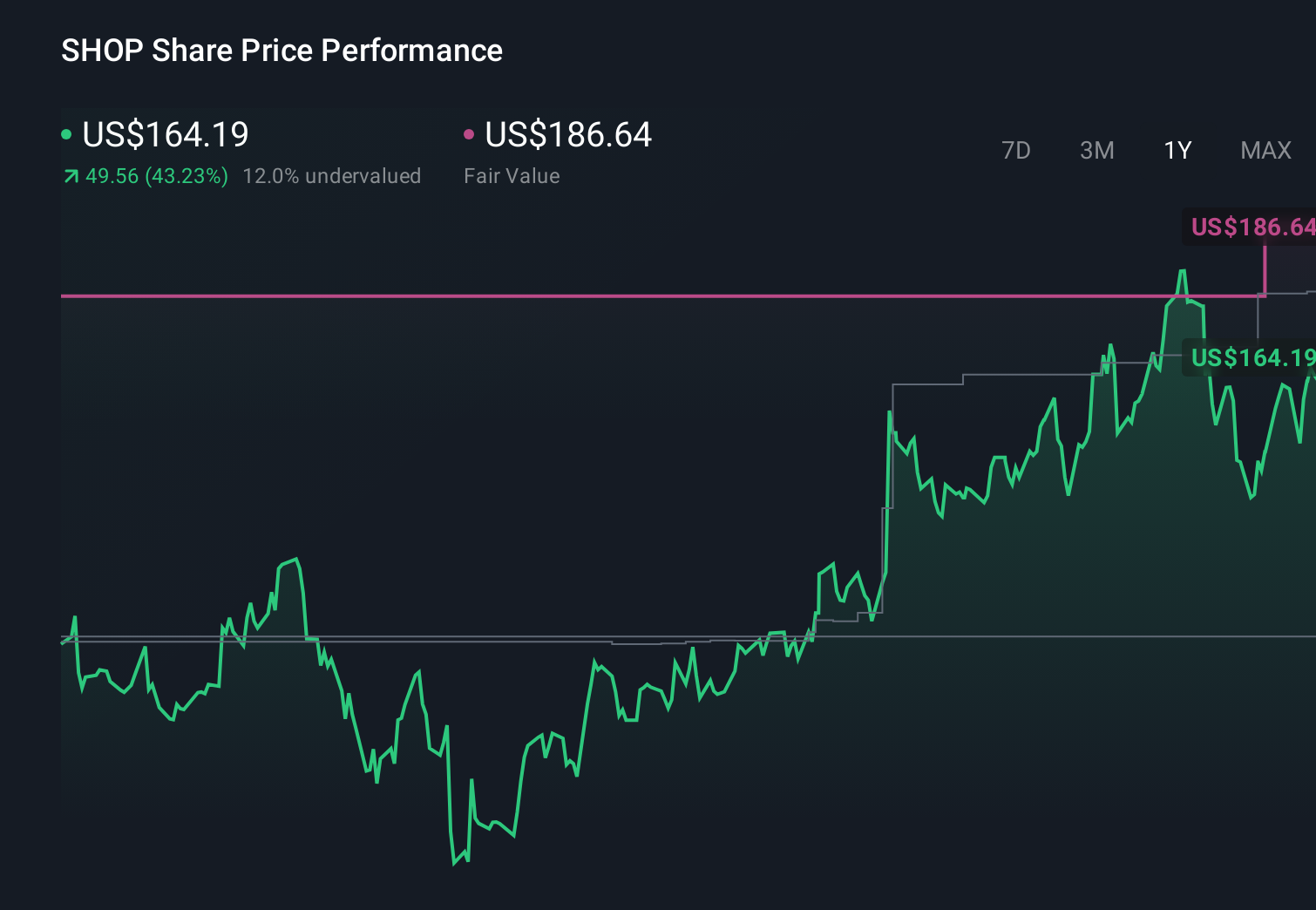
Some of the lowest ranked analysts were already cautious, assuming roughly US$21.9 billion in 2029 revenue and US$2.9 billion in earnings, and they worry that rising complexity in Shopify’s global ecosystem could limit the benefit from moves like this expanded buyback, which shows just how differently you and other shareholders might view the same stock.
Explore 17 other fair value estimates on Shopify - why the stock might be worth over 2x more than the current price!
Decide For Yourself
Don't just follow the ticker - dig into the data and build a conviction that's truly your own.
- A great starting point for your Shopify research is our analysis highlighting 2 key rewards and 2 important warning signs that could impact your investment decision.
- Our free Shopify research report provides a comprehensive fundamental analysis summarized in a single visual - the Snowflake - making it easy to evaluate Shopify's overall financial health at a glance.
Searching For A Fresh Perspective?
Every day counts. These free picks are already gaining attention. See them before the crowd does:
- Invest in the nuclear renaissance through our list of 88 elite nuclear energy infrastructure plays powering the global AI revolution.
- Capitalize on the AI infrastructure supercycle with our selection of the 48 best 'picks and shovels' of the AI gold rush converting record-breaking demand into massive cash flow.
- Find 44 companies with promising cash flow potential yet trading below their fair value.
This article by Simply Wall St is general in nature. We provide commentary based on historical data and analyst forecasts only using an unbiased methodology and our articles are not intended to be financial advice. It does not constitute a recommendation to buy or sell any stock, and does not take account of your objectives, or your financial situation. We aim to bring you long-term focused analysis driven by fundamental data. Note that our analysis may not factor in the latest price-sensitive company announcements or qualitative material. Simply Wall St has no position in any stocks mentioned.