

Did Unionization Push and Governance Tweaks Just Shift Lyft's (LYFT) Investment Narrative?
Lyft LYFT | 0.00 |
- Earlier this month, Lyft’s shareholders approved amendments to its Restated Certificate of Incorporation to remove inoperative provisions and align officer liability protections with Delaware law, while Illinois lawmakers passed a bill granting rideshare drivers the right to unionize and collectively bargain, pending the governor’s signature.
- Together, these shifts highlight how Lyft’s governance framework and labor model are being reshaped at the same time regulators scrutinize gig‑economy employment practices more closely.
- We’ll now examine how the potential for Illinois rideshare driver unionization could alter Lyft’s long-term cost structure and overall investment narrative.
AI is about to change healthcare. These 40 stocks are working on everything from early diagnostics to drug discovery. The best part - they are all under $10b in market cap - there's still time to get in early.
Lyft Investment Narrative Recap
To own Lyft, you need to believe that its ride sharing platform, partnerships and emerging autonomous vehicle efforts can support sustainable profitability despite heavy competition and evolving regulation. The Illinois unionization bill goes straight to Lyft’s largest near term swing factor: labor costs and flexibility. Depending on final implementation, it could become more material to margins than even rider growth, while competitive pressure from Uber and other platforms remains the clearest ongoing business risk.
Among recent developments, Illinois granting rideshare drivers the right to unionize is most relevant here because it directly intersects with Lyft’s AV and partnership catalysts. If collective bargaining raises cash labor costs per mile, the relative appeal of autonomous vehicle deployments with Baidu, Mobileye and Waymo may increase as a way to offset higher human driver expenses and preserve the economics of high frequency rides driven by alliances with DoorDash and United Airlines.
But against these potential benefits, rising regulatory and labor pressures could reshape Lyft’s cost base in ways investors should be aware of before assuming that...
Lyft's narrative projects $8.9 billion revenue and $458.9 million earnings by 2029. This requires 11.1% yearly revenue growth and a $2.4 billion earnings decrease from $2.9 billion today.
Uncover how Lyft's forecasts yield a $18.79 fair value, a 37% upside to its current price.
Exploring Other Perspectives
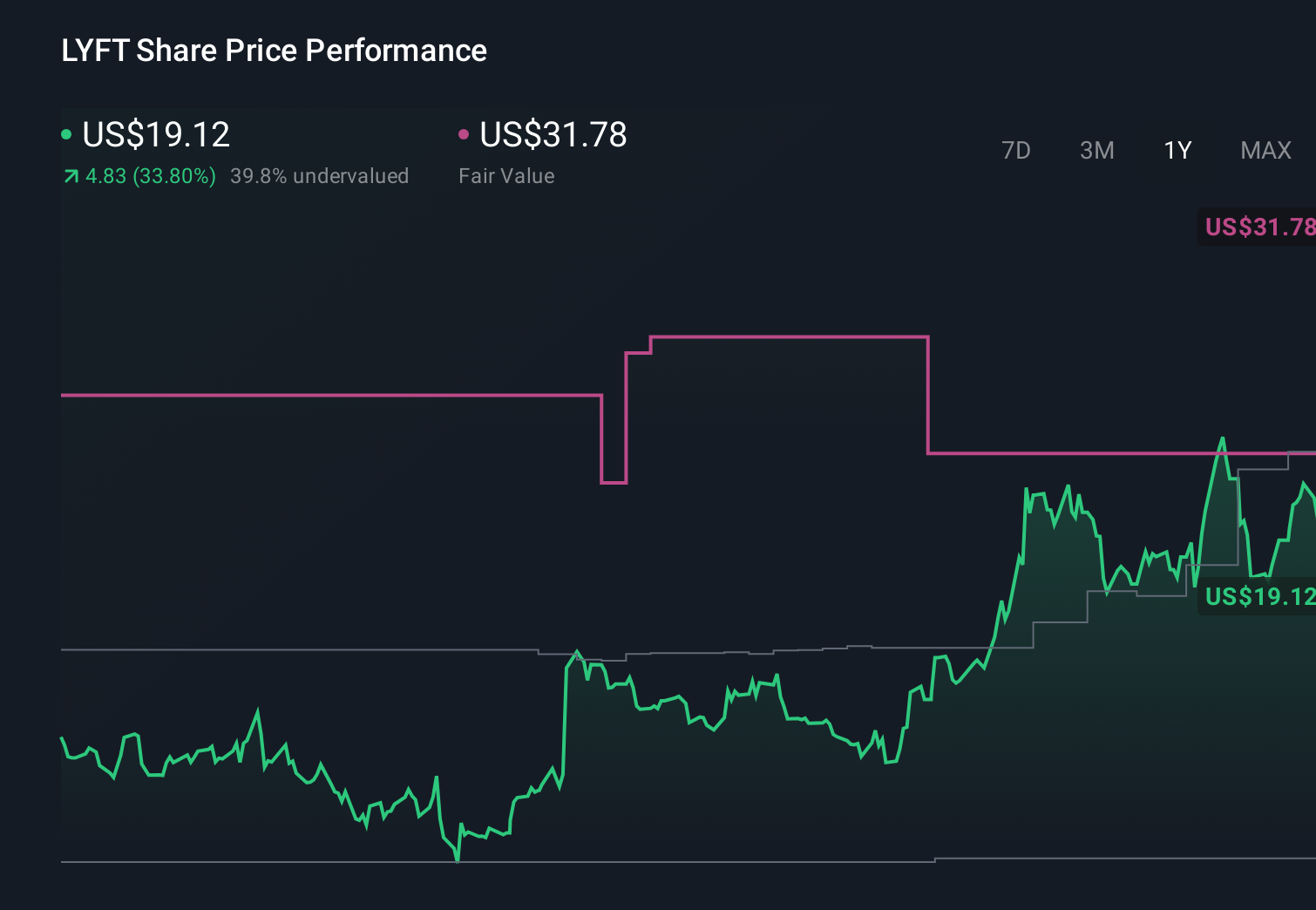
Some of the most optimistic analysts were expecting Lyft to reach about US$9.6 billion in revenue and US$480 million in earnings, yet Illinois style labor changes could make that bullish path look very different than the consensus risk view you just read.
Explore 8 other fair value estimates on Lyft - why the stock might be worth over 4x more than the current price!
Reach Your Own Conclusion
Disagree with existing narratives? Extraordinary investment returns rarely come from following the herd, so go with your instincts.
- A great starting point for your Lyft research is our analysis highlighting 3 key rewards and 2 important warning signs that could impact your investment decision.
- Our free Lyft research report provides a comprehensive fundamental analysis summarized in a single visual - the Snowflake - making it easy to evaluate Lyft's overall financial health at a glance.
Ready To Venture Into Other Investment Styles?
Markets shift fast. These stocks won't stay hidden for long. Get the list while it matters:
- Explore 29 top quantum computing companies leading the revolution in next-gen technology and shaping the future with breakthroughs in quantum algorithms, superconducting qubits, and cutting-edge research.
- Rare earth metals are an input to most high-tech devices, military and defence systems and electric vehicles. The global race is on to secure supply of these critical minerals. Beat the pack to uncover the 28 best rare earth metal stocks of the very few that mine this essential strategic resource.
- We've uncovered the 8 dividend fortresses yielding 5%+ that don't just survive market storms, but thrive in them.
This article by Simply Wall St is general in nature. We provide commentary based on historical data and analyst forecasts only using an unbiased methodology and our articles are not intended to be financial advice. It does not constitute a recommendation to buy or sell any stock, and does not take account of your objectives, or your financial situation. We aim to bring you long-term focused analysis driven by fundamental data. Note that our analysis may not factor in the latest price-sensitive company announcements or qualitative material. Simply Wall St has no position in any stocks mentioned.