

Did Walmart’s High-Margin Pivot in Ads and Memberships Just Shift Walmart's (WMT) Investment Narrative?
Walmart Inc. WMT | 0.00 |
- In recent days, Walmart has drawn fresh attention as it accelerates a shift toward higher-margin revenue streams, with advertising, Walmart+ memberships, AI tools like Sparky, and a new Google Gemini partnership reshaping how its vast US$1.00 trillion business earns profits.
- Behind the headlines, Walmart’s global advertising revenue and membership income now account for roughly one-third of operating profit, pushing investors and hedge funds to view the company less as a traditional retailer and more as a broad commerce platform.
- We’ll now examine how Walmart’s growing advertising and membership profit mix could influence its existing investment narrative and future assumptions.
Capitalize on the AI infrastructure supercycle with our selection of the 36 best 'picks and shovels' of the AI gold rush converting record-breaking demand into massive cash flow.
Walmart Investment Narrative Recap
To own Walmart, you need to believe it can keep compounding its core retail and grocery engine while steadily lifting margins through higher value services like advertising, memberships and AI enabled commerce. The recent headlines around growing retail media and Walmart+ earnings, plus the Gemini partnership, reinforce that near term catalyst, while margin pressure from tariffs, wage inflation and loss making international e commerce remain the key risks; none of the latest news meaningfully removes those pressures.
The clearest tie to this story is Walmart’s expanded Google Gemini integration, which plugs AI directly into the app experience to support instant checkout, personalization and membership benefits. For investors focused on higher margin growth drivers such as advertising and Walmart+, this rollout sits squarely in the current catalyst mix, even as ongoing delivery and logistics costs in grocery and international e commerce continue to weigh on how much of that digital progress falls to the bottom line.
Yet investors should also be aware that rising delivery and logistics costs in e commerce could still...
Walmart's narrative projects $817.4 billion revenue and $28.4 billion earnings by 2029. This requires 4.7% yearly revenue growth and a $6.5 billion earnings increase from $21.9 billion.
Uncover how Walmart's forecasts yield a $136.02 fair value, a 7% upside to its current price.
Exploring Other Perspectives
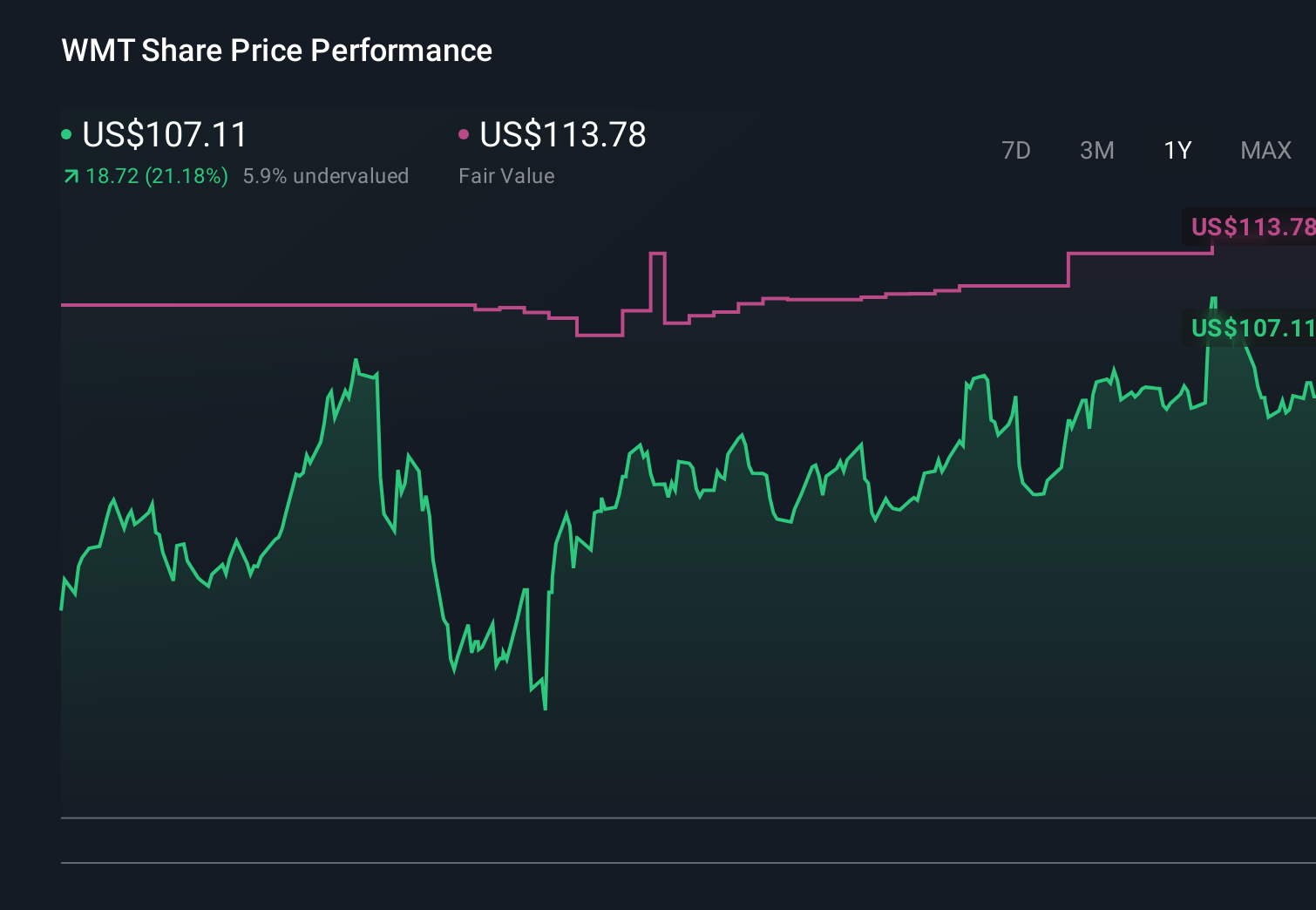
Eleven fair value views from the Simply Wall St Community cluster between US$104.83 and US$136.02, underscoring how far opinions can stretch on Walmart’s worth. Set against this, the growing role of higher margin advertising and membership income in the profit mix could influence how you think about its long run earnings power and invites you to weigh several different scenarios side by side.
Explore 11 other fair value estimates on Walmart - why the stock might be worth as much as 7% more than the current price!
Form Your Own Verdict
Disagree with existing narratives? Extraordinary investment returns rarely come from following the herd, so go with your instincts.
- A great starting point for your Walmart research is our analysis highlighting 2 key rewards and 1 important warning sign that could impact your investment decision.
- Our free Walmart research report provides a comprehensive fundamental analysis summarized in a single visual - the Snowflake - making it easy to evaluate Walmart's overall financial health at a glance.
Interested In Other Possibilities?
Every day counts. These free picks are already gaining attention. See them before the crowd does:
- Invest in the nuclear renaissance through our list of 93 elite nuclear energy infrastructure plays powering the global AI revolution.
- Rare earth metals are the new gold rush. Find out which 27 stocks are leading the charge.
- Find 58 companies with promising cash flow potential yet trading below their fair value.
This article by Simply Wall St is general in nature. We provide commentary based on historical data and analyst forecasts only using an unbiased methodology and our articles are not intended to be financial advice. It does not constitute a recommendation to buy or sell any stock, and does not take account of your objectives, or your financial situation. We aim to bring you long-term focused analysis driven by fundamental data. Note that our analysis may not factor in the latest price-sensitive company announcements or qualitative material. Simply Wall St has no position in any stocks mentioned.