
Disney’s New CEO and Inspire Visa Card Might Change The Case For Investing In Walt Disney (DIS)
Walt Disney Company DIS | 96.61 | +0.05% |
- In early February 2026, Disney’s board named long-time parks chief Josh D’Amaro as the next CEO and elevated Dana Walden to President and Chief Creative Officer, while Chase and Disney introduced the Disney Inspire Visa Card with new rewards tied to theme parks, cruises and streaming services.
- Together, these moves highlight how Disney is leaning on its Experiences segment and direct-to-consumer ecosystem to deepen guest engagement across parks, cruises, content and payments.
- We’ll now examine how the leadership handover to D’Amaro, alongside the sharpened focus on Experiences, reshapes Disney’s investment narrative.
Explore 22 top quantum computing companies leading the revolution in next-gen technology and shaping the future with breakthroughs in quantum algorithms, superconducting qubits, and cutting-edge research.
What Is Walt Disney's Investment Narrative?
For Disney to make sense in a portfolio, you really have to believe in the company’s ability to keep turning its intellectual property into cash across parks, cruises, consumer products and streaming, while using that cash to reward shareholders through dividends and sizeable buybacks. The handover to Josh D’Amaro, backed by Dana Walden on the creative side and a new corporate strategy lead in Benjamin Swinburne, ties that story much more tightly to the Experiences segment, which already generates the bulk of operating income. The new Disney Inspire Visa card fits the same theme: pulling guests deeper into Disney’s ecosystem rather than moving the financial needle on its own. In the near term, the bigger swing factor still looks to be execution on park expansion, cruise capacity and maintaining streaming profitability, all against a backdrop of modest revenue and earnings growth forecasts and a share price that has lagged broader markets.
However, there is one Experiences-related risk here that long term shareholders should really understand. Walt Disney's shares are on the way up, but they could be overextended by 6%. Uncover the fair value now.Exploring Other Perspectives
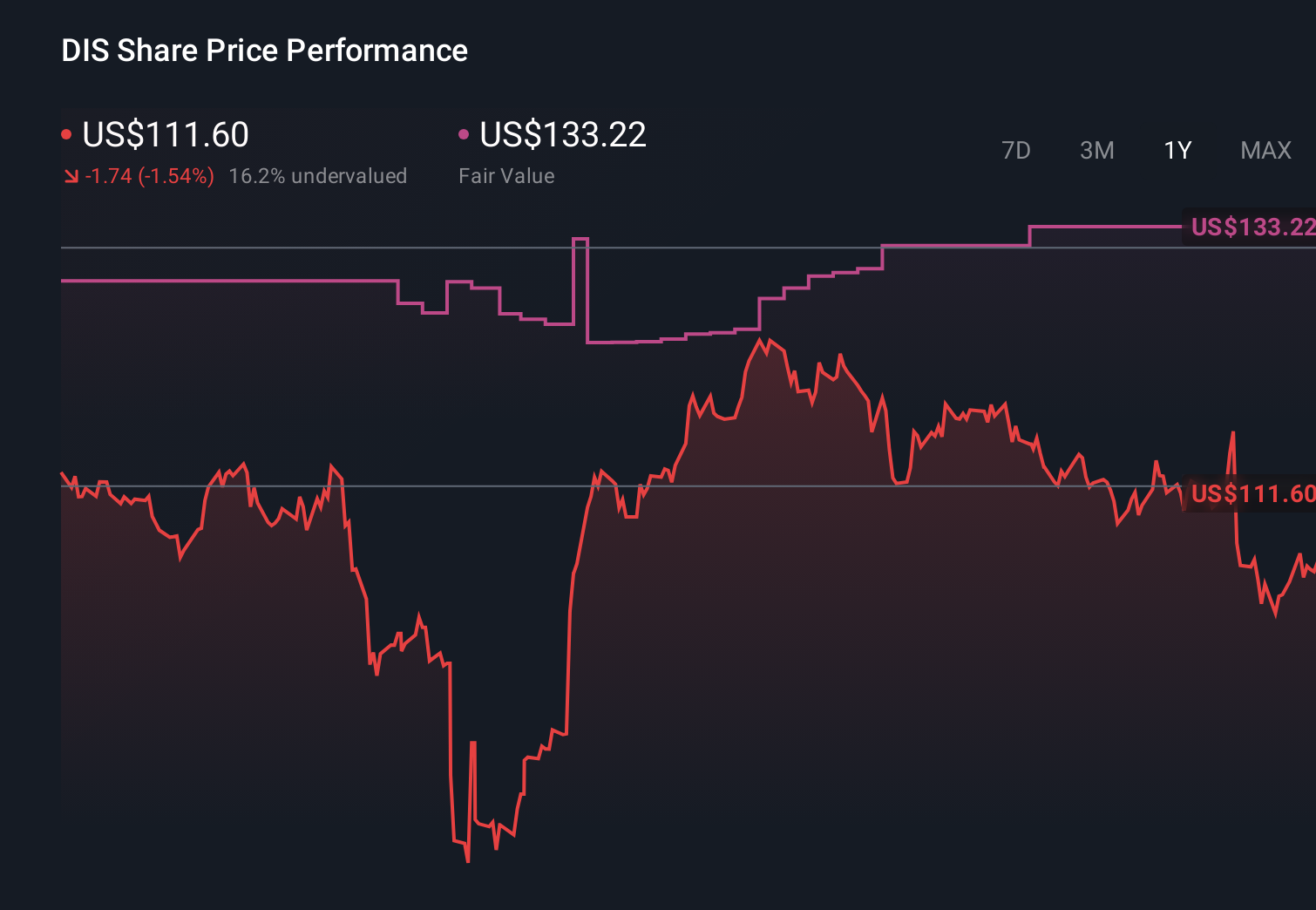
Nine fair value estimates from the Simply Wall St Community cluster between about US$102.44 and US$131.50, giving you a sense of how differently individual investors can look at the same numbers. Set that against Disney’s renewed focus on its Experiences segment as the main profit engine, and you can see why opinions on the company’s future performance and resilience diverge so widely. If you are weighing up Disney yourself, it is worth exploring several of these viewpoints before deciding what that leadership shift and cash return program really mean for the business.
Explore 9 other fair value estimates on Walt Disney - why the stock might be worth 6% less than the current price!
Build Your Own Walt Disney Narrative
Disagree with this assessment? Create your own narrative in under 3 minutes - extraordinary investment returns rarely come from following the herd.
- A great starting point for your Walt Disney research is our analysis highlighting 4 key rewards and 1 important warning sign that could impact your investment decision.
- Our free Walt Disney research report provides a comprehensive fundamental analysis summarized in a single visual - the Snowflake - making it easy to evaluate Walt Disney's overall financial health at a glance.
Looking For Alternative Opportunities?
Our top stock finds are flying under the radar-for now. Get in early:
- AI is about to change healthcare. These 26 stocks are working on everything from early diagnostics to drug discovery. The best part - they are all under $10b in market cap - there's still time to get in early.
- The future of work is here. Discover the 28 top robotics and automation stocks leading the charge in AI-driven automation and industrial transformation.
- We've uncovered the 14 dividend fortresses yielding 5%+ that don't just survive market storms, but thrive in them.
This article by Simply Wall St is general in nature. We provide commentary based on historical data and analyst forecasts only using an unbiased methodology and our articles are not intended to be financial advice. It does not constitute a recommendation to buy or sell any stock, and does not take account of your objectives, or your financial situation. We aim to bring you long-term focused analysis driven by fundamental data. Note that our analysis may not factor in the latest price-sensitive company announcements or qualitative material. Simply Wall St has no position in any stocks mentioned.