

Do TurboTax Pressures and Litigation Shift the Real Story on Intuit’s (INTU) AI Strategy?
Intuit Inc. INTU | 0.00 |
- In July 2026, Pomerantz LLP disclosed a past class action lawsuit against Intuit, alleging that from August 2025 to May 2026 the company misled investors about its competitive strengths, TurboTax growth outlook, and business model resilience amid intensifying tax-prep competition and a major workforce reduction.
- The filings and management’s own comments about losing price-sensitive TurboTax customers highlight how rising competition and pricing pressure may be reshaping Intuit’s core tax franchise and broader business model.
- We’ll now examine how the class action allegations and TurboTax weakness may influence Intuit’s AI-focused restructuring and long-term investment narrative.
Uncover the next big thing with 20 elite penny stocks that balance risk and reward.
Intuit Investment Narrative Recap
To own Intuit today, you have to believe its AI centric platform and mid market push can offset pressure in TurboTax and Mailchimp while supporting steady earnings growth. The class action and tax season shortfall sharpen the focus on a key near term catalyst: evidence that the AI driven restructuring can stabilize tax growth without eroding margins. The biggest current risk is that rising competition and price sensitivity in TurboTax signal a more structural strain on Intuit’s consumer franchise.
In that context, the 17% workforce reduction and related restructuring, announced alongside Q3 2026 results, is especially relevant. Management tied the cuts to refocusing on AI initiatives and simplifying operations, while also trimming full year TurboTax growth expectations after weaker tax season performance. How effectively Intuit executes on this leaner, AI heavy model will likely influence whether its broader platform catalysts can offset the tax related pressures highlighted in the lawsuit.
Yet behind Intuit’s AI story, a less visible risk investors should be aware of is how much depends on sustained customer adoption of its new AI agent suites and...
Intuit's narrative projects $29.2 billion revenue and $6.8 billion earnings by 2029. This requires 11.8% yearly revenue growth and about a $2.2 billion earnings increase from $4.6 billion today.
Uncover how Intuit's forecasts yield a $488.17 fair value, a 65% upside to its current price.
Exploring Other Perspectives
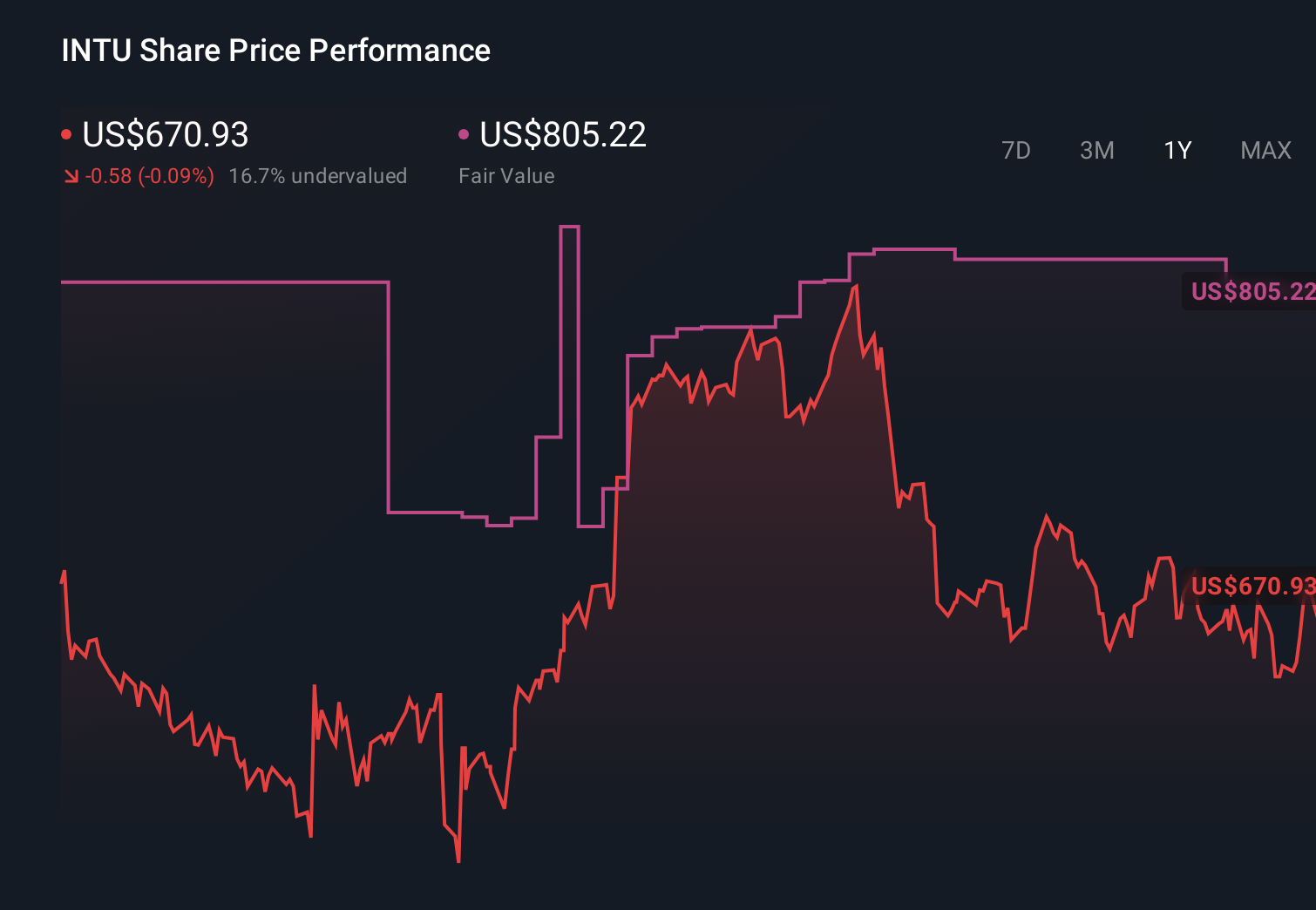
Some of the lowest estimate analysts were already cautious, assuming about 8.1% annual revenue growth and US$6.6 billion of earnings by 2029, and now this TurboTax driven reset and AI heavy restructuring could push their risk case on slower AI adoption even further, which is why it is worth looking at several different viewpoints before you decide what feels realistic to you.
Explore 22 other fair value estimates on Intuit - why the stock might be worth just $390.00!
Reach Your Own Conclusion
Don't just follow the ticker - dig into the data and build a conviction that's truly your own.
- A great starting point for your Intuit research is our analysis highlighting 5 key rewards that could impact your investment decision.
- Our free Intuit research report provides a comprehensive fundamental analysis summarized in a single visual - the Snowflake - making it easy to evaluate Intuit's overall financial health at a glance.
No Opportunity In Intuit?
These stocks are moving-our analysis flagged them today. Act fast before the price catches up:
- This technology could replace computers: discover 26 stocks that are working to make quantum computing a reality.
- Rare earth metals are an input to most high-tech devices, military and defence systems and electric vehicles. The global race is on to secure supply of these critical minerals. Beat the pack to uncover the 29 best rare earth metal stocks of the very few that mine this essential strategic resource.
- AI is about to change healthcare. These 40 stocks are working on everything from early diagnostics to drug discovery. The best part - they are all under $10b in market cap - there's still time to get in early.
This article by Simply Wall St is general in nature. We provide commentary based on historical data and analyst forecasts only using an unbiased methodology and our articles are not intended to be financial advice. It does not constitute a recommendation to buy or sell any stock, and does not take account of your objectives, or your financial situation. We aim to bring you long-term focused analysis driven by fundamental data. Note that our analysis may not factor in the latest price-sensitive company announcements or qualitative material. Simply Wall St has no position in any stocks mentioned.