

Does Best Buy’s New CFO Hire Reshape Its Long‑Term Strategy Narrative for Investors (BBY)?
Best Buy Co.,Inc. BBY | 0.00 |
- Earlier this month, Best Buy Co., Inc. appointed Anne Bramman as executive vice president and chief financial officer, effective August 19, 2026, with current CEO Corie Barry serving as interim CFO from August 1 until Bramman assumes the role.
- Bramman brings more than three decades of leadership across finance, operations, and transformation at companies such as Nordstrom, Avery Dennison, and Carnival Cruise Line, adding deep retail and analytics experience to Best Buy’s leadership team during its ongoing CEO transition.
- With an experienced retail and analytics-focused CFO joining alongside an incoming CEO, we’ll now examine how this leadership shift influences Best Buy’s investment narrative.
Capitalize on the AI infrastructure supercycle with our selection of the 55 best 'picks and shovels' of the AI gold rush converting record-breaking demand into massive cash flow.
Best Buy Investment Narrative Recap
To own Best Buy, you need to believe its physical stores, services, and marketplace can stay relevant as electronics buying keeps shifting online. The key near term catalyst is the coming PC and AI hardware upgrade cycle, while the biggest risk is pressure on margins from heavier promotional activity and online competition. The CFO change itself does not materially alter those near term drivers, but it does put more focus on execution around profitability and capital allocation.
Among recent announcements, the launch and scaling of Best Buy’s online marketplace stands out alongside this CFO appointment. The marketplace meaningfully expands assortment without tying up as much inventory, which is important if mix shifts toward lower margin computing categories during the upgrade cycle. As Best Buy leans into marketplace and retail media to support margins, investors may watch how the new finance leadership frames investments, profitability, and any shifts in reporting around these newer profit streams.
Yet for all the optimism around these initiatives, investors should be aware of the risk that rising e commerce competition could still pressure margins and...
Best Buy's narrative projects $43.2 billion revenue and $1.5 billion earnings by 2029. This requires 1.1% yearly revenue growth and about a $0.4 billion earnings increase from $1.1 billion today.
Uncover how Best Buy's forecasts yield a $79.15 fair value, a 7% downside to its current price.
Exploring Other Perspectives
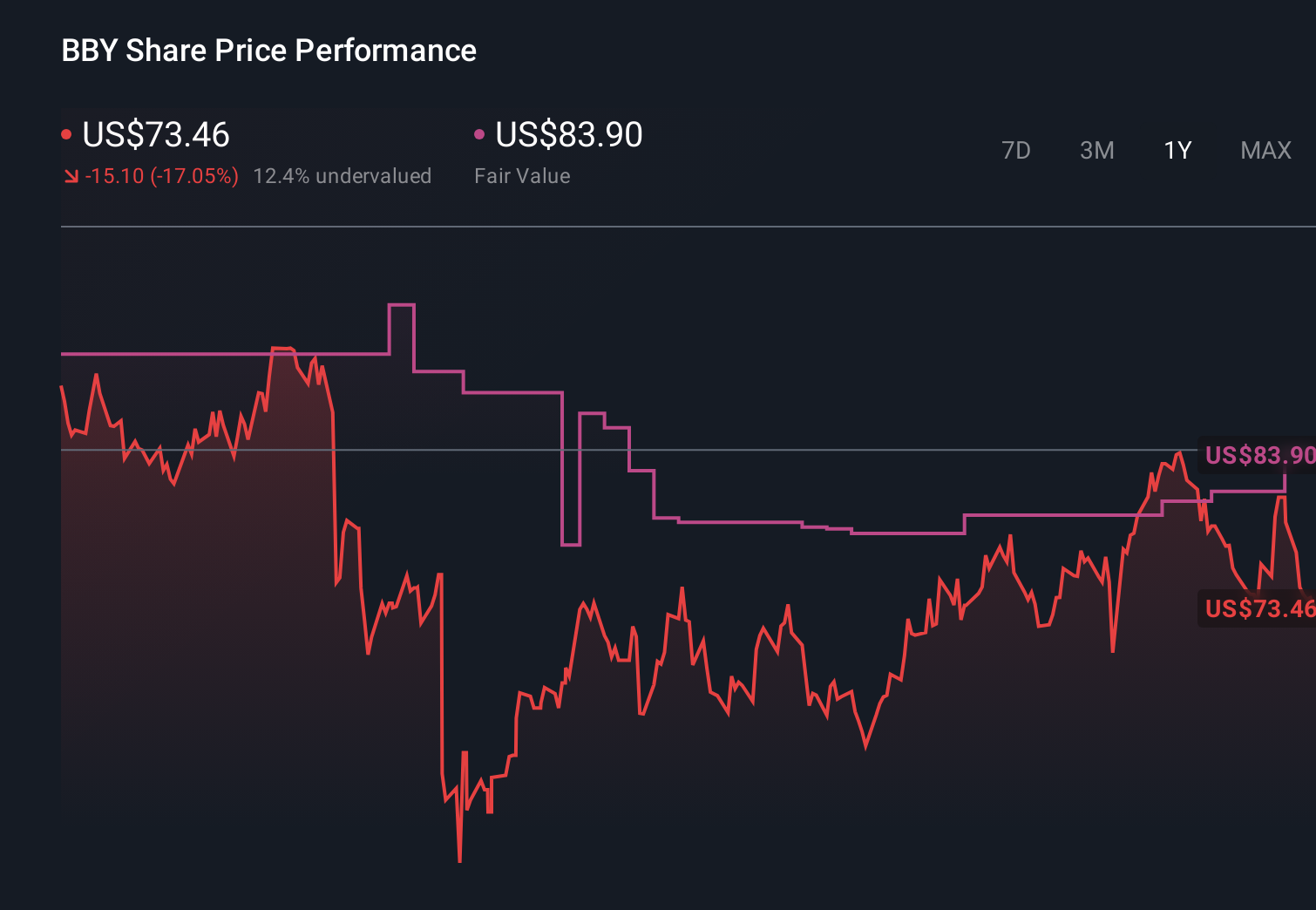
Some of the most optimistic analysts expected revenue of about US$44.1 billion and earnings near US$1.6 billion by 2029, which is a much rosier view than consensus. In light of the CFO and CEO transition, you may want to compare that bullish scenario with tariff risks and softer sales concerns to see how your own expectations line up and whether those pre news forecasts still feel realistic.
Explore 6 other fair value estimates on Best Buy - why the stock might be worth 18% less than the current price!
Decide For Yourself
Don't just follow the ticker - dig into the data and build a conviction that's truly your own.
- A great starting point for your Best Buy research is our analysis highlighting 5 key rewards and 1 important warning sign that could impact your investment decision.
- Our free Best Buy research report provides a comprehensive fundamental analysis summarized in a single visual - the Snowflake - making it easy to evaluate Best Buy's overall financial health at a glance.
Interested In Other Possibilities?
Our top stock finds are flying under the radar-for now. Get in early:
- The latest GPUs need a type of rare earth metal called Terbium and there are only 28 companies in the world exploring or producing it. Find the list for free.
- The future of work is here. Discover the 40 top robotics and automation stocks leading the charge in AI-driven automation and industrial transformation.
- Find 51 companies with promising cash flow potential yet trading below their fair value.
This article by Simply Wall St is general in nature. We provide commentary based on historical data and analyst forecasts only using an unbiased methodology and our articles are not intended to be financial advice. It does not constitute a recommendation to buy or sell any stock, and does not take account of your objectives, or your financial situation. We aim to bring you long-term focused analysis driven by fundamental data. Note that our analysis may not factor in the latest price-sensitive company announcements or qualitative material. Simply Wall St has no position in any stocks mentioned.