

Does Citigroup’s (C) Preferred Redemption and Digital Push Quietly Redefine Its Efficiency Story?
Citigroup Inc. C | 0.00 |
- Citigroup Inc. recently reported stronger second-quarter 2026 results, with higher net interest income, net income, and earnings per share, while also announcing a full US$1.50 billion redemption of its 6.250% Series T preferred stock in August 2026 as part of its funding and capital-structure optimization.
- At the same time, Citi expanded its fixed-income funding and advanced its digital payments and tokenization efforts, suggesting a tighter focus on capital efficiency, funding flexibility, and technology-enabled transaction services.
- We’ll now examine how Citi’s stronger Q2 earnings and planned preferred stock redemption shape the existing investment narrative around efficiency and growth.
The future of work is here. Discover the 33 top robotics and automation stocks leading the charge in AI-driven automation and industrial transformation.
Citigroup Investment Narrative Recap
To own Citigroup, you need to believe its global network, transaction services and wealth franchise can translate operational cleanup into steadier earnings and better efficiency. The Q2 2026 beat and the planned US$1.50 billion Series T preferred redemption support that efficiency story, but they do not remove the near term risks around regulatory scrutiny and execution on Citi’s multiyear transformation, which still look like the most important swing factors.
The most relevant recent announcement here is Citi’s Q2 2026 earnings: stronger net interest income of US$17,125 million and net income of US$5,831 million underpin management’s focus on profitability while it reshapes the balance sheet. Paired with the preferred redemption and recent fixed income issuance, this points to a tighter funding profile that could matter for returns, but it also raises the stakes if regulatory or transformation costs rise faster than planned.
Yet even with these positives, investors should be aware that mounting regulatory and transformation pressures could still...
Citigroup's narrative projects $102.4 billion revenue and $21.7 billion earnings by 2029. This requires 9.2% yearly revenue growth and about a $7.0 billion earnings increase from $14.7 billion today.
Uncover how Citigroup's forecasts yield a $146.93 fair value, a 14% upside to its current price.
Exploring Other Perspectives
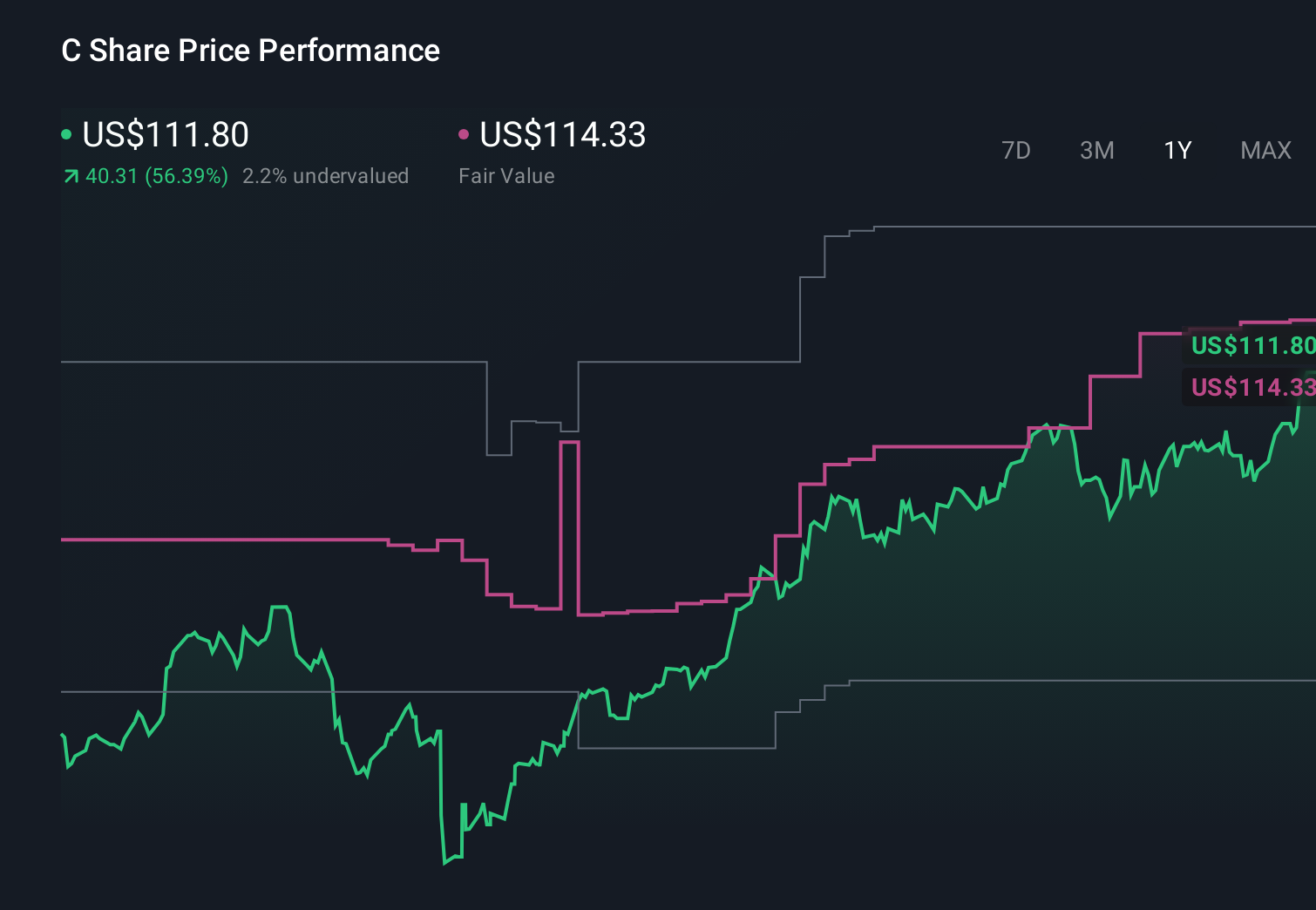
Compared with the consensus view, the most optimistic analysts were already expecting revenues near US$109.2 billion and earnings around US$24.0 billion by 2029, so this quarter’s capital moves may either reinforce that upbeat story or prompt you to question whether such aggressive assumptions on margins and capital returns still hold in light of Citi’s rising regulatory and execution risks.
Explore 8 other fair value estimates on Citigroup - why the stock might be worth as much as 52% more than the current price!
Decide For Yourself
Disagree with existing narratives? Extraordinary investment returns rarely come from following the herd, so go with your instincts.
- A great starting point for your Citigroup research is our analysis highlighting 4 key rewards that could impact your investment decision.
- Our free Citigroup research report provides a comprehensive fundamental analysis summarized in a single visual - the Snowflake - making it easy to evaluate Citigroup's overall financial health at a glance.
No Opportunity In Citigroup?
Don't miss your shot at the next 10-bagger. Our latest stock picks just dropped:
- Rare earth metals are the new gold rush. Find out which 29 stocks are leading the charge.
- The best AI stocks today may lie beyond giants like Nvidia and Microsoft. Find the next big opportunity with these 16 smaller AI-focused companies with strong growth potential through early-stage innovation in machine learning, automation, and data intelligence that could fund your retirement.
- Capitalize on the AI infrastructure supercycle with our selection of the 53 best 'picks and shovels' of the AI gold rush converting record-breaking demand into massive cash flow.
This article by Simply Wall St is general in nature. We provide commentary based on historical data and analyst forecasts only using an unbiased methodology and our articles are not intended to be financial advice. It does not constitute a recommendation to buy or sell any stock, and does not take account of your objectives, or your financial situation. We aim to bring you long-term focused analysis driven by fundamental data. Note that our analysis may not factor in the latest price-sensitive company announcements or qualitative material. Simply Wall St has no position in any stocks mentioned.