

Does Knight-Swift’s Removal From Russell Defensive Indices (KNX) Change The Bull Case?
Knight-Swift Transportation KNX | 0.00 |
- Knight-Swift Transportation Holdings Inc. was recently removed from both the Russell 1000 Defensive Index and the Russell 1000 Value-Defensive Index, potentially affecting how index-tracking funds and institutional investors allocate capital to the stock.
- This index exclusion highlights how shifts in quantitative factor classifications can influence a company’s perceived risk profile and portfolio role for many investors.
- We’ll now examine how Knight-Swift’s removal from these Russell defensive indices shapes the company’s investment narrative and future positioning.
Rare earth metals are the new gold rush. Find out which 30 stocks are leading the charge.
Knight-Swift Transportation Holdings Investment Narrative Recap
To own Knight-Swift, you need to believe that its diversified truckload and LTL network can translate scale, technology and cost discipline into better margins over time, even after a difficult earnings period. The recent removal from Russell’s defensive indices may prompt some short term selling from index-linked investors, but it does not directly change the core catalysts around LTL integration, cost initiatives or the key risk that weak freight demand and competitive pricing keep margins under pressure.
One of the more relevant recent developments alongside the index removal is Kevin Knight’s retirement as Executive Chairman and director. A founder stepping back can sharpen focus on the current management team’s execution on LTL integration, technology driven cost efficiencies and capital allocation, which sit at the heart of the thesis, but it also adds another layer of governance and leadership transition risk at a time when the company is working through lower profitability and index-related perception shifts.
Yet investors should also be aware that if weak freight demand persists and margin recovery stalls, the impact on earnings and balance sheet flexibility could...
Knight-Swift Transportation Holdings' narrative projects $9.3 billion revenue and $694.7 million earnings by 2029. This requires 7.6% yearly revenue growth and about a $660.7 million earnings increase from $34.0 million today.
Uncover how Knight-Swift Transportation Holdings' forecasts yield a $76.47 fair value, in line with its current price.
Exploring Other Perspectives
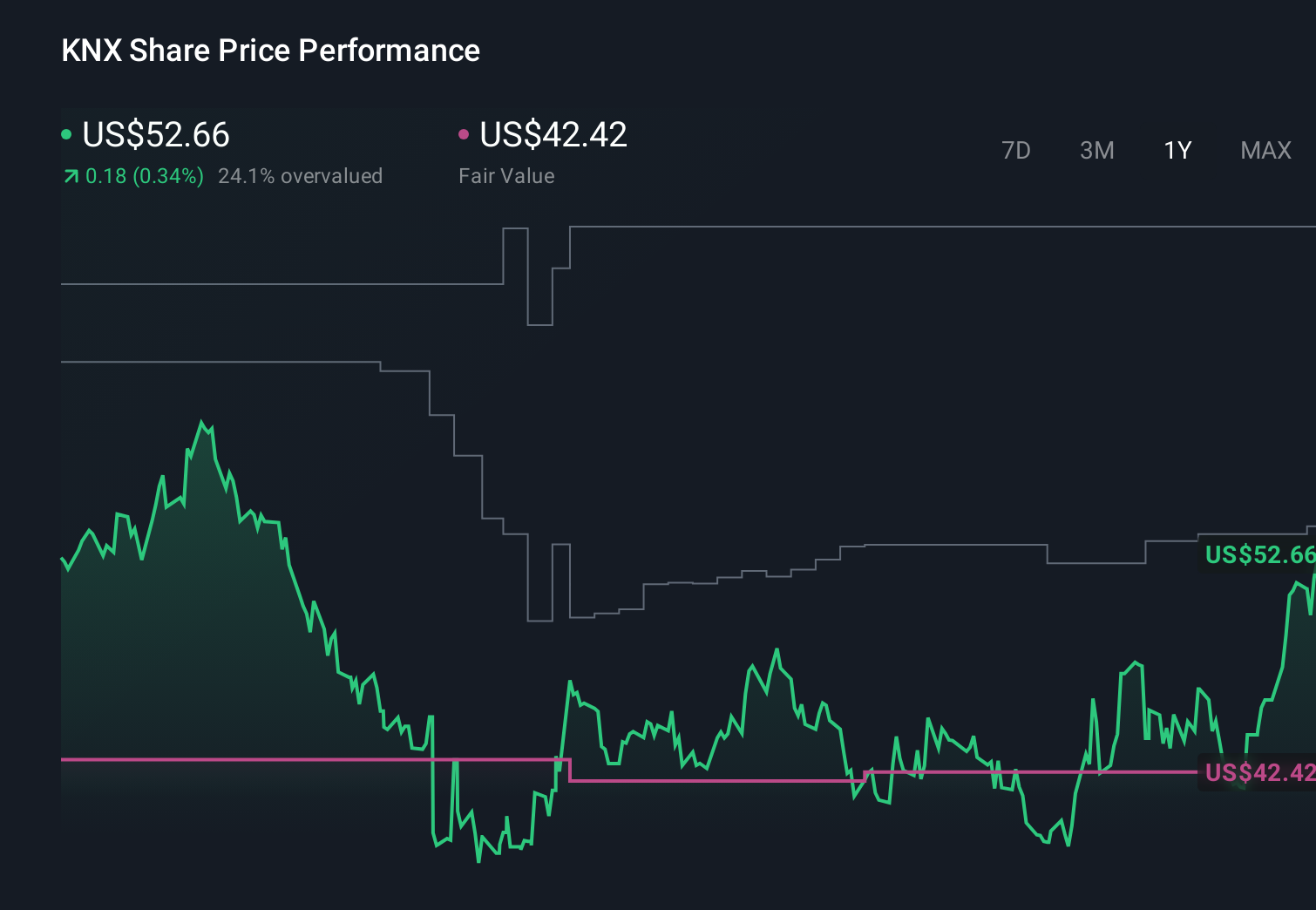
Some of the lowest estimate analysts paint a far more pessimistic picture, even before this index news, with revenue only reaching about US$9.0 billion and earnings about US$689.1 million by 2029, so as you weigh the removal from Russell’s defensive indices alongside concerns like rising environmental regulation, it is worth recognizing how sharply opinions differ and exploring several alternative viewpoints.
Explore 3 other fair value estimates on Knight-Swift Transportation Holdings - why the stock might be worth 36% less than the current price!
Decide For Yourself
Disagree with existing narratives? Extraordinary investment returns rarely come from following the herd, so go with your instincts.
- A great starting point for your Knight-Swift Transportation Holdings research is our analysis highlighting 2 key rewards and 2 important warning signs that could impact your investment decision.
- Our free Knight-Swift Transportation Holdings research report provides a comprehensive fundamental analysis summarized in a single visual - the Snowflake - making it easy to evaluate Knight-Swift Transportation Holdings' overall financial health at a glance.
Looking For Alternative Opportunities?
Early movers are already taking notice. See the stocks they're targeting before they've flown the coop:
- We've uncovered the 9 dividend fortresses yielding 5%+ that don't just survive market storms, but thrive in them.
- Outshine the giants: these 15 early-stage AI stocks could fund your retirement.
- Uncover the next big thing with 22 elite penny stocks that balance risk and reward.
This article by Simply Wall St is general in nature. We provide commentary based on historical data and analyst forecasts only using an unbiased methodology and our articles are not intended to be financial advice. It does not constitute a recommendation to buy or sell any stock, and does not take account of your objectives, or your financial situation. We aim to bring you long-term focused analysis driven by fundamental data. Note that our analysis may not factor in the latest price-sensitive company announcements or qualitative material. Simply Wall St has no position in any stocks mentioned.