

Does New Avatar Lawsuit and Cereal Toy Tie-In Shift Disney’s Content Risk-Reward Profile (DIS)?
Walt Disney Company DIS | 0.00 |
- In April 2026, Kasowitz LLP filed an amended copyright infringement lawsuit alleging extensive unauthorized use of creator Eric Ryder’s KRZ story across James Cameron’s Avatar franchise, targeting The Walt Disney Company and several subsidiaries, with claimed damages exceeding US$1.00 billion plus punitive awards and injunctive relief against further exploitation.
- Separately, WK Kellogg Co announced the return of toys in cereal boxes for the first time in over a decade, partnering with The Walt Disney Studios to promote Toy Story 5 and tap into nostalgic, screen‑free family play ahead of the film’s release.
- With this backdrop, we’ll examine how the expanded Avatar lawsuit could influence Disney’s investment narrative around content, streaming, and experiences.
We've uncovered the 13 dividend fortresses yielding 5%+ that don't just survive market storms, but thrive in them.
Walt Disney Investment Narrative Recap
To own Disney, you need to believe its mix of franchises, streaming, and in person experiences can keep converting audience attention into durable cash flows. The expanded Avatar lawsuit raises headline legal risk around a key film series but, for now, does not clearly alter the most immediate catalyst, which is how upcoming earnings clarify momentum in streaming and Experiences. The largest near term uncertainty remains the cost and payoff of Disney’s heavy content and capital spending.
Among recent developments, Morgan Stanley’s view that live experiences like sports and theme parks may hold value in an AI driven world feels directly relevant. It speaks to the same core catalyst many shareholders are watching today: whether Disney’s parks, cruises, and live content can sustain pricing power and attendance even as digital entertainment and short form platforms pull attention elsewhere.
Yet while the focus is often on growth opportunities, investors should also be aware that...
Walt Disney's narrative projects $110.7 billion revenue and $13.2 billion earnings by 2029. This requires 5.0% yearly revenue growth and about a $0.9 billion earnings increase from $12.3 billion today.
Uncover how Walt Disney's forecasts yield a $128.25 fair value, a 24% upside to its current price.
Exploring Other Perspectives
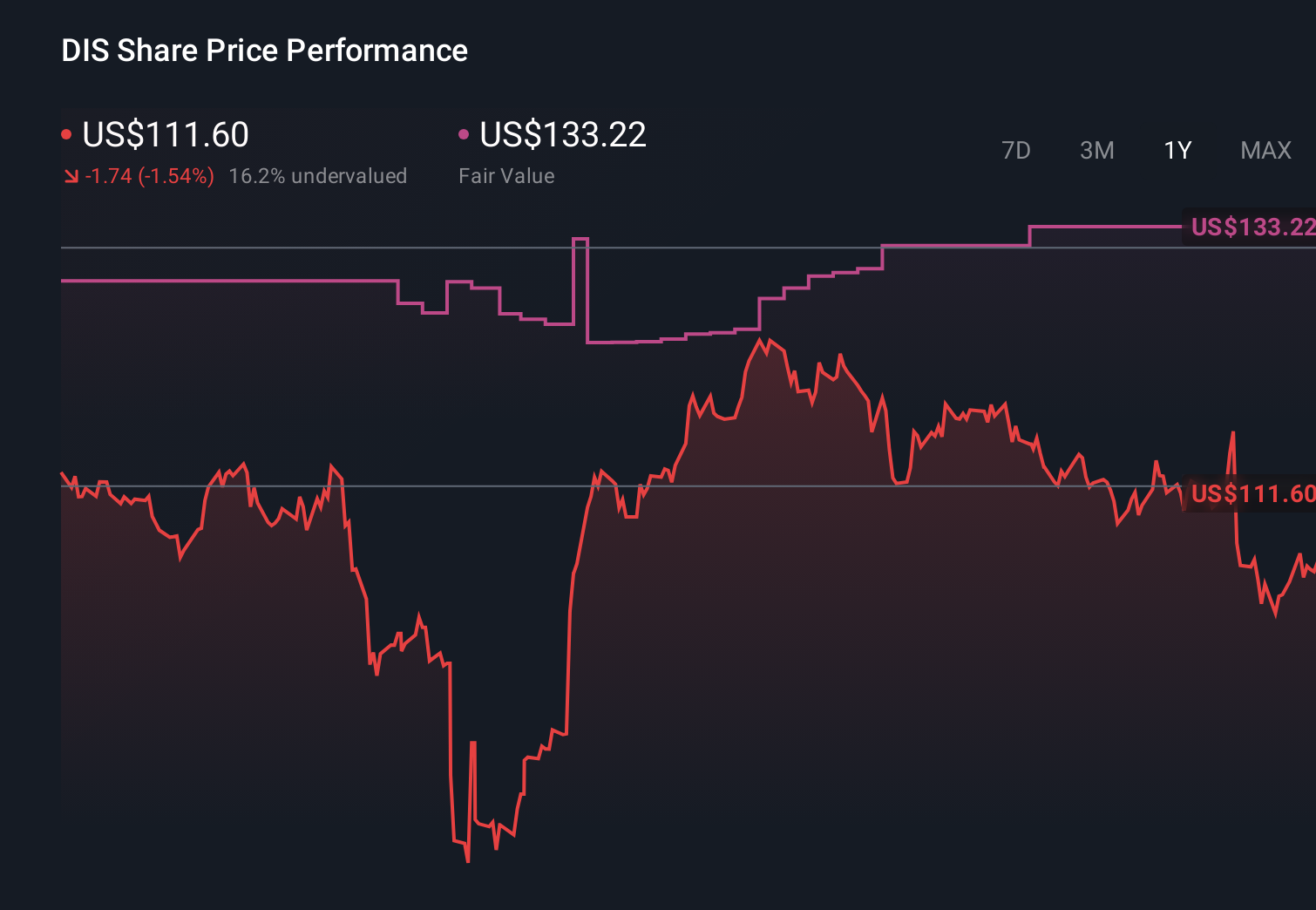
Eight members of the Simply Wall St Community currently place Disney’s fair value between US$103.62 and US$131.50, showing a wide spread of views. Set this against the risk that rising content and expansion spending could pressure margins if subscriber or park revenue growth falls short, and it becomes clear why comparing several perspectives on Disney’s outlook can be useful.
Explore 8 other fair value estimates on Walt Disney - why the stock might be worth just $103.62!
Decide For Yourself
Don't just follow the ticker - dig into the data and build a conviction that's truly your own.
- A great starting point for your Walt Disney research is our analysis highlighting 4 key rewards and 1 important warning sign that could impact your investment decision.
- Our free Walt Disney research report provides a comprehensive fundamental analysis summarized in a single visual - the Snowflake - making it easy to evaluate Walt Disney's overall financial health at a glance.
Contemplating Other Strategies?
Our daily scans reveal stocks with breakout potential. Don't miss this chance:
- Capitalize on the AI infrastructure supercycle with our selection of the 37 best 'picks and shovels' of the AI gold rush converting record-breaking demand into massive cash flow.
- Find 50 companies with promising cash flow potential yet trading below their fair value.
- Rare earth metals are an input to most high-tech devices, military and defence systems and electric vehicles. The global race is on to secure supply of these critical minerals. Beat the pack to uncover the 31 best rare earth metal stocks of the very few that mine this essential strategic resource.
This article by Simply Wall St is general in nature. We provide commentary based on historical data and analyst forecasts only using an unbiased methodology and our articles are not intended to be financial advice. It does not constitute a recommendation to buy or sell any stock, and does not take account of your objectives, or your financial situation. We aim to bring you long-term focused analysis driven by fundamental data. Note that our analysis may not factor in the latest price-sensitive company announcements or qualitative material. Simply Wall St has no position in any stocks mentioned.