
Does Robinhood’s Push Into Venture Funds and Premium Cards Reframe the Bull Case for HOOD?
Robinhood Markets, Inc. Class A HOOD | 69.65 | -0.19% |
- In recent days, Robinhood Markets expanded beyond its core brokerage roots by launching Robinhood Ventures Fund I on the NYSE and rolling out high-end offerings like its US$695-a-year Platinum credit card, while continuing to pursue a “financial super app” model across trading, banking, and wealth services.
- This push into venture investing and premium credit cards materially broadens Robinhood’s role in customers’ financial lives, raising fresh questions about how diversified revenue streams and new risk exposures could reshape the company’s long-term business profile.
- With Robinhood Ventures Fund I opening private-market access to retail investors, we’ll now assess how this shift affects the company’s investment narrative.
We've uncovered the 14 dividend fortresses yielding 5%+ that don't just survive market storms, but thrive in them.
Robinhood Markets Investment Narrative Recap
To own Robinhood today, you need to believe it can evolve from a trading app into a broad “financial super app” that keeps customers for years and earns more per user through subscriptions, banking, and asset management. The key near term catalyst is continued growth in non trading revenue like Gold and deposit products, while the biggest current risk is that new ventures such as Robinhood Ventures Fund I struggle to gain traction, which could undermine confidence in its expansion story. The fund’s weak debut is relevant here but does not yet fundamentally change that core thesis.
The launch of Robinhood Ventures Fund I, alongside the US$695-per-year Platinum card, is the clearest recent step toward that super app vision. RVI’s 11% drop on its first trading day and questions around private market valuations now sit in tension with management’s push into asset management and premium cards, making investor reception to these products a useful early signal for how much of Robinhood’s cross selling and recurring revenue catalyst is actually being realized.
Yet beneath the growth story, investors should be aware that a shift toward more passive, buy and hold customer behavior could...
Robinhood Markets' narrative projects $5.3 billion revenue and $1.8 billion earnings by 2028. This requires 14.0% yearly revenue growth and essentially no change in earnings from the current $1.8 billion level.
Uncover how Robinhood Markets' forecasts yield a $132.19 fair value, a 68% upside to its current price.
Exploring Other Perspectives
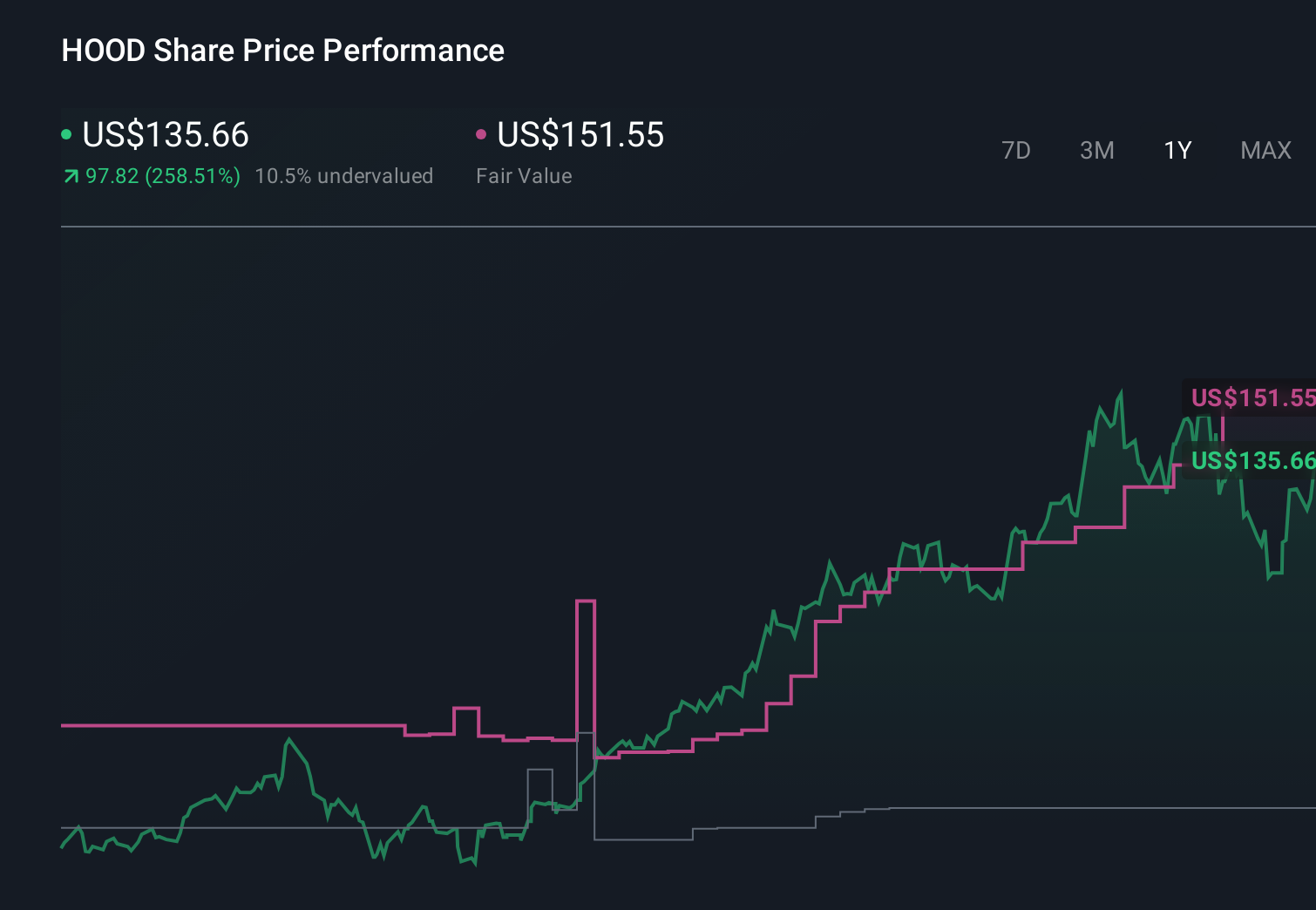
While the baseline view focuses on measured growth and diversification, the most optimistic analysts were penciling in roughly US$8.2 billion of revenue and US$3.0 billion of earnings by 2028, which assumes far stronger momentum from new areas like prediction markets and global expansion than consensus expects, and those projections may need a fresh look in light of Robinhood’s latest moves.
Explore 37 other fair value estimates on Robinhood Markets - why the stock might be worth 39% less than the current price!
Decide For Yourself
Don't just follow the ticker - dig into the data and build a conviction that's truly your own.
- A great starting point for your Robinhood Markets research is our analysis highlighting 2 key rewards that could impact your investment decision.
- Our free Robinhood Markets research report provides a comprehensive fundamental analysis summarized in a single visual - the Snowflake - making it easy to evaluate Robinhood Markets' overall financial health at a glance.
Contemplating Other Strategies?
Early movers are already taking notice. See the stocks they're targeting before they've flown the coop:
- Rare earth metals are the new gold rush. Find out which 29 stocks are leading the charge.
- Outshine the giants: these 18 early-stage AI stocks could fund your retirement.
- Invest in the nuclear renaissance through our list of 86 elite nuclear energy infrastructure plays powering the global AI revolution.
This article by Simply Wall St is general in nature. We provide commentary based on historical data and analyst forecasts only using an unbiased methodology and our articles are not intended to be financial advice. It does not constitute a recommendation to buy or sell any stock, and does not take account of your objectives, or your financial situation. We aim to bring you long-term focused analysis driven by fundamental data. Note that our analysis may not factor in the latest price-sensitive company announcements or qualitative material. Simply Wall St has no position in any stocks mentioned.