

Does Teradyne’s (TER) New Credit Line Hint at a Shift in Capital Allocation Priorities?
Teradyne, Inc. TER | 0.00 |
- In August 2026, Teradyne, Inc. entered into a five-year senior secured revolving credit facility of US$1.00 billion with PNC Bank and other lenders, providing flexible funding for working capital and general corporate purposes without initially drawing on the line.
- A key feature of this agreement is that collateral, guarantees, and several restrictive covenants can be lifted if Teradyne maintains investment grade credit ratings from at least two major agencies, potentially giving the company more financial flexibility over time.
- We’ll now examine how this new US$1.00 billion revolving credit facility could influence Teradyne’s investment narrative and future capital allocation.
Rare earth metals are an input to most high-tech devices, military and defence systems and electric vehicles. The global race is on to secure supply of these critical minerals. Beat the pack to uncover the 28 best rare earth metal stocks of the very few that mine this essential strategic resource.
Teradyne Investment Narrative Recap
To own Teradyne, you have to believe in the long-term need for advanced semiconductor test and automation, particularly around AI, HBM, and robotics. The new US$1.00 billion revolving credit facility mainly reinforces liquidity and balance sheet flexibility; it does not materially alter near term demand risks such as trade policy uncertainty, robotics softness, or visibility beyond the next couple of quarters.
The most relevant recent announcement alongside the new facility is Teradyne’s ongoing US$1.0 billion share buyback authorization through the end of 2026. Together, the undrawn credit line and active repurchases suggest the company has options in how it funds working capital, potential acquisitions, and shareholder returns, which matters if AI related test demand, silicon photonics, and automation opportunities evolve differently from current expectations.
Yet, against this stronger financial toolkit, investors should still be aware of how concentrated exposure to cyclical semiconductor and electronics spending could...
Teradyne's narrative projects $7.3 billion revenue and $2.2 billion earnings by 2029. This requires 17.8% yearly revenue growth and about a $1.0 billion earnings increase from $1.2 billion today.
Uncover how Teradyne's forecasts yield a $442.20 fair value, a 18% upside to its current price.
Exploring Other Perspectives
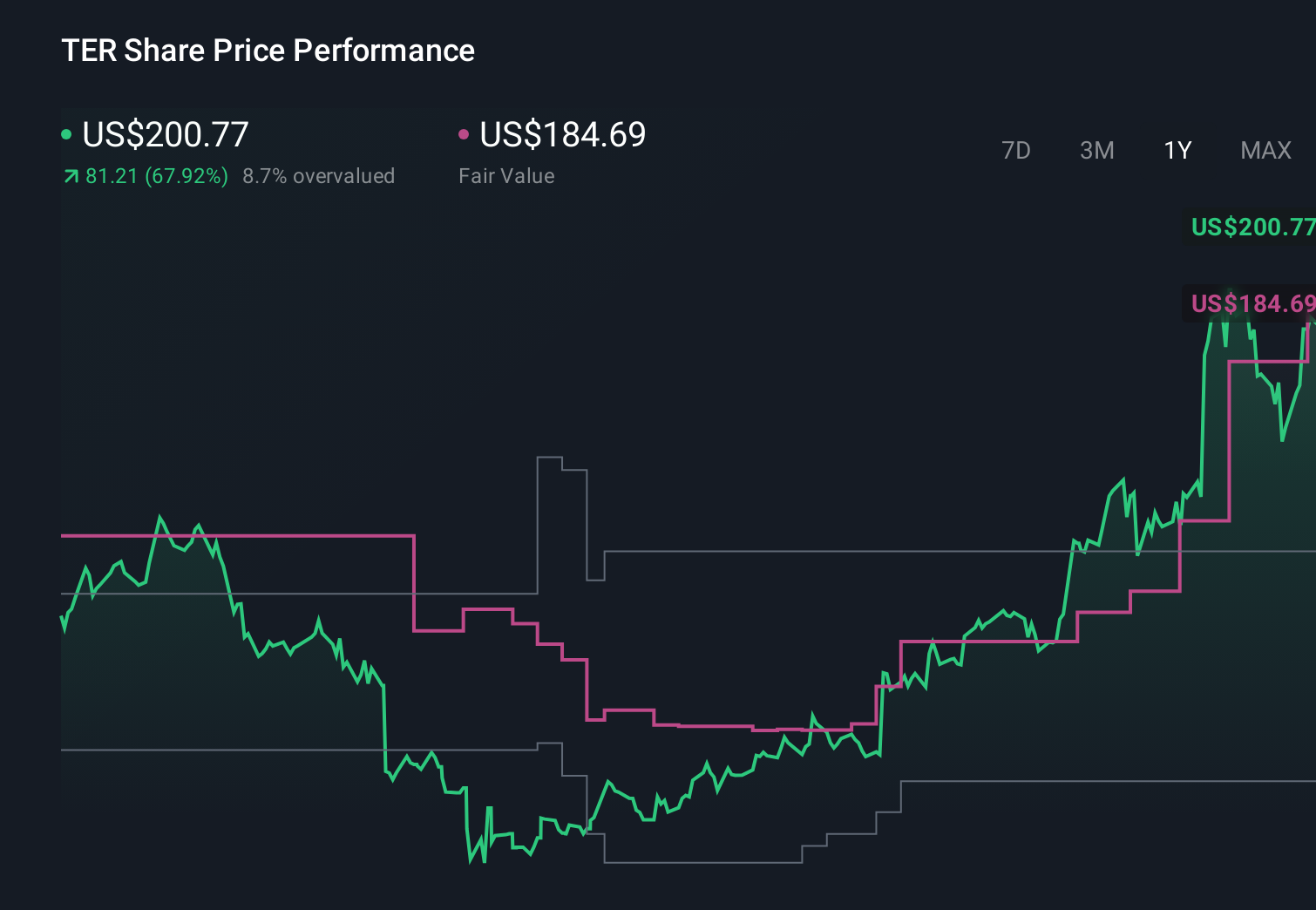
Some of the most optimistic analysts were assuming Teradyne could reach about US$8.8 billion in revenue and US$2.9 billion in earnings by 2029, but the new US$1.0 billion credit facility could either support that growth story or highlight the risk of overreliance on cyclical chip and electronics spending, so it is worth weighing how your own expectations differ from those bullish forecasts.
Explore 5 other fair value estimates on Teradyne - why the stock might be worth as much as 46% more than the current price!
Reach Your Own Conclusion
Disagree with existing narratives? Extraordinary investment returns rarely come from following the herd, so go with your instincts.
- A great starting point for your Teradyne research is our analysis highlighting 2 key rewards and 2 important warning signs that could impact your investment decision.
- Our free Teradyne research report provides a comprehensive fundamental analysis summarized in a single visual - the Snowflake - making it easy to evaluate Teradyne's overall financial health at a glance.
Contemplating Other Strategies?
Our daily scans reveal stocks with breakout potential. Don't miss this chance:
- Uncover the next big thing with 22 elite penny stocks that balance risk and reward.
- Outshine the giants: these 18 early-stage AI stocks could fund your retirement.
- Capitalize on the AI infrastructure supercycle with our selection of the 55 best 'picks and shovels' of the AI gold rush converting record-breaking demand into massive cash flow.
This article by Simply Wall St is general in nature. We provide commentary based on historical data and analyst forecasts only using an unbiased methodology and our articles are not intended to be financial advice. It does not constitute a recommendation to buy or sell any stock, and does not take account of your objectives, or your financial situation. We aim to bring you long-term focused analysis driven by fundamental data. Note that our analysis may not factor in the latest price-sensitive company announcements or qualitative material. Simply Wall St has no position in any stocks mentioned.