

Does U.S. Bancorp’s (USB) Modest Dividend Hike Reveal a Deeper Capital Allocation Strategy?
U.S. Bancorp USB | 0.00 |
- In recent weeks, U.S. Bancorp has outlined plans to raise its quarterly common stock dividend by 3.8%, subject to board approval, while maintaining a stress capital buffer of 2.6% and capital ratios comfortably above regulatory minimums.
- Alongside this, the bank is reinforcing its fee-oriented growth efforts, including new leadership in healthcare payments, signaling an emphasis on capital strength and diversified revenue streams.
- With this planned dividend increase highlighting balance sheet resilience, we’ll now examine how the announcement interacts with U.S. Bancorp’s existing investment narrative.
The future of work is here. Discover the 29 top robotics and automation stocks leading the charge in AI-driven automation and industrial transformation.
U.S. Bancorp Investment Narrative Recap
To own U.S. Bancorp, you generally need to believe in a well capitalized regional bank that can keep balancing shareholder payouts with disciplined risk management. The planned 3.8% dividend increase, supported by an unchanged 2.6% stress capital buffer, reinforces that capital footing, but does not materially change the near term focus on credit quality and commercial real estate exposure as key risks to watch.
The appointment of Eric Levine to lead healthcare payments is particularly relevant here, because it ties into U.S. Bancorp’s push to deepen fee based businesses outside traditional lending. For investors watching catalysts, this build out in healthcare payments and treasury services sits alongside the dividend policy as part of the bank’s effort to lean more on payments income rather than pure balance sheet growth.
Yet investors should still weigh how rising digital competition could affect those very payment and fee streams that...
U.S. Bancorp's narrative projects $36.1 billion revenue and $9.6 billion earnings by 2029.
Uncover how U.S. Bancorp's forecasts yield a $63.50 fair value, a 5% upside to its current price.
Exploring Other Perspectives
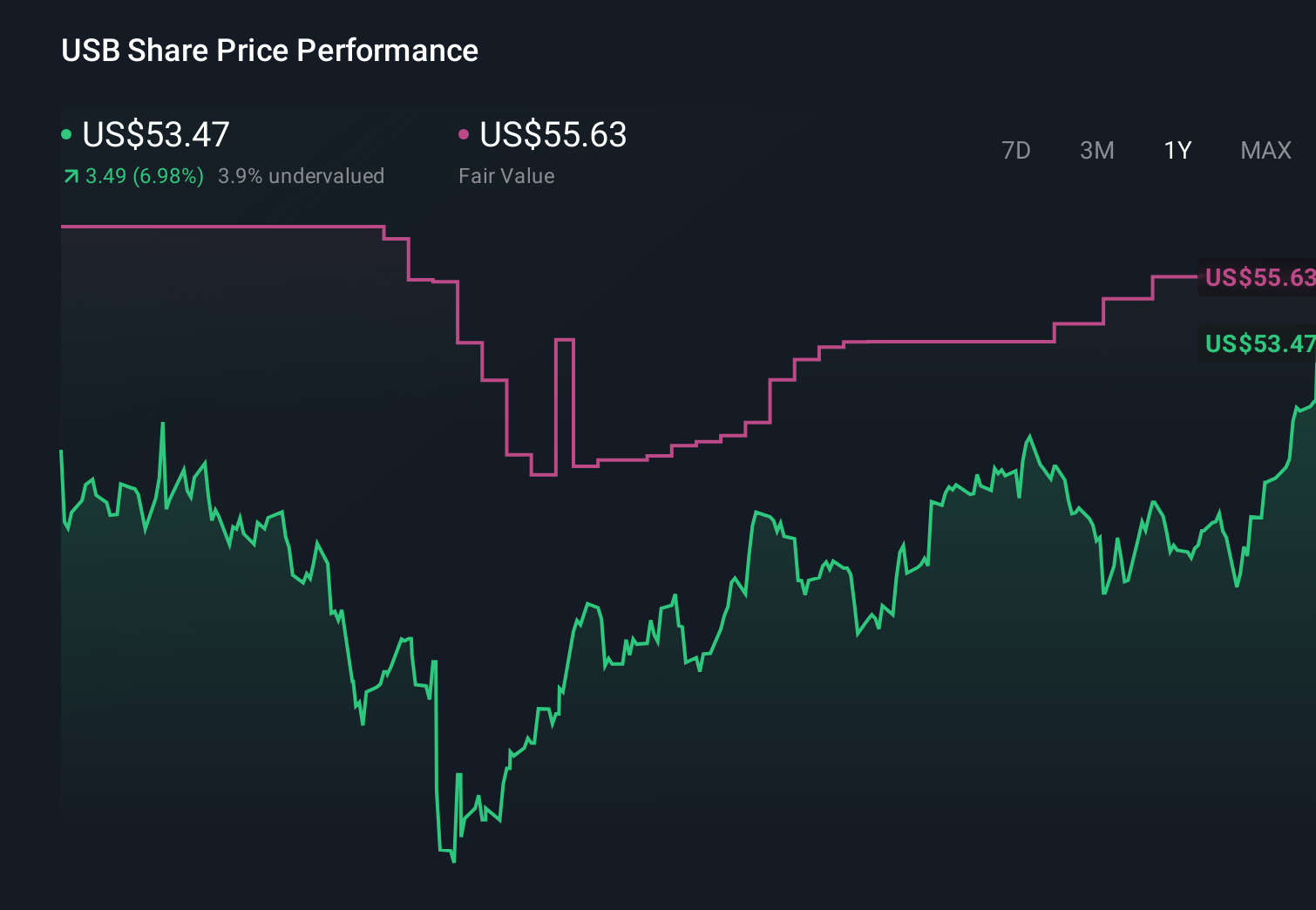
Six fair value estimates from the Simply Wall St Community span roughly US$58 to US$103 per share, underscoring how far apart individual views can be. As you compare those opinions with the bank’s emphasis on fee based growth in healthcare payments, consider how differently investors may be assessing the implications for future earnings resilience.
Explore 6 other fair value estimates on U.S. Bancorp - why the stock might be worth as much as 70% more than the current price!
Decide For Yourself
Don't just follow the ticker - dig into the data and build a conviction that's truly your own.
- A great starting point for your U.S. Bancorp research is our analysis highlighting 3 key rewards and 1 important warning sign that could impact your investment decision.
- Our free U.S. Bancorp research report provides a comprehensive fundamental analysis summarized in a single visual - the Snowflake - making it easy to evaluate U.S. Bancorp's overall financial health at a glance.
Contemplating Other Strategies?
Our top stock finds are flying under the radar-for now. Get in early:
- AI is about to change healthcare. These 40 stocks are working on everything from early diagnostics to drug discovery. The best part - they are all under $10b in market cap - there's still time to get in early.
- This technology could replace computers: discover 26 stocks that are working to make quantum computing a reality.
- Capitalize on the AI infrastructure supercycle with our selection of the 51 best 'picks and shovels' of the AI gold rush converting record-breaking demand into massive cash flow.
This article by Simply Wall St is general in nature. We provide commentary based on historical data and analyst forecasts only using an unbiased methodology and our articles are not intended to be financial advice. It does not constitute a recommendation to buy or sell any stock, and does not take account of your objectives, or your financial situation. We aim to bring you long-term focused analysis driven by fundamental data. Note that our analysis may not factor in the latest price-sensitive company announcements or qualitative material. Simply Wall St has no position in any stocks mentioned.