

Duolingo (DUOL) Stock May Be 50% Undervalued As Revenue Outlook Softens
Duolingo, Inc. DUOL | 0.00 |
Duolingo stock has had a tough year, with a sharp share price decline sitting alongside mixed valuation signals where the Discounted Cash Flow (DCF) intrinsic value estimate points to upside while traditional market multiples suggest the shares are expensive. Recent news around strong user growth but a softer revenue outlook has sharpened that debate about what the current price really builds in.
- Over the past 12 months Duolingo has fallen 58.9%, which means the market has already reset expectations quite a long way.
- Strong growth in daily users and paid subscriptions can support the DCF view of upside, but a slower revenue outlook and concerns about monetisation may weigh on how much investors are willing to pay today.
- On Simply Wall St's broader checks Duolingo scores just 2 out of 6 for value, which leans more towards the stock not being a clear bargain even though the DCF model flags it as undervalued.
For investors, the debate is whether the intrinsic value case around future cash flows can outweigh the weaker value score and overvalued multiples that the market is currently assigning to Duolingo.
Does Duolingo Look Undervalued on Cash Flow?
The Discounted Cash Flow (DCF) approach looks at the cash Duolingo is expected to generate for shareholders and brings those future amounts back to today.
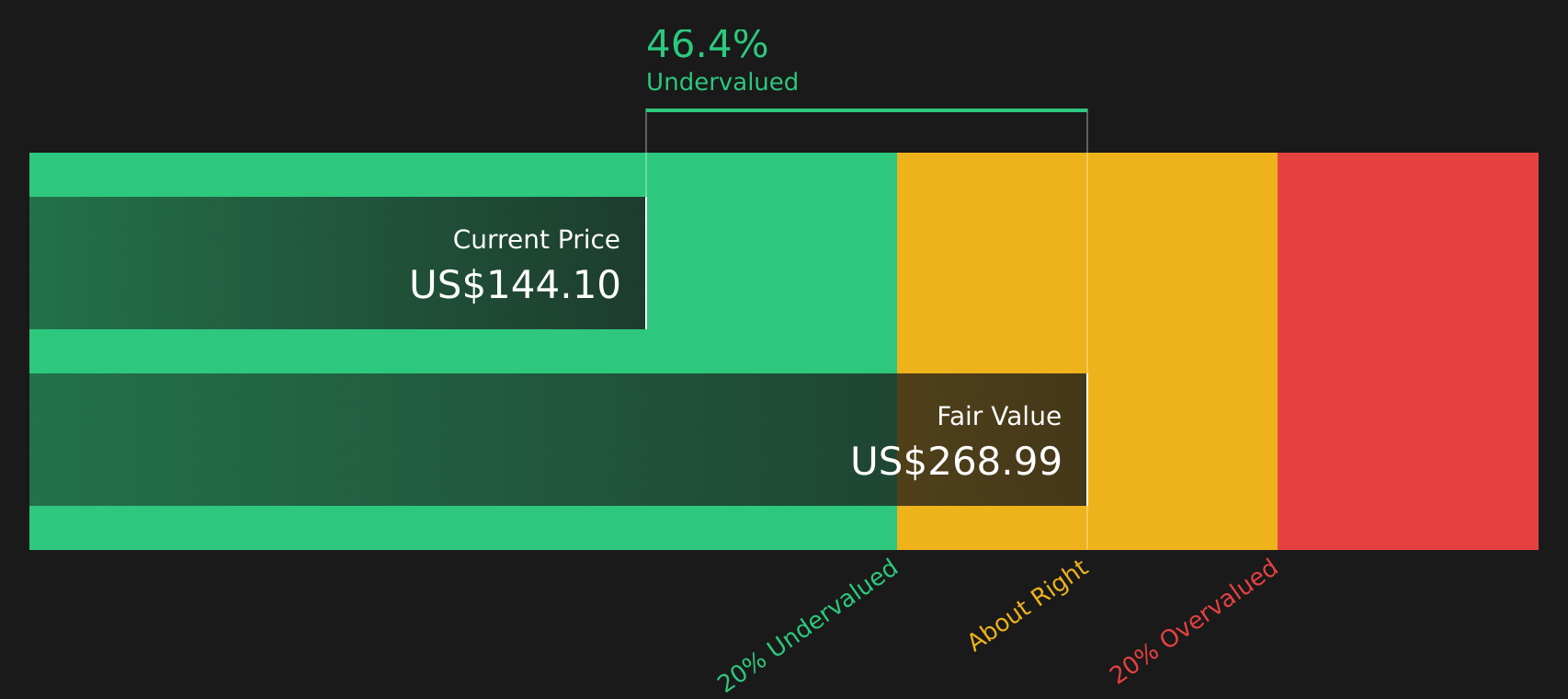
For Duolingo, the model uses latest twelve month free cash flow of about $400.4 million and assumes that cash flows keep growing rather than shrinking or recovering from a loss making base. On that basis, the 2 Stage Free Cash Flow to Equity model arrives at an estimated intrinsic value of about $269 per share.
This sits well above the current share price, which implies roughly a 50.0% discount to the DCF estimate, so the stock screens as undervalued on this cash flow view. The recent update that paired strong user and subscription growth with a softer revenue outlook helps explain why the share price has fallen faster than the DCF model would suggest.
Based on the cash flow math in this model, Duolingo stock appears undervalued relative to what the Discounted Cash Flow model implies.
Our Discounted Cash Flow (DCF) analysis suggests Duolingo is undervalued by 50.0%. Track this in your watchlist or portfolio, or discover 49 more high quality undervalued stocks.
Has Duolingo Run Too Far on Earnings?
For a profitable company like Duolingo, the P/E ratio is a straightforward way to see what you are paying for each dollar of earnings. Duolingo currently trades on a P/E of about 15.3x, compared with a Consumer Services industry average of roughly 13.1x and a peer group average near 12.6x. That points to a clear premium versus both its wider sector and more direct peers.
The fair P/E ratio implied by Simply Wall St's model is about 9.0x, which reflects what might be expected given Duolingo's size, margins and risk profile. Against that benchmark, the current 15.3x is higher, which supports the view that the stock does not look cheap on earnings alone, even after the recent share price reset and softer revenue outlook.
On this earnings multiple, Duolingo stock appears expensive relative to both its modelled fair P/E and sector comparisons.

The Duolingo Narrative: What Would Justify Today's Price?
Simply Wall St Narratives for Duolingo sit between the DCF upside case and the richer P/E multiples that the market is currently paying, and outline which paths for Duolingo's growth, margins and earnings would need to occur for the stock to be worth materially more or less than today. Each idea on the Community page links its number to a clear view on how growth, profitability and risks might evolve, so you can revisit the case as fresh information emerges.
Community views on Duolingo sit far apart, with one side seeing a reset opportunity and the other warning that expectations are already rich.
Bull case: 50% undervalued
"We often look for "dislocations" moments where market sentiment diverges from business fundamentals, and with Duolingo now trading around $181, down significantly from its 52-week highs, we have to ask, Is the growth story broken, or has the stock finally entered the "Value" zone…"
Bear case: 17% overvalued
"Intensifying competition from both AI-powered language tools and specialized, integrated offerings from large tech firms, combined with commoditization of language learning due to AI advancements, threatens Duolingo's pricing power and could exert downward pressure on net margins…"
Do you think there's more to the story for Duolingo? Head over to our Community to see what others are saying!
The Bottom Line
For Duolingo, the Discounted Cash Flow (DCF) intrinsic value estimate points to meaningful upside, while the earnings multiple view still screens the stock as overvalued relative to peers and a modelled fair P/E. That gap comes from the DCF leaning on longer term cash flow delivery, while the multiples are more sensitive to how much growth and monetisation investors are willing to price in today. Broader valuation checks remain weak. The key question is whether Duolingo can translate its user base into revenue and earnings in a way that ultimately justifies both the intrinsic value estimate and the current market premium.
This article by Simply Wall St is general in nature. We provide commentary based on historical data and analyst forecasts only using an unbiased methodology and our articles are not intended to be financial advice. It does not constitute a recommendation to buy or sell any stock, and does not take account of your objectives, or your financial situation. We aim to bring you long-term focused analysis driven by fundamental data. Note that our analysis may not factor in the latest price-sensitive company announcements or qualitative material. Simply Wall St has no position in any stocks mentioned.