

Duolingo (DUOL) Stock May Be A Bargain On Cash Flow But Rich On Earnings
Duolingo, Inc. DUOL | 0.00 |
Duolingo stock has had a difficult 12 months, with the share price down 55.7%, yet its Discounted Cash Flow (DCF) intrinsic value estimate currently points to meaningful upside while market multiples point the other way. On top of that, Duolingo only passes a small share of Simply Wall St's valuation checks, which leaves investors weighing a supportive intrinsic value signal against a broadly cautious scorecard.
- Over the past year Duolingo's share price has declined 55.7%, which puts recent analyst optimism and any valuation upside under closer scrutiny.
- Recent upgrades and the acquisition of animation studio Animade can support expectations for product growth, but integration execution and the market's reaction to new investment may still cap how much value investors are willing to pay for today.
- Duolingo passes just 2 of 6 valuation checks, which leans more toward the stock looking expensive on the broader measures even though the DCF intrinsic value suggests it trades at a 47.3% discount.
The stock's next move may depend on whether Duolingo's cash flow potential justifies trusting the DCF upside signal more than the low overall value score and richer market multiples.
Is Duolingo a Bargain on Cash Flow?
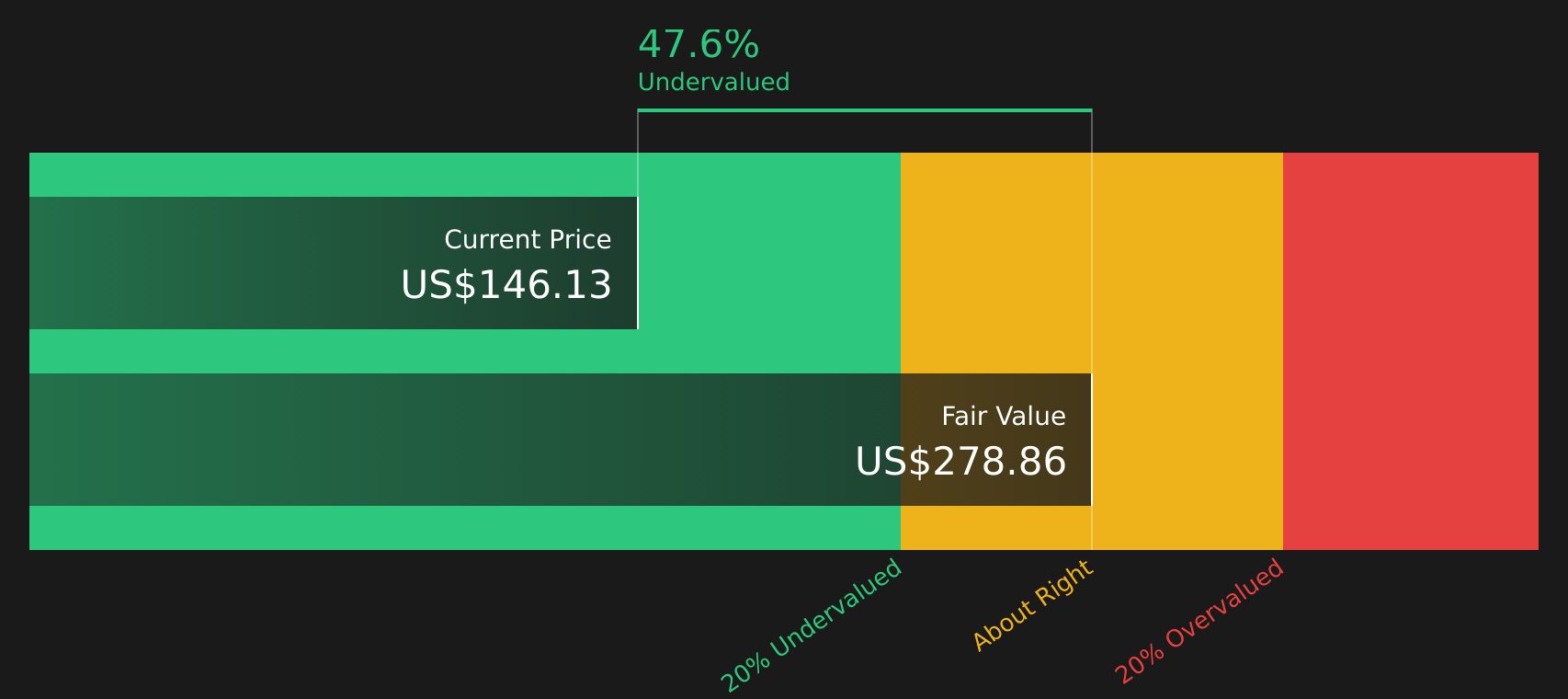
The Discounted Cash Flow (DCF) method estimates what Duolingo might be worth today based on its expected future cash generation. Duolingo has latest twelve month free cash flow of about $400.4 million and the model assumes that cash flow continues growing from this base over time. On that basis, the DCF points to an intrinsic value of about $278.86 per share.
Compared with the current share price, the DCF output implies Duolingo stock trades at a 47.3% discount to that intrinsic value, which screens as materially undervalued on this model. The recent upgrade from D.A. Davidson, with a higher price target after calling out a potential turning point, is one possible explanation for why sentiment has started to improve even though the cash flow model still suggests more value than the market is pricing in today.
On this DCF view, Duolingo stock currently appears undervalued relative to its projected cash flows.
Our Discounted Cash Flow (DCF) analysis suggests Duolingo is undervalued by 47.3%. Track this in your watchlist or portfolio, or discover 50 more high quality undervalued stocks.
Does Duolingo Look Pricey on Earnings?
P/E is a useful yardstick for Duolingo because the company currently reports positive earnings that can anchor the valuation. On this measure, Duolingo trades on a P/E of about 16.7x, compared with a Consumer Services industry average of 13.5x and a peer average of 14.4x. That places the stock on a clear premium to both its wider sector and closer listed comparables.
The fair P/E ratio for Duolingo, based on its profile and risk factors, is estimated at 9.3x. This is well below the current 16.7x reading, which indicates that investors are paying more for the stock relative to what the model suggests as a more balanced level. On this multiple, Duolingo does not screen as a bargain and instead appears richly priced versus both its tailored fair ratio and its industry benchmarks.
On the P/E multiple, Duolingo stock currently screens as overvalued compared with both its fair ratio and sector peers.

The Duolingo Narrative: What Would Justify Today's Price?
Simply Wall St Narratives for Duolingo pick up where the valuation puzzle leaves off. They spell out which paths for Duolingo's growth, margins and earnings would need to play out for the stock to be worth materially more or less than today's price, and they sit on the company’s Community page. Where a single ratio or model gives one figure, Narratives set out the future that figure relies on so you can see whether reality keeps matching that story.
Community views on Duolingo are split, with some investors seeing a reset opportunity while others see stretched expectations.
Bull case: 45% undervalued
"We often look for 'dislocations', moments where market sentiment diverges from business fundamentals…"
Bear case: 28% overvalued
"Intensifying competition from both AI-powered language tools and specialized, integrated offerings from large tech firms, combined with commoditization of language learning due to AI advancements, threatens Duolingo's pricing power and could exert downward pressure on net margins…"
Do you think there's more to the story for Duolingo? Head over to our Community to see what others are saying!
The Bottom Line
Duolingo presents a mixed picture on valuation. The Discounted Cash Flow (DCF) intrinsic value estimate points to a large discount, while the P/E and related market multiples suggest the stock is overvalued compared with peers and a tailored fair ratio. The low overall value score indicates that most traditional checks are cautious, despite the supportive DCF view. The key question for investors is whether Duolingo’s future cash generation ultimately aligns more closely with the intrinsic value perspective or with the market’s more restrained multiple, especially in light of execution and competitive risks already noted.
This article by Simply Wall St is general in nature. We provide commentary based on historical data and analyst forecasts only using an unbiased methodology and our articles are not intended to be financial advice. It does not constitute a recommendation to buy or sell any stock, and does not take account of your objectives, or your financial situation. We aim to bring you long-term focused analysis driven by fundamental data. Note that our analysis may not factor in the latest price-sensitive company announcements or qualitative material. Simply Wall St has no position in any stocks mentioned.