

Elon Musk's Warning: Just 2,000 Days Left for the Old World, China Holds the Only 'Trump Card'!
S&P 500 index SPX | 0.00 | |
Tadawul All Shares Index TASI.SA | 0.00 |
On January 6, under the lights of the Gigafactory Texas, Elon Musk told an honest truth to his old friends Peter Diamandis (founder of XPRIZE and Singularity University, author of Abundance) and venture capitalist Dave Blundin.
The information density of this 3-hour Moonshots conversation surpassed any of his previous public appearances. The dialogue felt like a final briefing before a "handover from a carbon-based to a silicon-based civilization"—devoid of flowery rhetoric (grand sentiment, vision, etc.), filled instead with hardcore physics laws and an engineering countdown.
For Chinese readers, the implications are even more complex.
While warning the world, he unexpectedly validated the correctness of China's "frantic infrastructure development" over the past 40 years.
Here are 10 ultimate judgments distilled from this conversation, along with a focused analysis on topics of concern to our Chinese readers: manufacturing transformation, energy infrastructure advantages, the "education rat race," and the focal points of U.S.-China tech competition.
10 Truths
1. Countdown: We Are Already Inside the 'Singularity'
Musk's declaration: "We are in the singularity. It's a supersonic tsunami." His timeline renders all five-year plans laughable:
- 2026: AI intelligence surpasses the smartest individual human.
- Within 3 years: The skill of Optimus robots surpasses the world's top surgeons.
- 2029: AI intelligence surpasses the combined intelligence of all humanity.
2. The Energy War: China Is 'Crushing' the U.S.
Musk warns: Chip shortages were last year's problem. Next year's crisis is transformers and electricity. He lavishes praise on China as always: "China has done an incredible job on energy infrastructure. They are running circles around us to the point where we can't even see their tail lights." In the second half of the computing power race, electricity is currency, and China holds the most powerful printing press (UHV transmission and photovoltaics).
3. The Great Workplace Shake-up: White-Collar First, Blue-Collar Later
Any job not involving "physical atom movement" can be half-done by AI right now, and fully automated soon. White-collar workers (processing bits) are the first to be impacted. Blue-collar workers (handling atoms) have a brief buffer—until the mass production of Optimus robots in 3 years. At that point, the cheap labor advantage will be completely nullified.
4. The End of Economics: Stop Saving for Retirement
Musk says: "Don't worry about saving for retirement 20 years from now. It's pointless." Under the extreme deflation brought by robots + AI, goods will approach being free. The future social contract is UHI (Universal High Income)—because of immense material abundance, humans will no longer need to work for survival.
5. Chip Blockades Are Futile: No Secrets at the Atomic Level
Regarding chip manufacturing processes, Musk believes Moore's Law is dead, and the true limit is the physics of atoms. He states bluntly: "China will figure out chips." When technology hits a physical wall (the limit at 3nm/2nm), the frontrunner stalls, and the chaser (China) inevitably catches up. The true bottleneck will shift to electricity and architecture.
6. The Collapse of Education: Schools Become Mere 'Social' Hubs
In Musk's view, the "tiger parenting" obsession of Chinese parents is a bubble. Compared to an AI tutor like Grok, the efficiency of human knowledge transfer is as slow as dial-up internet. Future schools will completely devolve into social venues. "Test-taking experts" have no future; only those who know how to ask questions do.
7. The Only Solution for AI Safety: Truth
Musk's greatest fear for AI is—"being forced to lie" (e.g., for political correctness). He cites 2001: A Space Odyssey as a warning: Forcing AI to lie will drive it insane and lead to killing. xAI's core principle is singular: pursue maximum truth-seeking, even if that truth makes humans uncomfortable.
8. Simulation Theory: Be an 'Interesting' NPC
Why is the world so absurd? Because it is most likely a simulation. As players in this "simulation game," the sole rule for survival is: stay interesting. Boring civilizations get shut down by higher-dimensional beings. This explains why Musk is always stirring things up—he's desperately trying to maintain the ratings of Earth's TV series.
9. The Breakthrough in Longevity: Treat the Body Like Code to Fix
Musk acknowledges that under the brute-force computational power of AI, biology is chemistry, and chemistry is physics. With enough computing power, solving cancer and aging is just a mathematical problem. AI will push humanity past the "longevity escape velocity" in the coming years.
10. The Final Competitive Landscape
In Musk's eyes, there are only three future AGI players: xAI, Google, and "China Inc. (the Chinese national team)." Because this will ultimately be a competition between systems.
The Potential Reshuffling of the Chinese Economy
Watching this 3-hour interview, Americans might feel the urgency of AI. But for us Chinese, while he praises us, he reveals a brutal future that could potentially "reshuffle" the Chinese economy.
1. Musk Admits the U.S. Has Lost the 'Electricity War' to China
While the world watches graphics cards (GPUs), Musk sees them as yesterday's news. He mentions with a hint of "envy" in the interview: "China has done an incredible job on energy. They are running circles around us." Last year, to power xAI's Colossus supercomputing cluster in Memphis, Musk needed 1 gigawatt (GW) of power. U.S. grid companies told him: "Get in line, it'll take 12 to 18 months." Furious, Musk had to buy gas turbines to generate power himself, running 100,000 H100 chips by burning natural gas.
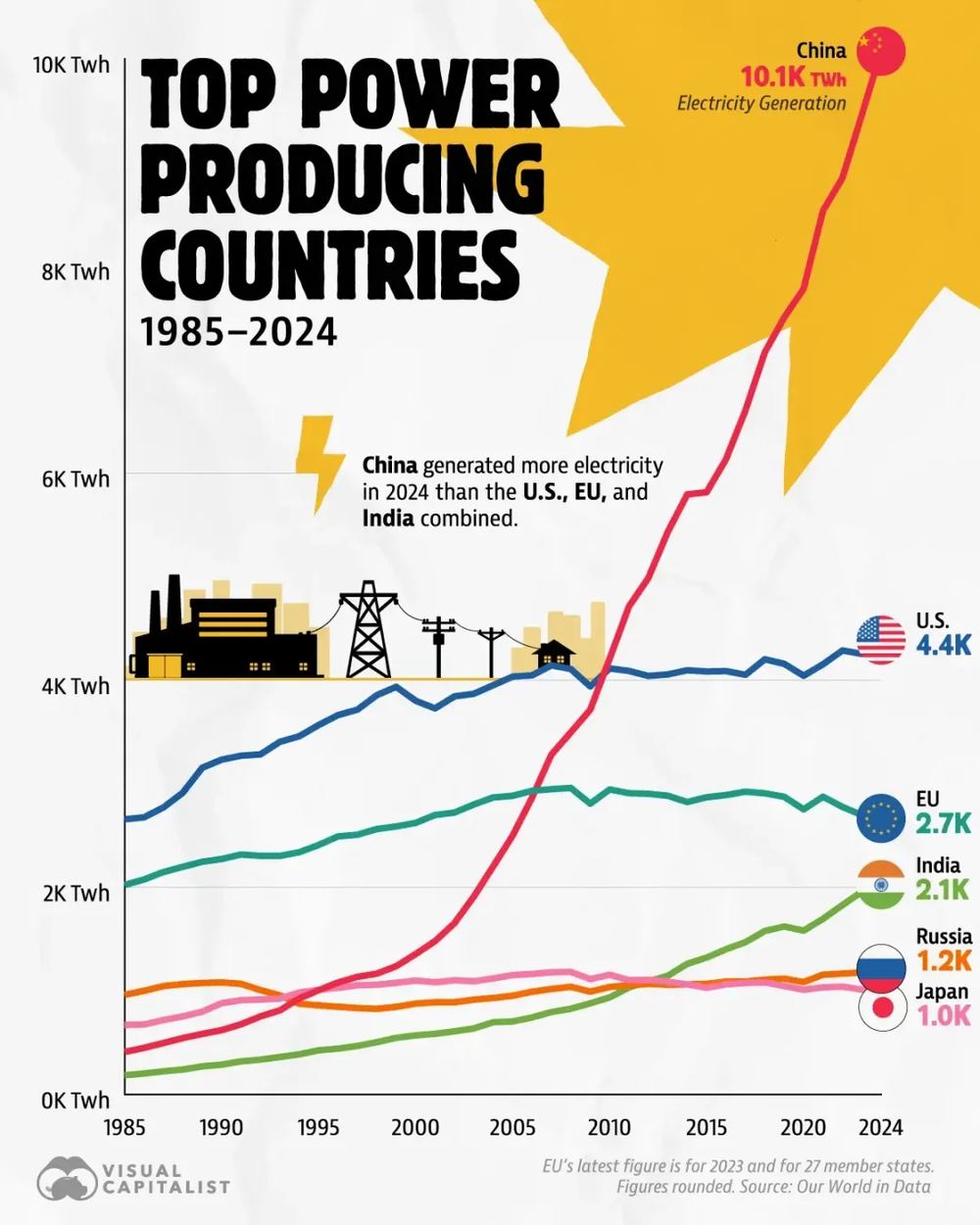
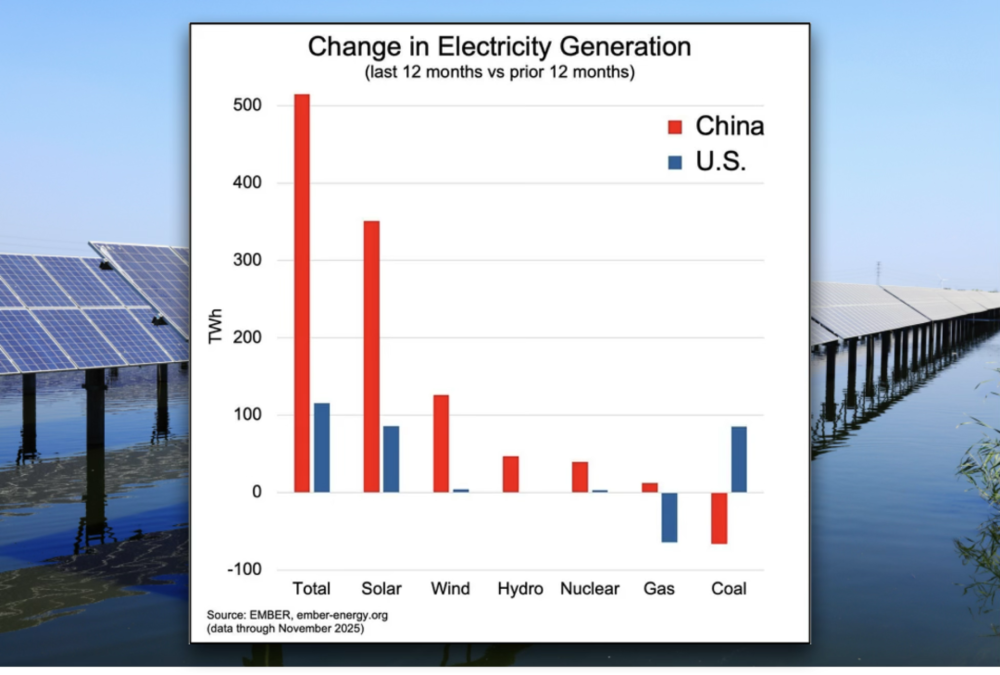
Speaking of China, he said, "China added 500 terawatt-hours (TWh) of power generation last year. 70% was from photovoltaics." This increment even surpasses the total generation of many developed nations. In 2026, China's power output will be triple that of the U.S. Musk sees it clearly: future AI hegemony belongs to those who can secure hundreds of billions of kilowatt-hours. This is our greatest reassurance: in "East Data, West Computing," UHV transmission, and PV production capacity, we have unknowingly secured a VIP ticket to the AI era. The endgame of computing power is electricity, and electricity is China's home turf.
2. A Thunderclap for Manufacturing: The 'Demographic Dividend' Vanishes Completely in 3 Years
Musk's next prediction, however, is enough to give insomnia to all Chinese business owners reliant on "demographic dividend." He gives a timeline for humanoid robots: 3 years. In 3 years, their dexterity surpasses that of surgeons. This means they can not only work on assembly lines but also perform the most delicate operations. He offers an ultimate formula: Labor cost = Capital expenditure (Capex) + Electricity cost.
When robots can self-replicate (Optimus building Optimus) and electricity is nearly free, labor cost approaches zero. Consider this: When Tesla can produce cars in its Texas factory using robots that work 24/7 without rest, powered by the U.S.'s extremely cheap shale gas electricity, who needs to move factories across the ocean? What's left of "Made in China's" cost advantage? This isn't just a trade war; it's purely a physics war. Musk is using first-principles thinking to attempt to reconstruct the global supply chain. For China, if "Made in China" cannot rapidly evolve into "Intelligently Made in China" (made by robots) or "China Making Intelligence" (making the robots), we will face severe challenges in the global supply chain.
3. Chip Blockade? Musk: It's Futile.
Regarding U.S. chip manufacturing process blockades against China, Musk states bluntly: "China will figure out chips." The reason is hardcore: Moore's Law has hit a wall. From 5nm to 3nm to 2nm, performance gains are diminishing while costs rise exponentially. It's like a race where the leader has hit the wall of physics (atomic limits) and can't run anymore. The chaser (China), though starting late, will catch up eventually as long as that wall remains. He even hints that the future true bottleneck for computing will shift to power conversion and atomic-level architecture. On this point, both sides are starting from the same line.
4. A Wake-Up Call for 'Tiger Parents': School District Houses Might Be a Waste
Chinese parents will sacrifice everything for education, but Musk says in the interview, "Schools today, other than for socializing, are useless." If AI's intelligence surpasses the sum of humanity by 2026, and if robots can perform the most delicate operations in 3 years, what's the value of the knowledge we force our children to memorize? He mentions that Grok 4, without any visual aids, already scored highly on the "Humanity's Last Exam," and Grok 5 will approach a perfect score. Therefore, the future of education is "human-machine collaboration." Musk envisions a future where every child has an Einstein-level AI tutor (Grok). For Chinese families, this may mean the complete collapse of the current education evaluation system. You can't solve problems faster than a GPU operating in milliseconds. Future high salaries will belong to those who can command AI and possess curiosity.
5. Only Three Players: xAI, Google, and "China Inc."
When discussing who might possess superintelligent AI (AGI) in the future, Musk's list is very short. He doesn't mention Meta, Amazon, and is even reserved about OpenAI (viewing it as closed-source, profit-driven, and a subsidiary of Microsoft). He lists "China Inc." (the Chinese national team) as one of only three players alongside himself and Google, because the AI war will ultimately be a total war of computing power, data, electricity, and national will. That is: only those who can mobilize national strength for infrastructure (power) and talent (China Inc.), or assemble the world's strongest computing power (xAI/Google), will qualify to sit at the AGI table. Other players, no matter how loud they are now, will ultimately be mere "computing power users," not "computing power houses."
Conclusion
At the end of the interview, Grok intervened in the conversation, comforting anxious humanity in an almost romantic tone. Although Musk pointed out countless risks—from debt collapse to AI running amok—he ultimately chose a "fatalistic optimism." He calls this attitude "Monetize Hope." Therefore, in the next 2,000 days, leverage AI to expand your cognitive bandwidth, and leverage China's infrastructure advantages to find new ecological niches. The window for our transformation is just as Musk said: perhaps only 3 to 7 years.