

Erie Indemnity (ERIE) Valuation Check After Mixed FY2026 Q1 Earnings And Cautious Analyst Outlook
Erie Indemnity Company Class A ERIE | 0.00 |
Erie Indemnity (ERIE) is back in focus after its FY2026 Q1 earnings report, where operating revenue and income rose but earnings missed expectations, and the stock saw a mixed share price reaction.
Since the earnings miss, Erie Indemnity's share price has been under pressure, with a 30 day share price return down 12.44% and year to date share price return down 20.06%. However, the 5 year total shareholder return of 24.72% reflects a much steadier long term picture.
If this earnings reaction has you rethinking your watchlist, it could be a good moment to look beyond insurance and check out 20 top founder-led companies
With Erie Indemnity stock under pressure despite an intrinsic discount of about 15% and some investors pointing to a GF Value estimate well above the current US$222 share price, should you see mispricing here or assume the market already has future growth in view?
Preferred P/E of 20.3x: Is it justified?
Erie Indemnity trades on a P/E of 20.3x, which sits against a last close of $222.07 and points to a richer valuation than many insurance peers.
The P/E multiple compares the current share price to earnings per share, so a higher figure usually signals that investors are willing to pay more for each dollar of earnings. For an insurance focused services company like Erie Indemnity, that can reflect factors such as its fee based revenue model, high return on equity and perceived earnings quality.
Here, the market appears to be assigning a premium tag. Erie Indemnity is flagged as trading at 15.5% below one fair value estimate and also below an SWS DCF value of $262.77. Yet it still carries a P/E of 20.3x while having earnings that declined 7% over the past year and net profit margins that slipped from 15.7% to 14%. That mix of an earnings contraction, pressure on margins and a high reported return on equity of 24.3% gives a more complex picture of what investors might be pricing in.
The peer and industry comparison is stark. Erie Indemnity's 20.3x P/E is described as expensive relative to both the US Insurance industry average of 11.3x and a peer group average of 13.2x. This signals that the stock trades on a materially richer earnings multiple than many competitors. See what the numbers say about this price — find out in our valuation breakdown.
Result: Price-to-earnings of 20.3x (OVERVALUED).
However, if earnings pressure continues or the broader US insurance sector re-rates to lower P/E levels, this premium valuation could compress faster than expected.
Another View: Cash Flows Point to a Different Story
If the P/E of 20.3x makes Erie Indemnity look expensive, the SWS DCF model tells a different story. On that measure, the stock price of $222.07 sits below an estimated future cash flow value of $262.77, implying the market may be pricing in a lot of caution.
Investors weighing this gap between earnings based and cash flow based signals might ask whether current worries are temporary noise, or if the cash flow assumptions are too optimistic for a business with recent earnings and margin pressure. Look into how the SWS DCF model arrives at its fair value.
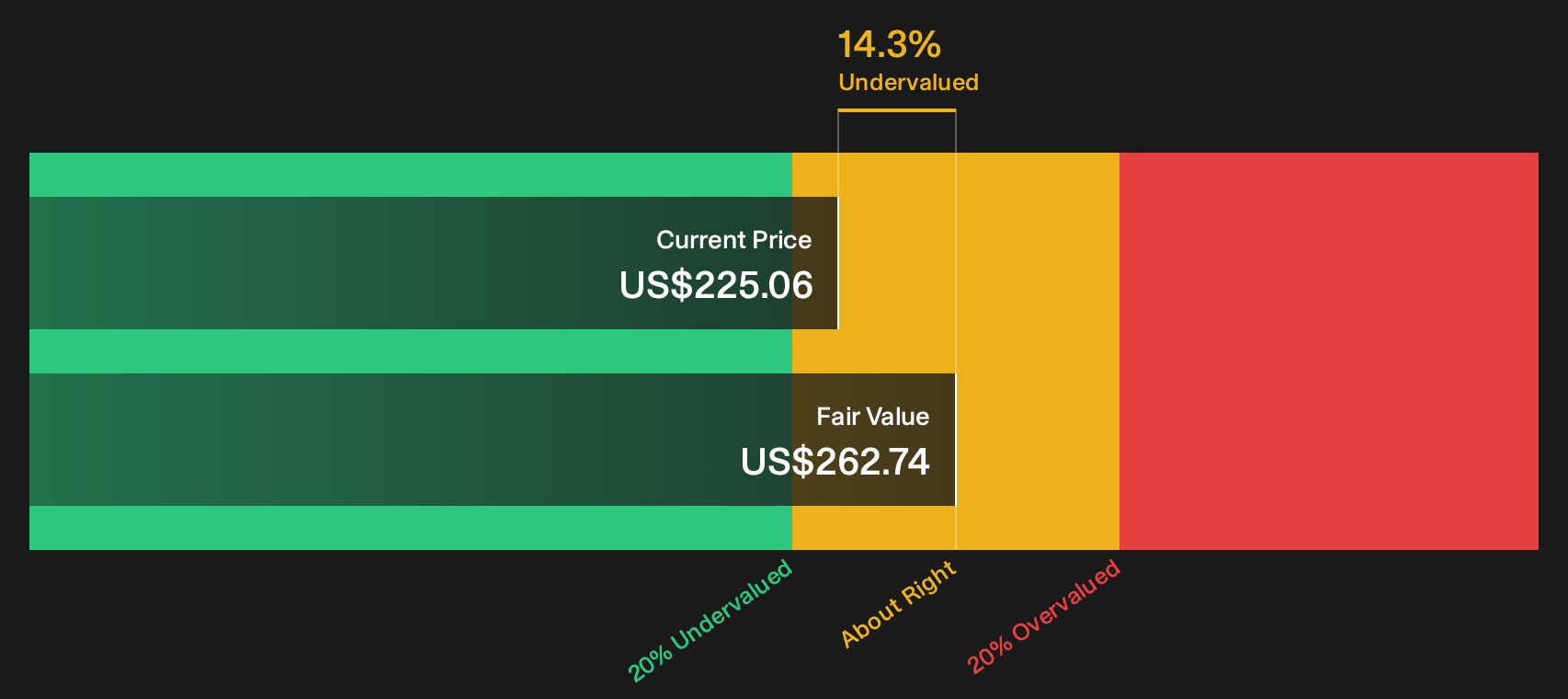
Simply Wall St performs a discounted cash flow (DCF) on every stock in the world every day (check out Erie Indemnity for example). We show the entire calculation in full. You can track the result in your watchlist or portfolio and be alerted when this changes, or use our stock screener to discover 51 high quality undervalued stocks. If you save a screener we even alert you when new companies match - so you never miss a potential opportunity.
Next Steps
With sentiment looking mixed, this is a good time to review the numbers yourself and decide how convincing the story really feels. To see what the market currently views as potential positives, take a closer look at the 2 key rewards.
Looking for more investment ideas?
If Erie Indemnity has raised new questions for your portfolio, treat this as your cue to expand your radar with a few focused stock ideas.
- Target resilient income potential by checking companies offering reliable payouts and strong yields through the 10 dividend fortresses.
- Hunt for quality at a reasonable price by scanning companies that look mispriced on fundamentals using the 51 high quality undervalued stocks.
- Prioritize peace of mind by reviewing companies with sturdier finances and lower risk profiles via the 67 resilient stocks with low risk scores.
This article by Simply Wall St is general in nature. We provide commentary based on historical data and analyst forecasts only using an unbiased methodology and our articles are not intended to be financial advice. It does not constitute a recommendation to buy or sell any stock, and does not take account of your objectives, or your financial situation. We aim to bring you long-term focused analysis driven by fundamental data. Note that our analysis may not factor in the latest price-sensitive company announcements or qualitative material. Simply Wall St has no position in any stocks mentioned.