
Europe in Review: Aluminum Prices Climb, EU Confidence Falls, Inflation Up on Mideast War
As conflict in the Middle East intensifies, Europe faces fresh economic strain, political backlash, and supply‑chain disruption. This week's briefing breaks down the pressure points, from surging aluminum prices to shifting public sentiment and hardening migration policy, impacting the region this week.
Weekly Chart: Aluminum Supplies Are The Latest Casualty of War
Aluminum production has become another victim of the war in the Middle East. Prices could rise to record levels after Iran struck Middle Eastern smelters, threatening a supply crisis. Over the weekend, Iran reportedly attacked Emirates Global Aluminum PJSC and state-run Aluminum Bahrain. Emirates Global said it sustained "significant damage" to its plant in Abu Dhabi.
The Middle East accounts for approximately 9% of the global metal output, used in airplanes, food packaging, and solar panels, Bloomberg reported on Monday. Aluminum futures in the UK jumped more than 3.9% to $3,403/ton, hovering near their highest level in four years. A sustained price spike would heap further pressure on manufacturers already reeling from the surge in energy costs.
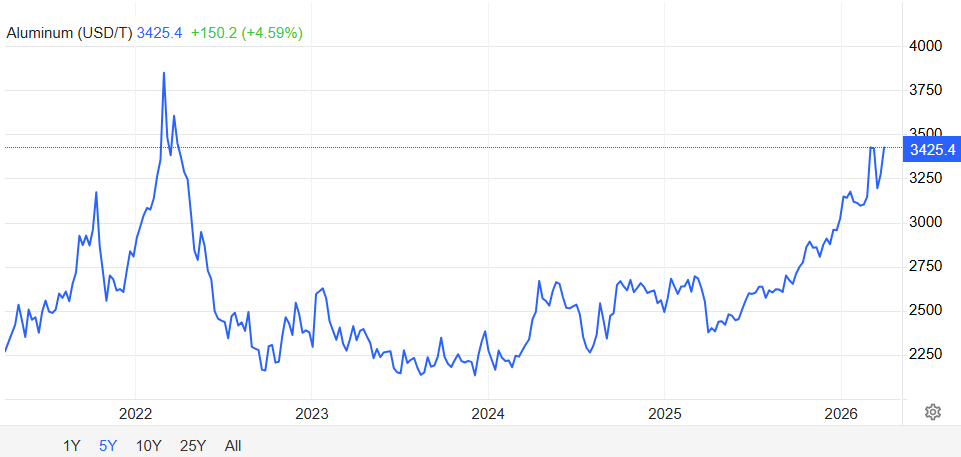
Aluminum Futures, source: TradingEconomics
"The aluminum supply chain has entered a new phase of disruption," AZ Global Consulting said in a note after the attacks. "We will wait to hear from both companies, but it is clear the system is now exposed to sudden production loss, not just gradual constraint."
EU, Euro Area Consumer Confidence Plunges
The consumer confidence indicator in March plummeted in the European Union (EU) by 3.4 percentage points, compared to February. It fell 4.0 percentage points in the euro area. At -15.2 (EU) and -16.3 (euro area) points, consumer confidence scores fell below their long-term averages. They reached their lowest level since October 2023, the European Commission said on March 23.
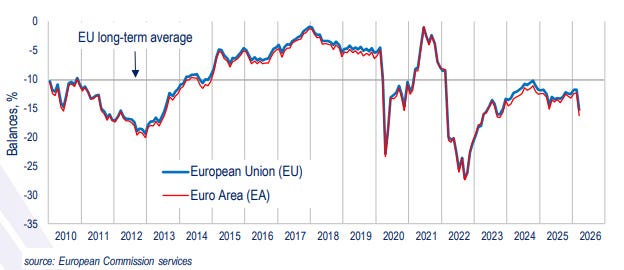
Why it matters: An aluminum supply shock will threaten the euro area with higher input costs and production delays. The region relies heavily on imported aluminum for autos, packaging, and green technology. Sustained record‑high prices would squeeze European manufacturers' margins and slow investment. They will also raise end‑product inflation, especially for transport and energy‑transition hardware.
Higher prices will likely impact business and consumer confidence in Europe's biggest economy. Germany's Ifo Business Climate Index dropped on Wednesday to 86.4 in March. Germany's GfK Consumer Climate Indicator fellto –28 heading into April, the weakest reading since March 2024.
"Uncertainty among companies has increased noticeably," Clemens Fuest, president of the ifo Institute, said. "The war in Iran has put any hope of a recovery on ice for the time being. Expectations, in particular, have declined significantly. The companies also assessed their current situation less favorably. Energy-intensive industries are most affected."
Stock in Focus: Norsk Hydro Hits 52-Week High
Norsk Hydro (NHY.OL) traded sharply higher on Monday, reflecting the aluminum‑shortage theme. The stock rose more than 9.3% today and is up 29% year-to-date. The share price reached a 52-week high, as investors factor in higher aluminum prices and the Middle East-driven supply squeeze.
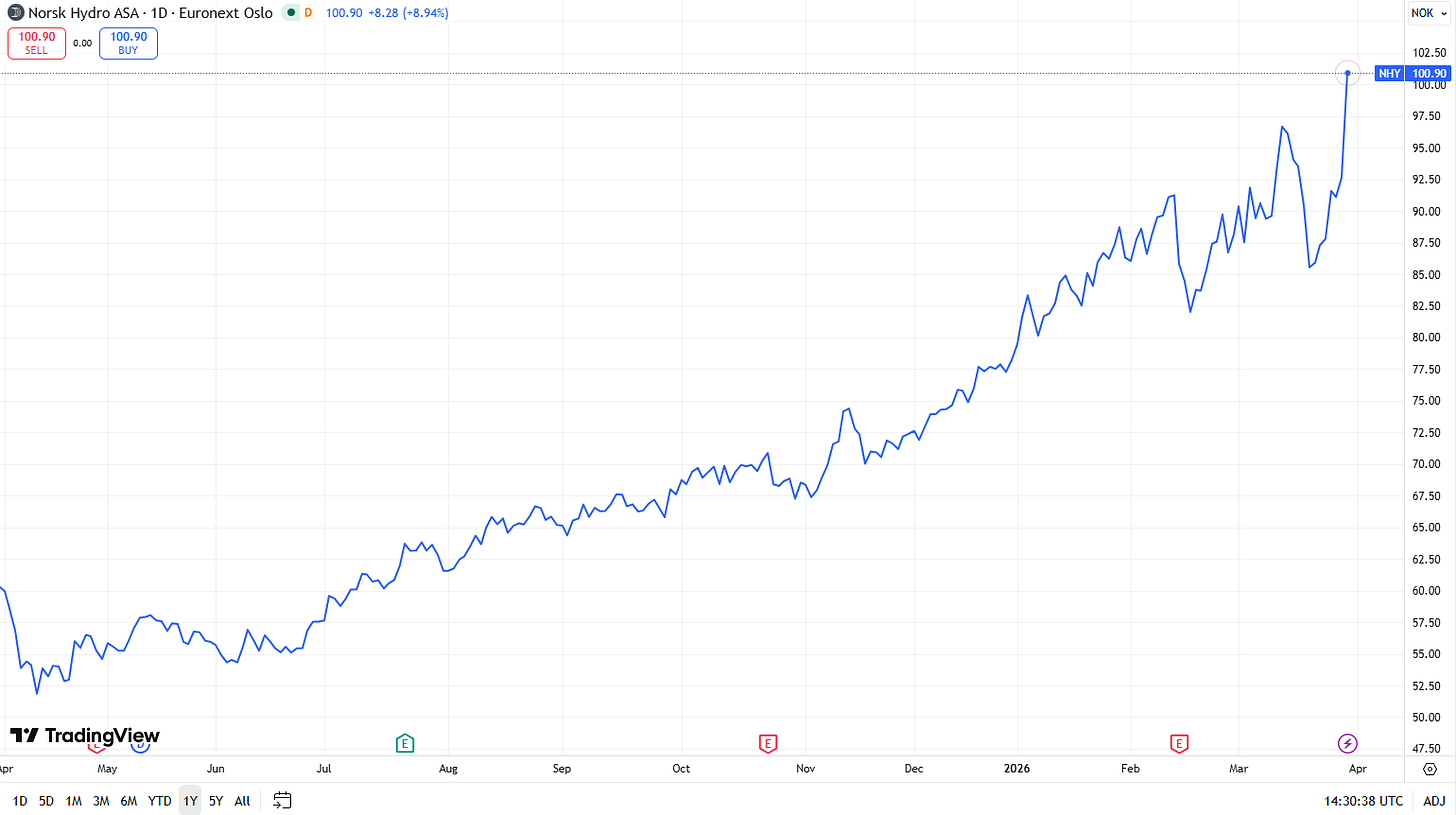
Source: TradingView
Norsk Hydro announced on March 3 a controlled shutdown of aluminum production at its joint venture Qatalum in Qatar. The company expected the controlled shutdown of the Qatalum smelter to be completed by the end of March.
Following confirmation from Qatalum's gas supplier that it will maintain supply at reduced levels, Qatalum decided on March 12 to halt further curtailment and maintain aluminum production at around 60% capacity. Qatalum is a 50/50 joint venture owned by Norsk Hydro and Qatar Aluminum Manufacturing Co. The plant has a nameplate capacity of 648,000 metric tons of primary aluminum.
Data This Week: Euro Area Sentiment, German Prices
Euro Area:
- Economic Sentiment Indicator (Monday): 96.6 (March) vs 98.2 (February)
- Consumer Price Trend (Monday): 43.4 (March) vs 26.2 (February)
- Industrial confidence indicator (Monday): -7.0 (March) vs -7.2 (February)
- Annual inflation rate (Tuesday): Previous reading 1.9% (February)
- Unemployment Rate (Wednesday): Previous reading 6.1% (January)
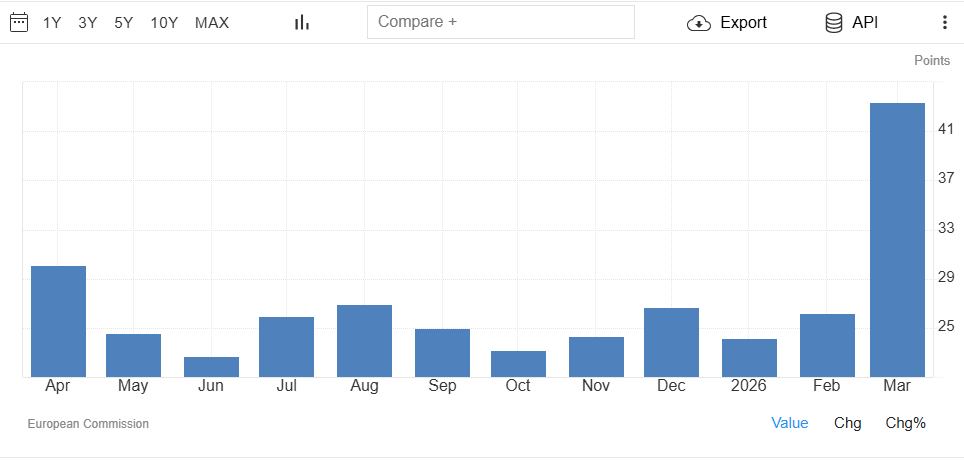
Consumer Price Trend, source: TradingEconomics
France:
- Annual inflation (Tuesday): Previous reading 0.9% (February)
- EU-harmonized annual inflation rate (Tuesday) Previous reading 1.1% (February)
- State Budget (Wednesday): Previous reading -€9.7B (January)
- Industrial Production MoM (Friday): Previous reading 0.5% MoM (January)
Germany:
- Annual inflation rate YoY (Monday): 2.7% (March) vs 1.9% (February)
- EU-harmonized annual inflation rate in Germany YoY (Monday): 2.8% (March) vs 2% (February)
- Retail Sales YoY (Tuesday): Previous reading 1.2% (January)
- Seasonally adjusted unemployment rate (Tuesday): Previous reading 6.3% (February)
United Kingdom:
- Nationwide House Price Index YoY (Tuesday): Previous reading 1% (February)
- Business investment QoQ (Tuesday): Previous reading 2.5% QoQ (December)
Why it matters: The drop in the Economic Sentiment Indicator shows that overall business and consumer confidence in Europe's near‑term outlook has weakened. The reading is still technically above the very low levels seen during the pandemic or energy‑crisis troughs. It is another example of how the Middle East conflict is feeding into Europe's outlook. The sharp rise in the consumer price trend signals a significant deterioration in what households think will happen to prices ahead.
Geopolitics: Trump Ramps Up Criticism of European Allies
US President Trump has increased his criticism of European leaders for refusing to help keep open the Strait of Hormuz. On Friday, he reiterated his disappointment with NATO allies over their refusal to send military forces to help. He said Washington may not help them in the future if asked to do so.
"They just weren't there," he said at an investment forum in Miami. "We spend hundreds of billions of dollars a year on NATO, protecting them, and we would have always been there for them, but now, based on their actions, I guess we don't have to be, do we?"
US Secretary of State Marco Rubio also weighed in when asked about European support.
"The observation is that the US is constantly being asked to help in a war, and we have done more than any other country in the world, in a war that's happening on another continent, in Ukraine," Rubio said. "It was a couple of leaders in Europe who said that this was not Europe's war. Well, Ukraine is not America's war, and yet we've contributed more to that fight than any other country in the world."
Domestic Opposition
For European leaders, the conflict in the Middle East has caused domestic political opposition. In Italy, Prime Minister Giorgia Meloni lost a referendum to overhaul the judicial system due to the perception that she is close to Trump, the New York Times reported on Thursday. In France, the far‑left party France Unbowed made gains in mayoral elections this month because of its opposition to the US‑Israeli war in Iran.
British Prime Minister Keir Starmer, whom Trump has attacked for his refusal to support the war effort, has taken into account the public's opposition to the war. About 59% of the British public is against the war, according to YouGov. Trump's net popularity in the UK is currently around -65, according to polling from January.
Why it matters: President Trump's criticism will further fray ties between Washington and European leaders. Relations are likely to enter a period of sharper tension and reduced trust. It reinforces Washington's long‑standing belief that NATO burden‑sharing is fundamentally unbalanced. The public nature of Trump's criticism, combined with Europe's firm "this is not our war" stance, sets up a confrontation that touches NATO solidarity, energy security, and the politics of Ukraine support.
Policy Moves: Tough Immigration Rules
The European Parliament on Thursday approved new legislation designed to accelerate the removal of irregular migrants. The new rules will enable the creation of deportation facilities outside EU territory, Euronews reported. The measure, paired with tougher enforcement rules, underscores a broader political shift as Europe moves to the right.
The law extends the maximum detention period for migrants to up to two years. It allows EU countries to impose effectively open‑ended entry bans on those who are returned. Brussels views the new "return regulation" as central to boosting the number of people repatriated after being denied the right to stay.
Meanwhile, Denmark's Prime Minister Mette Frederiksen, who is set for a third term after Tuesday's elections, has pushed for the establishment of return hubs outside the EU. She has spearheaded the push for more deportations and efforts to rein in the European Court of Human Rights. Frederiksen has pulled traditionally hardline migration policies into the mainstream discourse both at home and abroad. Her tough migration stance is likely to remain intact even if a left‑leaning coalition emerges, Euractiv reported.
Why it matters: Europe may be undergoing a structural shift toward more restrictive migration politics. The European Parliament's approval demonstrates a shift from the political center. The vote is a redefinition of what is considered "mainstream" in European migration policies.
Disclaimer: Any opinions expressed in this article are not to be considered investment advice and are solely those of the authors. European Capital Insights is not responsible for any financial decisions made based on the contents of this article. Readers may use this article for information and educational purposes only.
Benzinga Disclaimer: This article is from an unpaid external contributor. It does not represent Benzinga’s reporting and has not been edited for content or accuracy.