

Exxon Mobil And 2 US Stocks With Fuel Cost And Debt Risk
Exxon Mobil Corporation XOM | 0.00 |
Energy costs are jumping, inflation is holding at 4.2%, and the US Federal Reserve has kept rates at 3.5 to 3.75%, which leaves some stocks directly in the crosshairs of these pressures. For investors, this mix of sticky inflation, an energy crunch tied to the war in Iran, and uncertainty around future Fed policy can create both risk and opportunity. This article breaks down three stocks exposed to the current news backdrop, with one that could benefit from higher energy prices and two that may struggle as fuel and financing costs squeeze profit margins.
United Airlines Holdings (UAL)
Overview: United Airlines Holdings is a major US airline group that transports passengers and cargo across the United States, Canada, the Atlantic, the Pacific, and Latin America, while also offering loyalty programs, ground handling, training, and aircraft maintenance services for itself and third parties.
Operations: United Airlines generates essentially all of its US$60.5b in revenue from airline transportation, with around US$35.8b from the United States and Canada and the rest split across the Atlantic (US$12.0b), Pacific (US$7.1b), and Latin America (US$5.5b).
Market Cap: US$38.4b
United Airlines Holdings may look appealing with a relatively low P/E multiple, strong recent revenue and earnings figures, and a push into higher margin premium products, but the context is heavy fuel and financing headwinds. Management itself flags sharply elevated fuel prices, with the current fuel bill described as billions of dollars above 2019 levels. This comes at a time when the Fed is holding rates at 3.5 to 3.75% and inflation is stuck at 4.2%. High debt, rich executive pay, insider selling, and ambitions for double digit margins all sit uncomfortably against this backdrop, leaving investors to decide whether United’s premium growth story is enough to compensate for rising costs and financial risk.
United Airlines’ push for premium growth may be colliding with rising fuel and financing costs, high debt, and insider selling, so it is worth seeing how these pressures show up in the 2 warning signs

Delta Air Lines (DAL)
Overview: Delta Air Lines provides passenger and cargo flights across the United States and key international hubs, and also offers aircraft maintenance, repair, and vacation packages supported by a fleet of around 1,314 aircraft.
Operations: Delta Air Lines generates about US$59.5b from its Airline segment and US$7.3b from its Refinery segment, partially offset by US$1.6b of intersegment sales and other items.
Market Cap: US$55.0b
Delta Air Lines sits at the center of today’s energy and inflation story, with a business model that depends heavily on jet fuel at a time when supply disruptions linked to the war in Iran have pushed fuel prices sharply higher and inflation is still at 4.2% while the Fed holds rates at 3.5 to 3.75%. Management is cutting capacity and trying to protect margins and cash flow, but the company carries high debt, faces higher funding costs in a world of elevated rates, and has seen insider selling even as it leans into premium products and aircraft upgrades. For investors, the open question is whether Delta’s premium demand, refinery economics, and brand strength truly offset rising fuel and financing risks, or if earnings quality is masking growing pressure on the balance sheet.
Delta Air Lines is leaning into premium upgrades while fuel and debt costs keep climbing, so the real tension sits on its balance sheet and funding risk profile, not today’s headline earnings. Before you assume the story holds together, scan the Delta Air Lines financial health report

Exxon Mobil (XOM)
Overview: Exxon Mobil is a large integrated energy company that explores for and produces oil and gas, refines fuels, manufactures chemicals and specialty products, and sells energy solutions, including lower emission options, under the Exxon, Esso, and Mobil brands around the world.
Operations: Exxon Mobil generates most of its revenue from Energy Products and Upstream, with around US$122.1b from Energy Products in the United States, US$173.6b from Energy Products outside the United States, and a combined US$101.8b from Upstream, alongside smaller contributions from Chemical and Specialty Products segments, partly offset by US$124.7b of intersegment eliminations.
Market Cap: US$571.1b
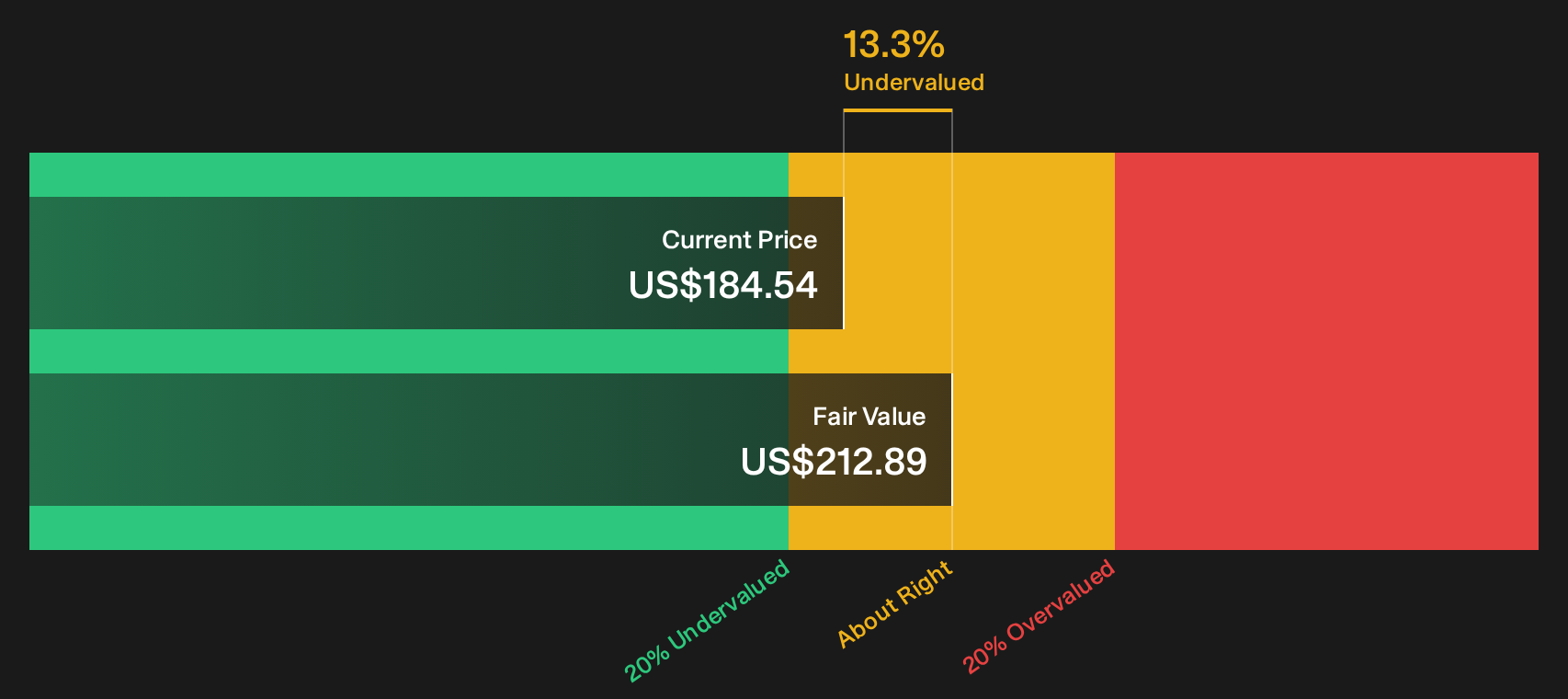
Exxon Mobil sits at the heart of today’s energy story, with a large, integrated portfolio that can benefit when supply disruptions in the Middle East keep oil prices elevated. Its low cost projects in places like Guyana and the Permian are framed as capable of supporting cash generation through volatile cycles. At the same time, investors need to weigh a richer P/E, pressure on profit margins, reliance on external borrowing, and a dividend that is not fully covered by free cash flow against analyst expectations for earnings growth and upside to fair value estimates. The company is also pushing into LNG, lower emission projects, and new geographies, which could matter far more for long term value than many headline oil price moves suggest.
Exxon Mobil’s integrated oil, gas, and lower emission projects story is often framed around headline prices. However, the real twist lies in how its portfolio, cash flows, and risks line up in the analysis report for Exxon Mobil
Take Control of Your Investment Journey
If Delta Air Lines or any of these companies have caught your attention, register for FREE with Simply Wall St and add your companies to a Watchlist to monitor the share price against the fair value and track any new developments as they happen. Once you've made your move, manage your holdings with our Portfolio Command Center that filters out the noise to deliver only the most critical, actionable updates. Throughout your journey, our Community allows you to filter the best ideas from thousands of investor perspectives. By uncovering hidden catalysts and risks early, you'll accelerate your decision-making and stay one step ahead of the market.
Seeking Fresh Alternatives Before They Fly
Some stocks are already building breakout momentum while others stay under the radar for now. Pricing can shift fast before the crowd catches on, so consider researching potential opportunities promptly.
- Spot underfollowed opportunities early by scanning the 19 high quality undiscovered gems, curated to highlight companies with strong fundamentals before they get fully caught by the market.
- Target resilient cash generators by reviewing the 8 dividend fortresses, built to surface companies aiming to pair higher yields with balance sheet strength while it still matters.
- Position ahead of the next AI infrastructure trend by assessing the 49 AI infrastructure stocks, featuring businesses tied to the hardware and networks that keep data flowing.
This article by Simply Wall St is general in nature. We provide commentary based on historical data and analyst forecasts only using an unbiased methodology and our articles are not intended to be financial advice. It does not constitute a recommendation to buy or sell any stock, and does not take account of your objectives, or your financial situation. We aim to bring you long-term focused analysis driven by fundamental data. Note that our analysis may not factor in the latest price-sensitive company announcements or qualitative material. Simply Wall St has no position in any stocks mentioned.