

FedEx (FDX) Stock Looks Supported By Cash Flow As A 64% Run Tests Value
FedEx Corporation FDX | 0.00 |
FedEx stock has delivered a 64.0% return over the past year, and at a last close of US$314.96 both the Discounted Cash Flow (DCF) intrinsic value estimate and earnings multiples currently point to the shares trading at a discount, raising the question of how much of that gap really reflects mispricing rather than optimism about the business.
- FedEx's 64.0% 1 year return suggests investors have repriced the stock significantly higher, even as valuation models still indicate room between the current price and intrinsic value.
- The newly announced 2026 peak season surcharges can support margins and cash flow if parcel volumes hold up, while pressure on ecommerce customers from higher delivery costs may limit how much pricing power FedEx can sustain over time.
- The company scores 4 out of 6 on broader valuation checks, which is a mixed picture rather than a straightforward bargain or clear overvaluation.
The stock's next move may depend on whether FedEx's earnings and cash generation are strong enough to justify what the Discounted Cash Flow (DCF) and multiple based estimates are currently implying about its intrinsic value.
Is FedEx Still Cheap on Cash Flow?
The Discounted Cash Flow (DCF) model here is based on FedEx’s projected free cash generation over time. On the latest twelve-month figures, FedEx produced about $4.4b of free cash flow, and the model assumes these cash flows continue growing rather than shrinking, which supports a higher estimate of what the business could be worth in aggregate.
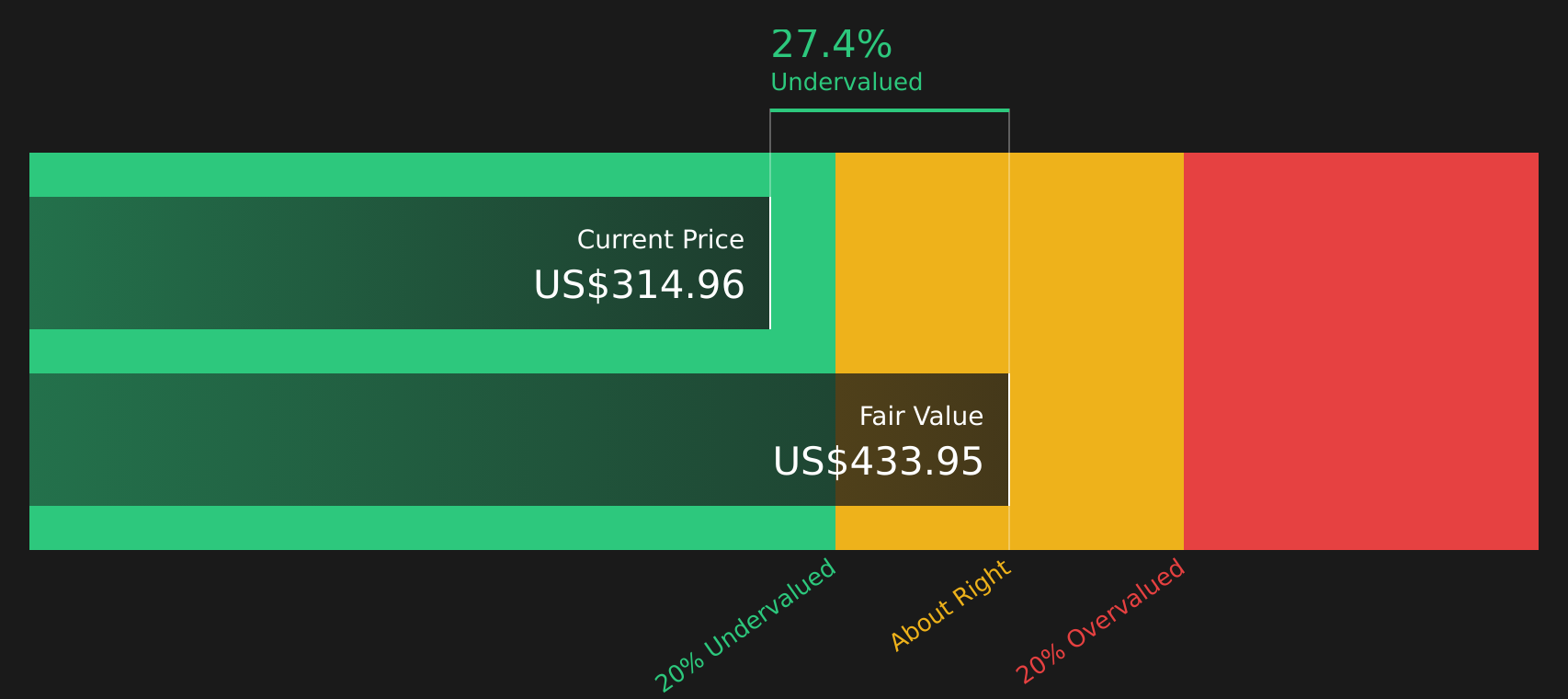
On these assumptions, the DCF points to an intrinsic value of about $434 per share, compared with the recent share price around $314, implying the stock screens as roughly 27.4% undervalued. FedEx’s newly announced 2026 peak season surcharges help explain why the market might be granting more credit to its cash flow outlook, even if the DCF suggests there is still a gap between price and intrinsic value.
On this cash flow view, FedEx stock currently looks undervalued relative to its estimated intrinsic value.
Our Discounted Cash Flow (DCF) analysis suggests FedEx is undervalued by 27.4%. Track this in your watchlist or portfolio, or discover 49 more high quality undervalued stocks.
Does FedEx Look Undervalued on Earnings?
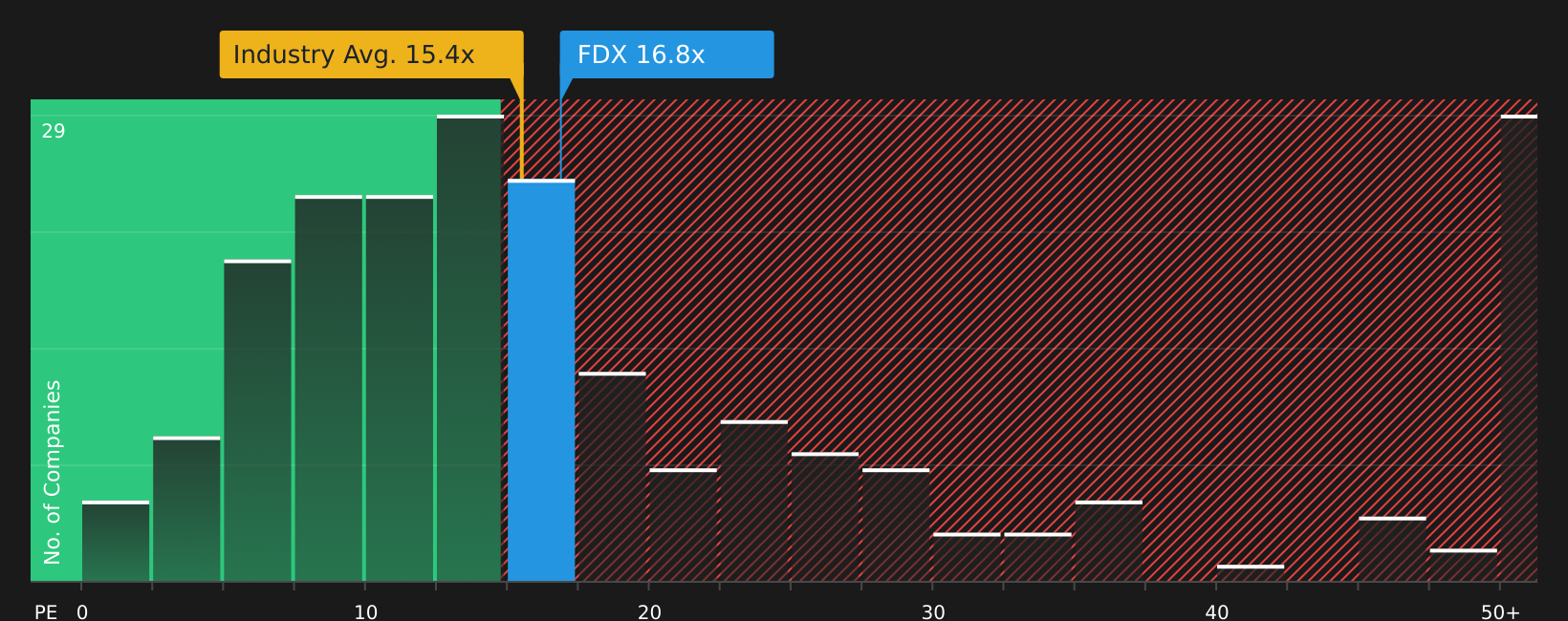
P/E is a useful check for FedEx because earnings are a key driver for a mature, cash generative logistics business. FedEx currently trades on a P/E of about 16.8x, compared with an industry average around 15.4x and a peer average near 24.0x, so it sits modestly above the broader logistics group but below many direct peers.
The tailored fair P/E ratio for FedEx is estimated at 23.0x, which is higher than the present 16.8x level. This suggests the stock trades at a discount to what this framework implies for its earnings, margins, size and risk profile. The gap between the current P/E and that fair ratio indicates investors are paying less for each dollar of FedEx earnings than this model would usually ascribe to a company with similar characteristics.
On the P/E multiple, FedEx stock currently screens as undervalued relative to the earnings-based fair ratio estimate.
The FedEx Narrative: What Would Justify Today's Price?
FedEx's recent share price and valuation gap sets up the role of Simply Wall St Narratives, which link that puzzle to the specific assumptions about future growth, margins and earnings that would need to hold for the stock to be worth materially more or less than it is today. These narratives are available on the company's Community page.
Each narrative ties a fair value to a clear storyline about FedEx's potential catalysts and risks, so you can follow which version of events appears to be unfolding over time.
The community is split on FedEx, with one camp seeing meaningful upside in the transformation story and another arguing the stock already reflects too much optimism.
Bull case: 10% undervalued
"FedEx's DRIVE initiative is achieving significant cost savings, with a target of $2.2 billion for FY '25 and a total of $4 billion compared to the FY '23 baseline..."
Bear case: 42% overvalued
"Structural declines in parcel volumes, rising labor and environmental costs, and intensifying price competition threaten long-term revenue growth and margin sustainability..."
Do you think there's more to the story for FedEx? Head over to our Community to see what others are saying!
The Bottom Line
FedEx screens as undervalued on both the Discounted Cash Flow (DCF) intrinsic value estimate and the earnings multiple view, which is an encouraging alignment rather than a conflicting signal. The mixed broader valuation checks suggest treating that discount as a potential opportunity but not a free lunch, especially given the debates around parcel demand, pricing power and cost pressures. What really decides it from here is whether FedEx can sustain cash generation and margins at the level implied by the intrinsic value estimate, without eroding volume or customer goodwill through higher delivery costs.
This article by Simply Wall St is general in nature. We provide commentary based on historical data and analyst forecasts only using an unbiased methodology and our articles are not intended to be financial advice. It does not constitute a recommendation to buy or sell any stock, and does not take account of your objectives, or your financial situation. We aim to bring you long-term focused analysis driven by fundamental data. Note that our analysis may not factor in the latest price-sensitive company announcements or qualitative material. Simply Wall St has no position in any stocks mentioned.