

First Busey (BUSE) On Its Fresh Preferred Dividend And A Valuation That Looks About Right
First Busey Corporation BUSE | 0.00 |
First Busey (BUSE) recently declared a quarterly cash dividend of $0.515625 per depositary share on its 8.25% Fixed-Rate Series B Non-Cumulative Perpetual Preferred Stock, with payment scheduled for September 1, 2026.
At a share price of US$30.21, First Busey has seen a 90 day share price return of 11.56% and a year to date share price return of 26.40%, while the 1 year total shareholder return of 35.55% and 3 year total shareholder return of 68.34% point to momentum that has held up over longer periods.
If this kind of steady progress interests you, it may be a good moment to broaden your watchlist and check out 21 top founder-led companies
After First Busey’s strong recent run and a fresh preferred dividend declaration, the next question is simple: Does today’s price already reflect that progress, or does the current valuation still leave room to be patient?
Price-to-Earnings of 11.8x: Is it justified for First Busey?
On a P/E of 11.8x, First Busey is priced below the peer average of 14x, which suggests the market is paying less for each dollar of its current earnings than for comparable banks.
The P/E ratio compares the share price to earnings per share and is a common yardstick for bank stocks because earnings are a key driver of long term value. For First Busey, the recent improvement in earnings quality and profit margins, along with solid 1 year and 3 year total returns, helps explain why investors may focus closely on this earnings based yardstick.
Compared with the wider US Banks industry, First Busey also trades around the sector average P/E of 11.8x. However, the estimated fair P/E ratio for the company is 11.2x. That suggests the market is placing a modest premium over the level the SWS fair ratio points to, and it could shift closer to that level if sentiment cools or earnings expectations change.
Result: Price-to-Earnings of 11.8x (ABOUT RIGHT)
However, the recent slide over the past week and the reliance on US banking and payment activity mean that shifts in credit quality or loan demand could quickly test that valuation story.
Another View on First Busey’s Valuation
While the current P/E of 11.8x makes First Busey look roughly in line with peers, the SWS DCF model points to a different picture. At a current share price of $30.21 versus an estimated future cash flow value of $50.38, the stock screens as materially undervalued. Which signal do you trust more?
For a closer look at how this cash flow based view is built, including the assumptions behind it, you can review Look into how the SWS DCF model arrives at its fair value.
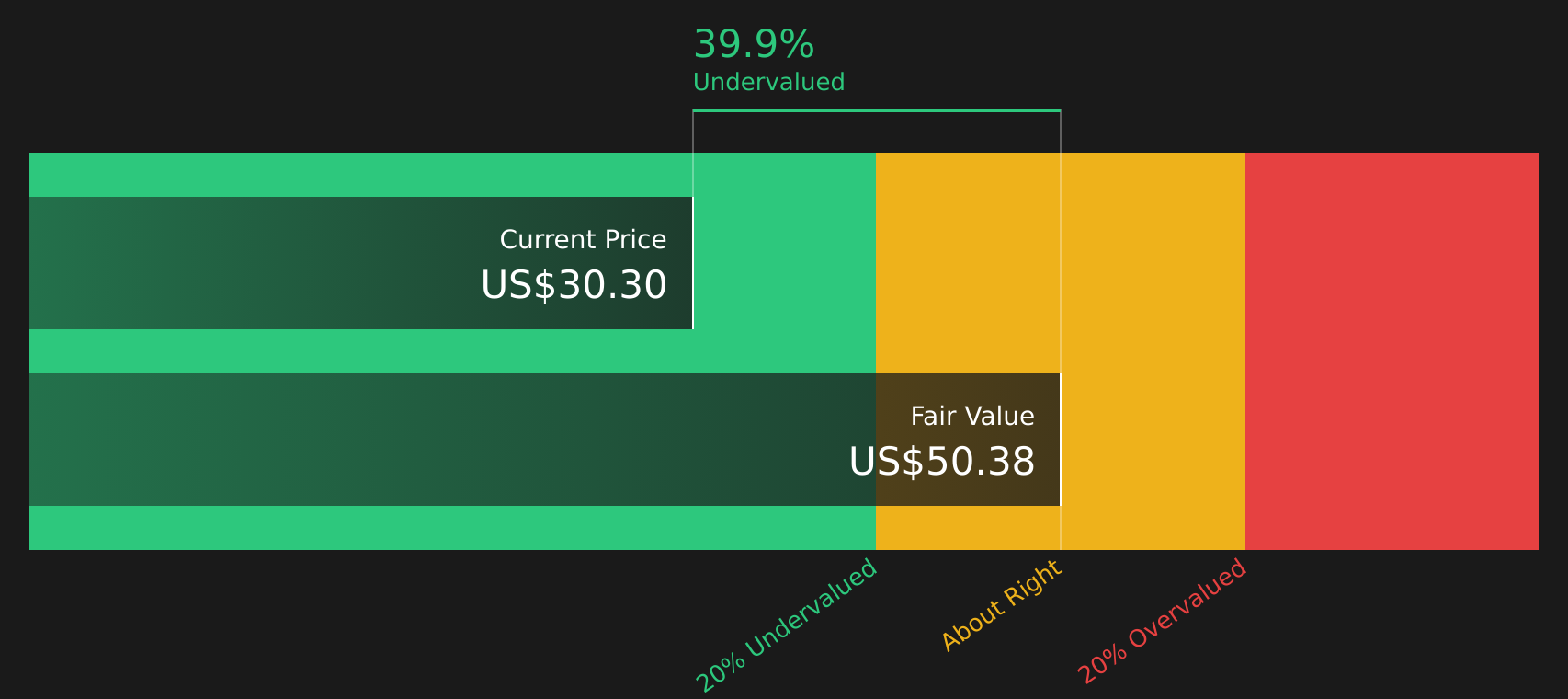
Simply Wall St performs a discounted cash flow (DCF) on every stock in the world every day (check out First Busey for example). We show the entire calculation in full. You can track the result in your watchlist or portfolio and be alerted when this changes, or use our stock screener to discover 50 high quality undervalued stocks. If you save a screener we even alert you when new companies match - so you never miss a potential opportunity.
Next Steps
If this First Busey story feels mixed to you, that is exactly why now is a useful time to look at the numbers yourself and stress test the assumptions. To see what investors are currently optimistic about, review the 3 key rewards.
Looking for more investment ideas beyond First Busey?
If you want to build on what you have learned about First Busey, now is the moment to widen your search before potential opportunities move out of reach.
- Scan for quality at a discount by reviewing companies that currently screen as attractively priced on earnings, cash flows, and balance sheet strength through the 50 high quality undervalued stocks.
- Strengthen your income stream and see which companies offer higher yields with balance sheets that support ongoing payouts inside the 12 dividend fortresses.
- Dial back portfolio risk and focus on companies with resilient fundamentals by filtering through the 79 resilient stocks with low risk scores.
This article by Simply Wall St is general in nature. We provide commentary based on historical data and analyst forecasts only using an unbiased methodology and our articles are not intended to be financial advice. It does not constitute a recommendation to buy or sell any stock, and does not take account of your objectives, or your financial situation. We aim to bring you long-term focused analysis driven by fundamental data. Note that our analysis may not factor in the latest price-sensitive company announcements or qualitative material. Simply Wall St has no position in any stocks mentioned.