

First Busey (BUSE) Stock Could Be 44% Below Fair Value After Recent Run
First Busey Corporation BUSE | 0.00 |
First Busey (BUSE) drew fresh attention after recent trading left the stock at a last close of $28.23. This prompted investors to reassess its performance and business mix across banking, wealth management, and payments.
First Busey’s recent 4.25% 1 month share price return and 18.12% year to date share price return, alongside a 31.56% 1 year total shareholder return, suggests momentum has been building as investors reassess its risk and income profile.
If you are scanning the market for what else might be gaining interest, this is a good moment to broaden your search with 20 top founder-led companies
With First Busey trading near its analyst price target yet screening with an intrinsic discount, the key question is whether the current valuation leaves meaningful upside on the table or if the market is already pricing in future growth.
Preferred Price-to-Earnings of 11.9x: Is it justified?
On current figures, First Busey trades on a P/E of 11.9x, which sits close to the wider US Banks industry at 11.9x and a touch above its estimated fair P/E of 11.2x.
The P/E multiple links the $28.23 share price to the earnings that support it, so it is a quick way to see how much investors are paying for each dollar of profit in a bank like First Busey.
Here, the market is assigning First Busey a slightly richer tag than the 11.2x level suggested by the fair ratio, and also a discount to the 13.8x peer average. This can indicate that expectations for future earnings are more restrained than for peers, while still leaving room for the valuation to drift toward that fair ratio level if sentiment tightens around those earnings assumptions.
Compared with the broader US Banks industry on 11.9x, First Busey’s multiple is effectively in line. Yet the fair P/E of 11.2x implies the stock is trading a little above where the regression based assessment suggests it might settle if pricing fully reflected those modeled fundamentals.
Result: Preferred multiple of price-to-earnings of 11.9x (ABOUT RIGHT)
However, if First Busey’s earnings or credit quality fall short of expectations, or if its payments and wealth management segments underperform, that P/E premium could quickly unwind.
Another View: What Does the DCF Say About First Busey?
While the P/E suggests First Busey is only slightly rich compared with its fair ratio, the SWS DCF model paints a very different picture. With the stock at $28.23 against an estimated future cash flow value of $50.17, it screens as heavily undervalued on this measure.
That gap raises a key question for you as an investor: is the market too cautious about First Busey’s future cash generation, or is the DCF model building in assumptions that will prove too optimistic over time?
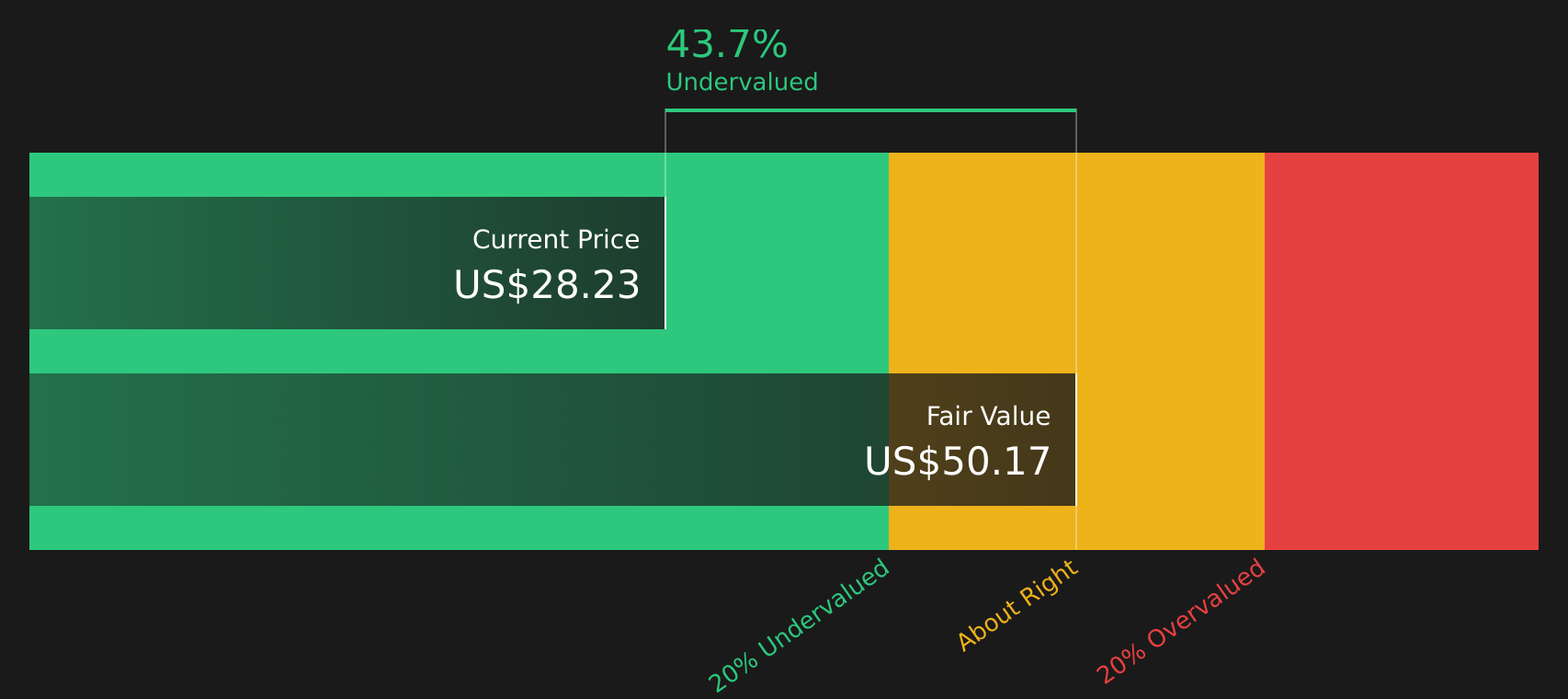
Simply Wall St performs a discounted cash flow (DCF) on every stock in the world every day (check out First Busey for example). We show the entire calculation in full. You can track the result in your watchlist or portfolio and be alerted when this changes, or use our stock screener to discover 45 high quality undervalued stocks. If you save a screener we even alert you when new companies match - so you never miss a potential opportunity.
Next Steps
If this mix of signals on First Busey leaves you unsure, move quickly to check the underlying drivers and pressure test your own thesis. To understand what optimistic investors see in the stock, take a closer look at its 4 key rewards
Looking for more investment ideas beyond First Busey?
If First Busey has sharpened your focus on valuation and quality, now is the time to widen your watchlist with fresh ideas across sectors and styles.
- Target potential mispricings by scanning 45 high quality undervalued stocks that pair solid fundamentals with room for sentiment to shift.
- Strengthen your income stream by reviewing 8 dividend fortresses that combine higher yields with resilience in their payouts.
- Protect your downside by zeroing in on 65 resilient stocks with low risk scores that score well on balance sheet strength and risk factors.
This article by Simply Wall St is general in nature. We provide commentary based on historical data and analyst forecasts only using an unbiased methodology and our articles are not intended to be financial advice. It does not constitute a recommendation to buy or sell any stock, and does not take account of your objectives, or your financial situation. We aim to bring you long-term focused analysis driven by fundamental data. Note that our analysis may not factor in the latest price-sensitive company announcements or qualitative material. Simply Wall St has no position in any stocks mentioned.