

FIS Stock Could Gain From UK Banking Consolidation
Fidelity National Information Services, Inc. FIS | 0.00 |
Nationwide’s £2.9b takeover of Virgin Money and the decision to cut 600 overlapping roles has put a fresh spotlight on what banking consolidation really means for investors. Cost synergies, branch commitments through 2030 and a bigger push into business banking could reshuffle where value sits across UK retail finance and the companies that supply it with technology and outsourced services. This article picks out three UK banking consolidation impact stocks and efficiency plays from the screener, showing how one stock could benefit from the shift and why two others may face tougher questions after the news.
Fidelity National Information Services (FIS)
Overview: Fidelity National Information Services (FIS) provides the core software and payment plumbing that banks, lenders, wealth managers and capital markets firms use for everyday operations, from mobile banking and card processing to risk management and trading systems.
Operations: FIS generates most of its revenue from Banking Solutions at about US$8.0b, with Capital Market Solutions contributing around US$3.2b and Corporate and Other around US$0.2b, across roughly US$8.9b from North America and US$2.6b from other regions.
Market Cap: US$19.9b
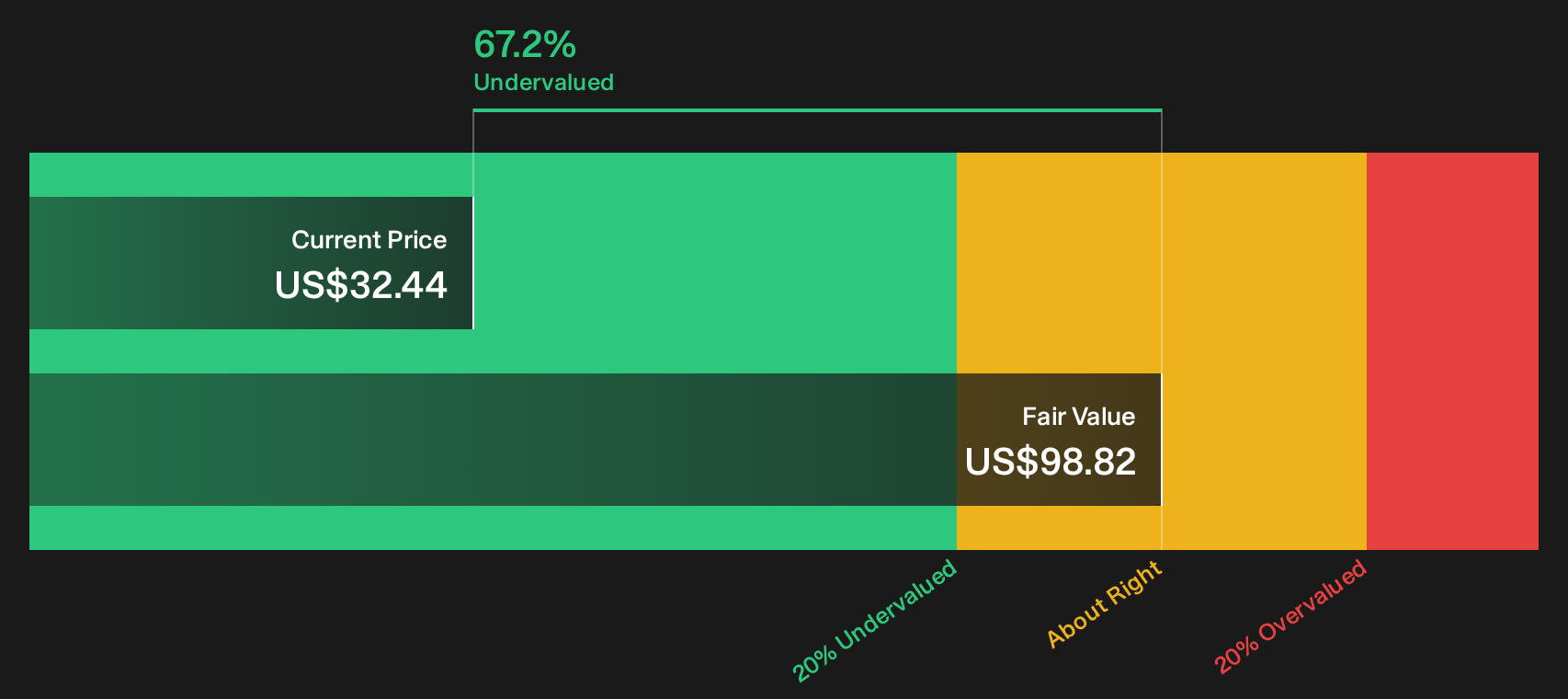
FIS operates in the slipstream of bank consolidation, which is front and center after Nationwide’s Virgin Money deal. Larger combined banks often look to simplify tech stacks, outsource more of their back office and upgrade risk controls. With a suite that spans digital banking, payments and AI powered risk and compliance, plus partnerships in lending and wealth management, FIS may appeal to clients seeking cost efficiencies and automation. The stock trades on a low P/E and has been described as trading below some fair value estimates, yet there are ongoing questions around debt, one off charges and analyst forecasts for earnings to soften in coming years. This leaves investors balancing potential opportunity against execution risk.
Fidelity National Information Services sits at the crossroads of bank consolidation and automation. However, the full picture of its cost opportunities and execution questions is not obvious from the headline numbers alone, so it is worth scanning the 3 key rewards and 4 important warning signs (2 are major!)
NatWest Group (LSE:NWG)
Overview: NatWest Group is a major UK banking group headquartered in Edinburgh that offers everyday retail banking, private banking and wealth management, and commercial and institutional services for customers ranging from individual households to large corporates across the UK and select international hubs.
Operations: NatWest generates most of its revenue from Commercial & Institutional banking at about £8.7b, alongside £6.1b from Retail Banking, £1.1b from Private Banking & Wealth Management, and £0.3b from Central Items & Other.
Market Cap: £52.3b
NatWest Group looks cheap on some valuation measures and is pushing hard on cost cutting, branch optimisation and AI enabled efficiency. However, the story is less straightforward than the headline discount suggests. Nationwide’s decision to keep almost 700 branches open, while also aiming for cost synergies after the Virgin Money deal, underlines how intense the battle for high street customers could become at a time when NatWest is rightsizing its own footprint and shifting operations out of markets like Poland. Add in modest forecast growth, a mixed dividend track record and credit loss sensitivity, and the risk reward balance for NatWest is more finely poised than many investors may assume at first glance.
NatWest’s mix of cost cutting, branch closures and modest growth expectations could be masking where the real pressure sits. Before assuming the discount tells the whole story, scan the 3 key rewards and 2 important warning signs

HSBC Holdings (LSE:HSBA)
Overview: HSBC Holdings is a global bank that provides everyday banking, wealth management, corporate lending and capital markets services, anchored in Hong Kong and the UK while serving retail, wealthy and institutional clients across Asia, Europe and other key regions.
Operations: HSBC generates most of its revenue from Corporate & Institutional Banking at about US$26.9b, followed by Hong Kong at about US$14.6b, the UK at about US$12.6b, International Wealth & Premier Banking at about US$13.9b, partly offset by a Corporate Centre loss of about US$2.9b.
Market Cap: £244.0b
HSBC Holdings looks interesting in the Nationwide Virgin Money context because it sits on strong earnings growth and a large Asian wealth and trade franchise, yet still carries issues that could matter more as UK competition heats up. Nationwide’s branch heavy push into business banking could squeeze UK margins, just as HSBC is spending heavily on AI, restructuring and exits to keep its own cost base in check, while also dealing with a high bad loan ratio and low provisioning. Add in legal and regulatory questions around money laundering cases and scam handling, plus an unstable dividend record, and HSBC is not a simple “big bank beneficiary” story from consolidation; it is a complex risk reward puzzle.
HSBC’s earnings engine, substantial AI and restructuring expenses, and legal overhangs raise an obvious question: is headline strength masking a deeper risk profile that only the analysis report for HSBC Holdings can fully illuminate?

Take Control of Your Investment Journey
If HSBC Holdings or any of these companies have caught your attention, register for FREE with Simply Wall St and add your companies to a Watchlist to monitor the share price against the fair value and track any new developments as they happen. Once you've made your move, manage your holdings with our Portfolio Command Center that filters out the noise to deliver only the most critical, actionable updates. Throughout your journey, our Community allows you to filter the best ideas from thousands of investor perspectives. By uncovering hidden catalysts and risks early, you'll accelerate your decision-making and stay one step ahead of the market.
Seeking Alternatives Before Everyone Else?
Fresh stock ideas do not stay under the radar for long. Momentum can shift fast, breakouts get caught quickly and weak stories start dropping, so move before the crowd and act now.
- Spot overlooked strength early by scanning list of solid balance sheet and fundamentals (48 results) to keep your focus on companies with cleaner finances while they are still flying below most radars.
- Ride structural shifts in energy demand by using the 89 nuclear energy infrastructure stocks to find infrastructure players involved in long term projects before valuations fully catch up.
- Prepare for the next automation wave by reviewing the curated 29 robotics and automation stocks where established businesses, not concepts, are already building momentum.
This article by Simply Wall St is general in nature. We provide commentary based on historical data and analyst forecasts only using an unbiased methodology and our articles are not intended to be financial advice. It does not constitute a recommendation to buy or sell any stock, and does not take account of your objectives, or your financial situation. We aim to bring you long-term focused analysis driven by fundamental data. Note that our analysis may not factor in the latest price-sensitive company announcements or qualitative material. Simply Wall St has no position in any stocks mentioned.