

Following Republic Bancorp (RBCA.A) Leadership Change, Is Its Valuation Now Too Rich?
Republic Bancorp (RBCA.A) is in focus after William R. Nelson, President of Republic Processing Group, resigned to join an RPG customer. Long-time executive Brent Shuman is stepping in as Interim President.
Beyond the leadership change at Republic Processing Group and the recently affirmed dividend, Republic Bancorp’s share price has been firm, with a 30 day share price return of 7.16% and a 90 day share price return of 23.54%. The 3 year total shareholder return of 121.20% points to momentum that has built over time rather than appearing only around this announcement.
If this kind of move has you thinking about what else is out there, it could be a good time to broaden your search and check out the 18 top founder-led companies
Republic Bancorp shares have risen ahead of this leadership change, but the current price is above the analyst target and only modestly below one intrinsic estimate. This raises the question: where does a reasonable fair value range actually land?
Price-to-Earnings of 14.1x: Is it justified?
On the numbers provided, Republic Bancorp trades on a P/E of 14.1x, which sits above both its estimated fair P/E of 11x and the broader US Banks industry average.
The P/E ratio compares the share price to earnings per share and is a common way investors gauge how much they are paying for each dollar of current earnings. For a bank like Republic Bancorp, where earnings growth is forecast but not at very high rates, a higher than peer P/E suggests the market is attaching a premium to its current profit profile rather than deeply discounted future growth.
That premium stands out when set against the US Banks industry average P/E of 12.3x. It also exceeds the estimated fair P/E of 11x. The market could move toward that level if sentiment cools or if earnings do not keep pace with expectations. Together, these comparisons point to a stock that is priced richer than both industry peers and its own implied fair ratio.
Result: Price-to-Earnings of 14.1x (OVERVALUED)
However, Republic Bancorp’s premium P/E and a share price above the US$80 analyst target leave less room for error if earnings or sentiment soften.
Another View: Republic Bancorp Through a Cash Flow Lens
While Republic Bancorp looks expensive on its 14.1x P/E, the SWS DCF model suggests a different angle. With the stock at $90.83 and the DCF value at $96.13, it screens as around 5.5% below that cash flow estimate. So is price, earnings, or cash flow giving the better signal here?
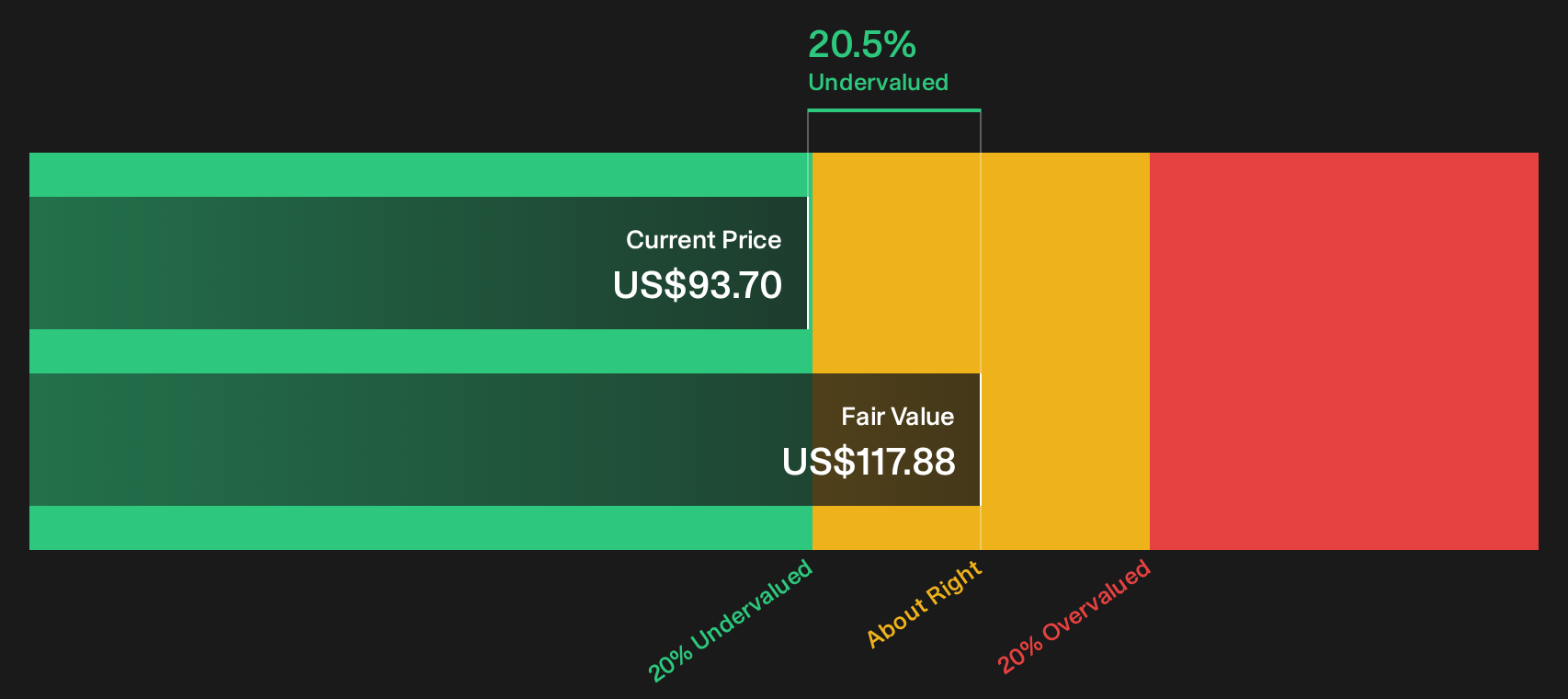
Simply Wall St performs a discounted cash flow (DCF) on every stock in the world every day (check out Republic Bancorp for example). We show the entire calculation in full. You can track the result in your watchlist or portfolio and be alerted when this changes, or use our stock screener to discover 45 high quality undervalued stocks. If you save a screener we even alert you when new companies match - so you never miss a potential opportunity.
Next Steps
Given the mixed signals on Republic Bancorp’s valuation and outlook, it may be helpful to act promptly, review the numbers yourself, and decide where you stand using the 3 key rewards and 1 important warning sign
Looking for more Republic Bancorp investment ideas?
If Republic Bancorp has your attention, do not stop here. Take a few minutes to scan other opportunities so you are not relying on just one stock.
Use the Simply Wall St screener to uncover other stocks and investment ideas that may complement or contrast with what you see in Republic Bancorp.
- Target reliability first by reviewing companies screened as 80 resilient stocks with low risk scores that may offer a steadier profile when markets feel unpredictable.
- Hunt for potential mispricings by checking companies flagged in the screener containing 20 high quality undiscovered gems that might not yet be widely followed.
- Focus on financial strength by scanning the solid balance sheet and fundamentals stocks screener (48 results) so you can compare Republic Bancorp with businesses that also prioritise balance sheet resilience.
This article by Simply Wall St is general in nature. We provide commentary based on historical data and analyst forecasts only using an unbiased methodology and our articles are not intended to be financial advice. It does not constitute a recommendation to buy or sell any stock, and does not take account of your objectives, or your financial situation. We aim to bring you long-term focused analysis driven by fundamental data. Note that our analysis may not factor in the latest price-sensitive company announcements or qualitative material. Simply Wall St has no position in any stocks mentioned.