

From $50,000 to $1.1 Billion! How Quant Trading Genius Woodruff Achieved a 118% Annual Return Rate
PowerShares QQQ Trust,Series 1 QQQ | 0.00 | |
Apple Inc. AAPL | 0.00 | |
Tesla Motors, Inc. TSLA | 0.00 | |
ADES 2382.SA | 0.00 | |
SAUDI ARAMCO 2222.SA | 0.00 |

Have you ever wondered how a modest $50,000 investment could transform into a staggering $1.1 billion?
Today, we unveil the inspiring story of Jaffray Woodriff, the CEO of Quantitative Investment Management (QIM), a billion-dollar quantitative hedge fund. Woodriff is a trailblazer in data-driven investing, and his journey from a modest background to becoming one of the world's top hedge fund managers is nothing short of extraordinary. Let’s dive into his story and explore the unique trading philosophy that propelled him to the pinnacle of financial success.
Humble Beginnings: Woodriff’s Early Life and Education
Jaffray Woodriff was born in 1969 in Charlottesville, Virginia, where he grew up working on his family’s farm. Despite his rural upbringing, his true passion lay far from agriculture. As a teenager, Woodriff became fascinated by the world of probabilities and statistics. He spent countless hours rolling dice, recording outcomes, and analyzing patterns—a hobby that hinted at his future career in quantitative finance.
As he grew older, his curiosity expanded to technology. Captivated by the world of computers, he devoured books on programming and technology, laying the foundation for his future endeavors.
In 1987, Woodriff enrolled at the University of Virginia, just 20 miles from his home, where he pursued a Bachelor of Science degree. By the time he graduated in 1991, he had acquired the technical and analytical skills necessary to thrive in the world of finance.
Career Journey and Turning Points
After graduating, Woodriff didn’t rush into a conventional job, much to his mother’s concern. Instead, he spent his time doing what he loved—building futures trading systems. Eventually, he heeded his mother’s advice and joined IBM as a software engineer. During his time at IBM, Woodriff honed his programming and data analysis skills, which would later become critical in his career.
In August 1994, Woodriff took a bold step, pooling $50,000 from family and friends to invest in the futures market. This marked the beginning of his trading journey.
Not long after, he moved to New York, where he worked as a proprietary trader at Société Générale. These years gave him invaluable hands-on experience and helped him refine his unique trading approach. By the time he left the bank two years later to manage his own funds, his initial capital had grown to $300,000.
The real turning point in his career came in 2003, when Woodriff co-founded Quantitative Investment Management (QIM) alongside Michael Geismar and Greyson Williams. QIM was no ordinary hedge fund—it was built on a foundation of data science and quantitative models, relying on sophisticated algorithms to make investment decisions. This innovative approach not only disrupted traditional investment practices but also catapulted Woodriff into the ranks of the financial elite.
Track Record of Success
Still skeptical about Woodriff’s prowess? Let the numbers speak for themselves.
From 2003 to 2011, QIM delivered an impressive average annual compound return of 12.5%, with a standard deviation of 10.5%. These metrics are nothing short of remarkable in the competitive world of finance.
Under Woodriff’s visionary leadership, QIM didn’t just grow—it exploded. Today, the firm manages over $1.1 billion in assets. In 2014, Forbes recognized Woodriff as one of the highest-earning hedge fund managers in the world, solidifying his status as a financial legend.
Take a look at the chart below comparing QIM’s performance over the past five years (red) against the S&P 500 (blue):
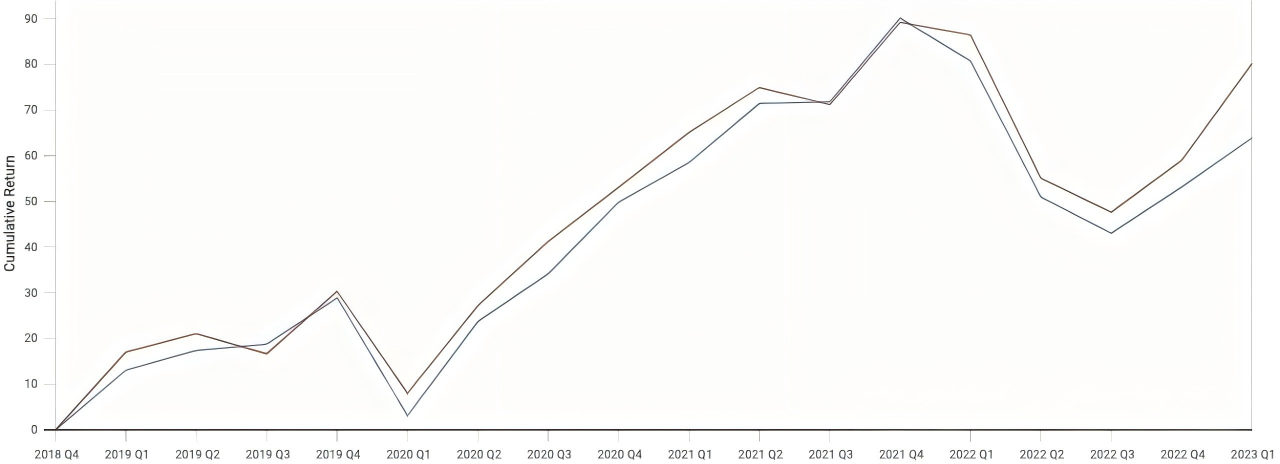
But perhaps the most jaw-dropping aspect of Woodriff’s success is his personal futures trading account, which boasts an average annual compound return of 118% with a standard deviation of 81%. These numbers are virtually unheard of in the investment world.
So, what sets Jaffray Woodriff apart from other traders? How did he achieve such extraordinary results?
Learning Quantitative Strategies from Jaffray Woodriff
1. Weighted Data: The Secret Weapon
"Data weighting" is Jaffray Woodriff's secret weapon—a method designed to make the most critical data shine.
He values historical data, such as market patterns from the 1980s, while also incorporating current market information. By using an algorithm known as "exponential smoothing," he combines old and new data into one cohesive picture.
This approach is more scientific than traditional methods like trend following or mean reversion because it relies on statistical and data models rather than intuition.
2. Understanding Market Capacity and Allocation
Woodriff likens position allocation to pouring water into a kettle—too much and it overflows, too little and it’s not enough. He smooths risk through frequent, high-frequency trades rather than relying solely on opening or closing trades.
When it comes to market selection, he avoids concentrated bets and advocates for diversification across multiple markets. Early in his career, he made the mistake of focusing on just two or three markets, which cost him dearly. Today, he prefers highly liquid markets like equity indices and interest rate futures, steering clear of non-financial futures that are prone to high volatility and low liquidity.
3. Building a Trading System: The Financial GPS
A robust trading system acts like a GPS in the financial world, guiding traders through emotional noise with precision.
Woodriff is a firm believer in "a replicable, cross-market model" that outperforms systems built specifically for individual markets.
His trading system consists of thousands of models designed to predict market movements over the next 24 hours. These models are continuously optimized using machine learning to adapt to changing market conditions.
4. Strictly Following Trading Rules
Every system has its rules—entry, exit, stop-loss, and position adjustments.
Woodriff targets an annualized volatility of 20%, with all operations centered around risk control.
He believes the real challenge lies not in creating rules but in strictly following them. "Human emotions are the biggest noise," he says. "Only by adhering to data-driven logic can you maintain a long-term edge."
5. Risk Management and Leverage Control
Woodriff evaluates market risk using a "weighted moving average of dollar volatility" and dynamically adjusts positions to remain flexible in volatile markets.
This system helped his firm, Quantitative Investment Management (QIM), achieve a 12% annualized return during the 2008 financial crisis.
He also stresses the importance of cautious leverage usage. "Leverage is like a credit card—used wisely, it amplifies returns; used recklessly, it leads to bankruptcy."
6. Evaluating Model Performance
Woodriff’s evaluation period for his models spans an impressive 31 years. He avoids focusing on short-term fluctuations and instead relies on statistical tools—such as hypothesis testing, confidence intervals, and p-values—to verify whether his models are genuinely effective, rather than relying on luck.
This rigorous, scientific validation process ensures his systems remain stable and reliable over the long term.
7. Emotional Discipline: Overcoming the Pull of Fear
Woodriff refers to the emotional stress in trading as "the emotional pull."
When faced with losses, traders often succumb to fear and self-doubt. His solution? Focus on improving the system rather than reacting emotionally.
This "emotional optimization" requires patience and self-reflection but is critical for achieving long-term success in trading.

Reorganizing the Research Team: Woodriff Returns to the Creative Engine Role
With new hires and a revamped research team, Jaffray Woodriff—still the core of the company’s investment strategy—can now dedicate more time to strategy development and creative ideation rather than execution. The company is also ramping up its marketing efforts, planning to raise funds globally from institutional investors with a target of increasing assets under management to $4 billion.
The market environment seems favorable for QIM once again.
As large multi-strategy funds like Millennium Management gain prominence in institutional portfolios, there’s growing demand for managers like QIM who offer volatility and non-correlation with stock and bond markets.
In 2022, QIM’s two main strategies performed robustly—the flagship strategy, launched first, achieved a 19.2% return, drawing renewed market attention. As of October this year, QIM’s aggressive strategy is up over 34%, while the flagship strategy has risen 1.7%.
“I love mathematical geniuses, and Jaffray and his team are exactly that,” says Salem Abraham, a 17-year investor in the company and long-time partner of the late billionaire T. Boone Pickens.
“QIM is the kind of company Harry Markowitz, the father of modern portfolio theory, would be delighted to discover,” Abraham adds.
The Trader Who Never Retires
Although Woodriff has passions outside of work—he’s a key figure in building the UVA School of Data Science and a squash enthusiast, having received a special contribution award from the US Squash Association in 2014—his true love remains the market.
“I knew in college I’d never want to retire.”
Thirty years later, that conviction hasn’t changed.
“For him, it’s not just a career, but a hobby and a passion,” says co-founder Williams.
Those who know him say Woodriff’s renewed focus on strategy isn’t about reigniting a passion—it’s about making the flame burn even brighter.
“They’re a unique company and a unique fund,” says investor Abraham.
“In a portfolio, stocks and bonds are the ‘meat and potatoes,’ while a fund like QIM is the ‘pepper’—adding flavor to the entire dish.”
“They’re spicy,” Abraham adds with a smile.
Since college, Woodriff has aimed to be “different.”
So it’s no surprise that QIM didn’t close during tough times, and Woodriff’s continued belief in himself and his team’s abilities remains steadfast.
“I still feel I’m quite good at this,” he asserts confidently.
Conclusion
Reflecting on Jaffray Woodriff’s journey to success, we see more than just the story of a billionaire—it’s a replicable blueprint for trading:
✍ Replace emotions with data science.
✍ Use systematic thinking to manage risk.
✍ Build a compounding curve with discipline.
Every great journey begins with a bold decision.