
Has The Recent 64% Share Price Slump Opened Up An Opportunity In HubSpot (HUBS)?
HubSpot, Inc. HUBS | 244.67 | +0.77% |
- If you are wondering whether HubSpot's share price now reflects a fair deal or an overreaction, this article walks through what the numbers are saying about value.
- At a last close of US$274.06, HubSpot's stock has seen sharp recent moves, with returns of 16.7% decline over 7 days, 28.3% decline over 30 days and year to date, and 64.2% decline over 1 year. Over 3 years and 5 years, the returns are a 23.9% decline and a 34.6% decline respectively.
- These price swings are landing against a backdrop of ongoing interest in software and customer relationship tools. Investors are watching how companies like HubSpot position themselves. While this article does not focus on specific headlines, it aims to put recent share price moves in context by focusing on what can be measured quantitatively.
- Simply Wall St currently assigns HubSpot a valuation score of 4 out of 6, based on how the stock screens for potential undervaluation on six separate checks. Next, we will walk through the usual valuation approaches, before circling back to a more holistic way of thinking about value at the end of the article.
Approach 1: HubSpot Discounted Cash Flow (DCF) Analysis
A Discounted Cash Flow, or DCF, model takes estimates of the cash a business could generate in the future and discounts those cash flows back to today, to arrive at an estimate of what the entire company might be worth right now.
For HubSpot, the model used is a 2 Stage Free Cash Flow to Equity approach. The latest twelve month free cash flow is about $553.8 million. Simply Wall St uses analyst estimates for the next few years and then extends those projections further out. In this case, the ten year path runs from $708.7 million in 2026 up to a projected $1.4 billion by 2030 and continues with extrapolated figures through 2035, all in dollars.
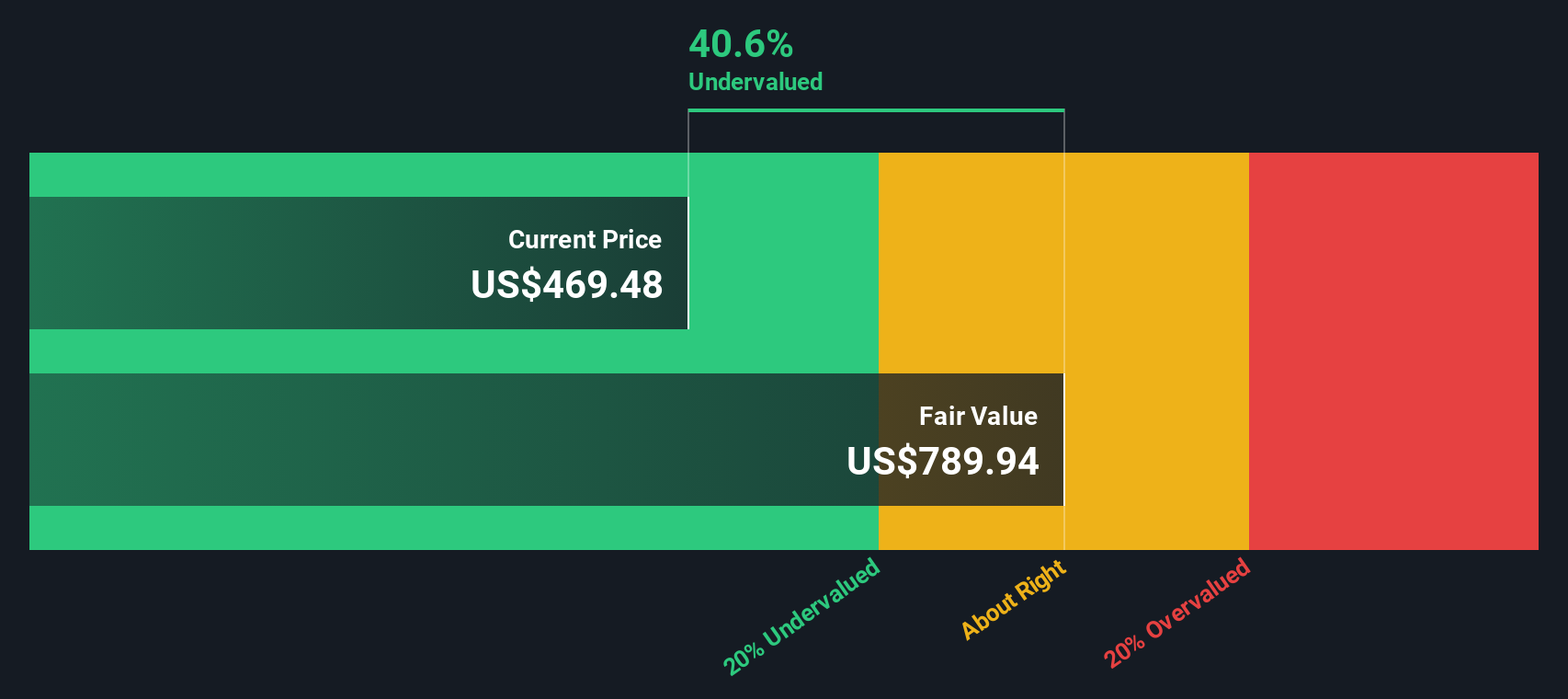
After discounting those future cash flows, the model arrives at an estimated intrinsic value of about $505.17 per share. Compared with the recent share price of $274.06, this points to an implied 45.7% discount, which suggests the stock screens as materially undervalued based on this DCF input set.
Result: UNDERVALUED
Our Discounted Cash Flow (DCF) analysis suggests HubSpot is undervalued by 45.7%. Track this in your watchlist or portfolio, or discover 875 more undervalued stocks based on cash flows.
Approach 2: HubSpot Price vs Sales
For companies where earnings are not a clean guide, revenue can be a useful anchor, so the P/S ratio is often a practical way to think about value. Investors typically accept a higher or lower P/S depending on what they expect for future growth and how risky they feel the business is, so there is no single “right” level in isolation.
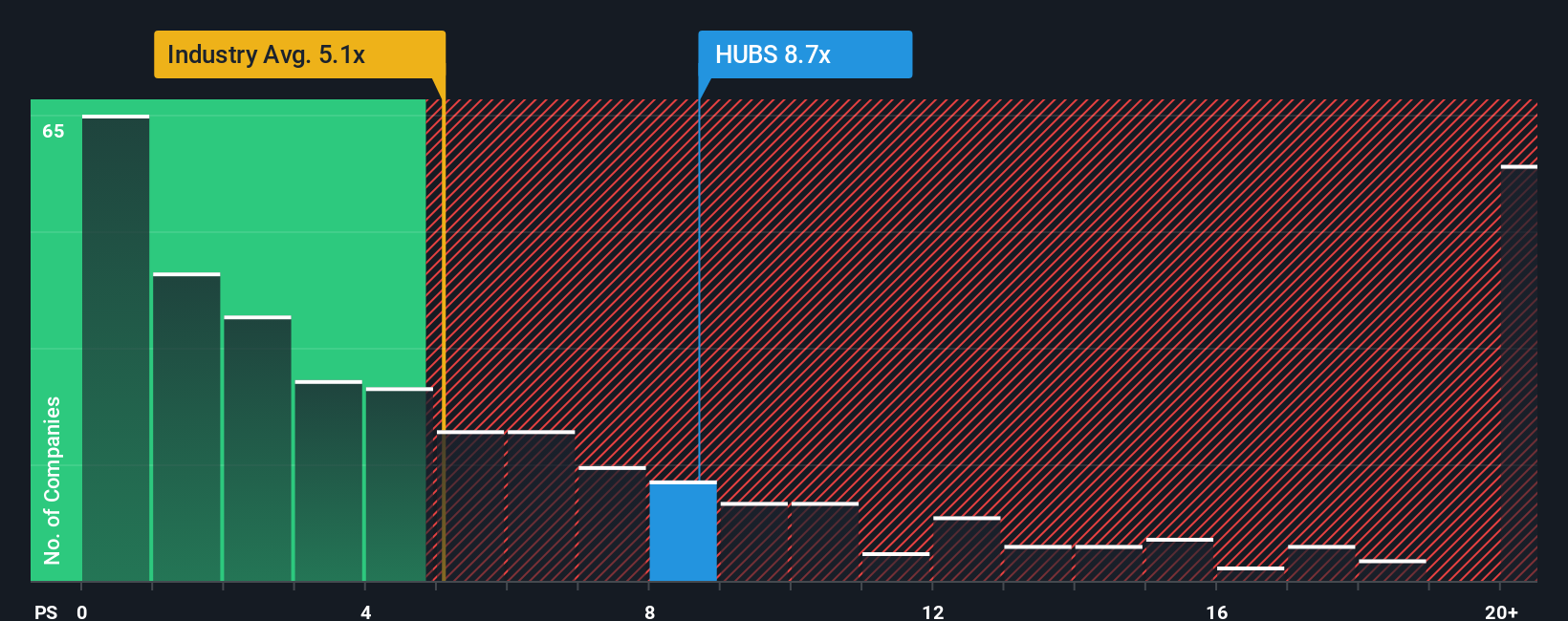
HubSpot currently trades on a P/S of 4.81x. That sits slightly above the broader Software industry average of 4.24x and below the peer group average of 7.20x. Simply Wall St also calculates a proprietary “Fair Ratio” of 8.27x for HubSpot. This Fair Ratio is designed to reflect the kind of P/S multiple that might be reasonable given factors such as earnings growth, industry, profit margin, market cap and risk.
Compared with simple peer or industry comparisons, the Fair Ratio framework can be more tailored because it adjusts for the company’s own growth outlook, risk profile and profitability rather than treating all software names as interchangeable. Setting the current 4.81x P/S against the 8.27x Fair Ratio, HubSpot screens as trading below that Fair Ratio on this measure.
Result: UNDERVALUED
P/S ratios tell one story, but what if the real opportunity lies elsewhere? Discover 1424 companies where insiders are betting big on explosive growth.
Upgrade Your Decision Making: Choose your HubSpot Narrative
Earlier we mentioned that there is an even better way to understand valuation, so let us introduce you to Narratives, which are simply the story you believe about a company linked directly to the numbers you plug in for fair value, future revenue, earnings and margins.
On Simply Wall St, within the Community page used by millions of investors, a Narrative connects your view of HubSpot’s business to a financial forecast and then to an estimated fair value. This allows you to compare that fair value with the current share price and decide whether the stock looks attractive or stretched based on your assumptions.
Narratives are kept current as new information such as earnings reports or major news is added. This means your view of HubSpot’s value updates automatically instead of sitting still while the story moves on.
For HubSpot, one investor Narrative might assume a relatively high fair value based on stronger long term revenue growth and improving margins. Another might land on a lower fair value with more conservative growth and profitability estimates. In both cases, investors can clearly see how their story flows through to the numbers and their decision to buy, hold or sell.
Do you think there's more to the story for HubSpot? Head over to our Community to see what others are saying!

This article by Simply Wall St is general in nature. We provide commentary based on historical data and analyst forecasts only using an unbiased methodology and our articles are not intended to be financial advice. It does not constitute a recommendation to buy or sell any stock, and does not take account of your objectives, or your financial situation. We aim to bring you long-term focused analysis driven by fundamental data. Note that our analysis may not factor in the latest price-sensitive company announcements or qualitative material. Simply Wall St has no position in any stocks mentioned.