

Hospitality Push and Capital Relief Could Be A Game Changer For PNC Financial Services Group (PNC)
PNC Financial Services Group, Inc. PNC | 0.00 |
- Earlier this month, The PNC Financial Services Group, Inc. appointed Chris Hill as its first Chief Hospitality Officer to enhance human-centered service across its more than 2,200-branch network, while the Federal Reserve proposed easing post-crisis capital requirements for mid-sized banks including PNC.
- This combination of a differentiated hospitality-focused role and potential capital relief positions PNC to rethink how it deploys its branch footprint and balance sheet capacity.
- We’ll now examine how potential capital rule easing, alongside PNC’s new hospitality focus, could influence the bank’s existing investment narrative.
We've uncovered the 12 dividend fortresses yielding 5%+ that don't just survive market storms, but thrive in them.
PNC Financial Services Group Investment Narrative Recap
To own PNC, you need to be comfortable with a large, traditional bank focused on controlled growth, disciplined expenses and customer acquisition amid shifting economic and regulatory conditions. The Fed’s proposed easing of capital rules for mid sized banks could support PNC’s lending capacity in the near term, while key risks remain tied to tariff uncertainty, possible recessionary pressures and resulting swings in noninterest income. Overall, this news does not materially change the core risk reward balance for shareholders.
The appointment of Chris Hill as PNC’s first Chief Hospitality Officer is closely tied to the bank’s US$2.0 billion, 300 branch expansion and renovation plan, which aims to deepen relationships and support organic growth. For investors, this hospitality focus sits alongside interest rate management and efficiency efforts as part of the broader push to sustain margins and grow earnings, even as capital markets related fees and client activity remain vulnerable to economic uncertainty.
Yet investors should also weigh how a mild recession scenario and rising unemployment could pressure expenses and net margins if revenues stall...
PNC Financial Services Group's narrative projects $24.5 billion revenue and $6.5 billion earnings by 2028. This implies 4.9% yearly revenue growth and about a $0.7 billion earnings increase from $5.8 billion today.
Uncover how PNC Financial Services Group's forecasts yield a $251.90 fair value, a 24% upside to its current price.
Exploring Other Perspectives
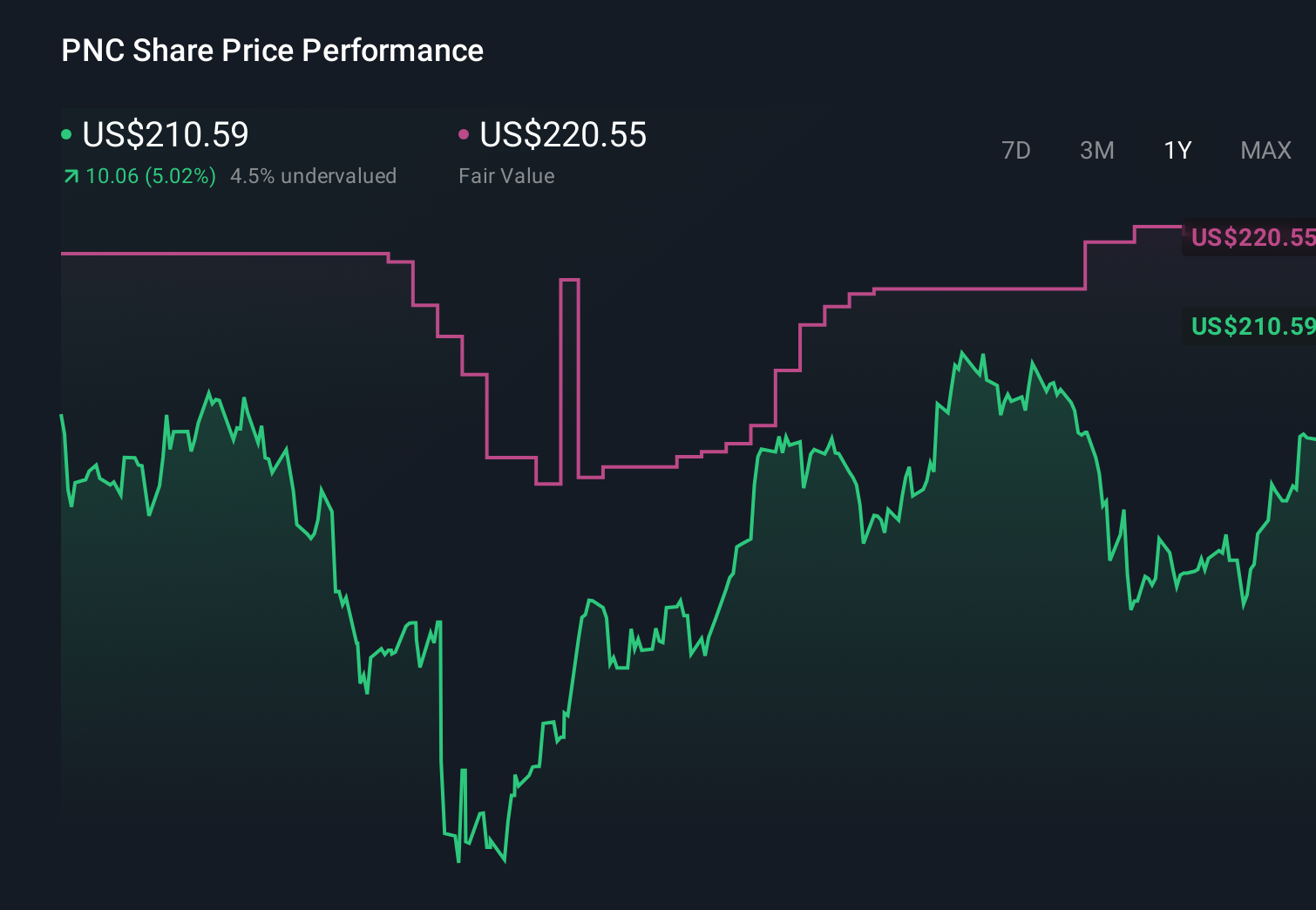
Five members of the Simply Wall St Community value PNC between US$179.10 and US$393.31 per share, underlining how far opinions can stretch. Against that spread, concerns about volatile noninterest income and tariff related weakness remind you to test these viewpoints against your own expectations for PNC’s earnings resilience.
Explore 5 other fair value estimates on PNC Financial Services Group - why the stock might be worth 12% less than the current price!
Reach Your Own Conclusion
Disagree with existing narratives? Extraordinary investment returns rarely come from following the herd, so go with your instincts.
- A great starting point for your PNC Financial Services Group research is our analysis highlighting 5 key rewards and 1 important warning sign that could impact your investment decision.
- Our free PNC Financial Services Group research report provides a comprehensive fundamental analysis summarized in a single visual - the Snowflake - making it easy to evaluate PNC Financial Services Group's overall financial health at a glance.
Searching For A Fresh Perspective?
Don't miss your shot at the next 10-bagger. Our latest stock picks just dropped:
- Invest in the nuclear renaissance through our list of 89 elite nuclear energy infrastructure plays powering the global AI revolution.
- The future of work is here. Discover the 32 top robotics and automation stocks leading the charge in AI-driven automation and industrial transformation.
- Find 55 companies with promising cash flow potential yet trading below their fair value.
This article by Simply Wall St is general in nature. We provide commentary based on historical data and analyst forecasts only using an unbiased methodology and our articles are not intended to be financial advice. It does not constitute a recommendation to buy or sell any stock, and does not take account of your objectives, or your financial situation. We aim to bring you long-term focused analysis driven by fundamental data. Note that our analysis may not factor in the latest price-sensitive company announcements or qualitative material. Simply Wall St has no position in any stocks mentioned.