

How A Tightening Truckload Labor Market At Knight-Swift (KNX) Has Changed Its Investment Story
Knight-Swift Transportation KNX | 0.00 |
- Earlier this week, an analyst at UBS upgraded Knight-Swift Transportation Holdings after observing signs of a tightening truckload market, including fewer new commercial driver licenses since late 2025.
- This shift in labor supply highlights how changes in driver availability can influence expectations for freight capacity, pricing power, and earnings for large carriers like Knight-Swift.
- Next, we’ll explore how the apparent tightening in truckload capacity interacts with Knight-Swift’s existing investment narrative and earnings outlook.
We've uncovered the 13 dividend fortresses yielding 5%+ that don't just survive market storms, but thrive in them.
Knight-Swift Transportation Holdings Investment Narrative Recap
To own Knight-Swift, you need to believe that its scale, technology investments, and expanding LTL network can eventually turn a tough freight cycle into better margins and more resilient earnings. The UBS upgrade on tightening truckload capacity supports the near term catalyst of improving pricing, but it does not remove the key risk that soft freight demand and integration costs in LTL could still weigh on profitability if volumes do not improve meaningfully.
The recent dividend increase to US$0.20 per share, marking seven consecutive years of growth, is the clearest recent signal of how management is balancing near term earnings pressure with a commitment to ongoing shareholder returns. In the context of tighter truckload supply, that higher dividend puts more attention on whether expected earnings recovery can support both continued payouts and the heavy capital needs of a large, asset intensive fleet.
But while tighter capacity can help pricing, investors should also be aware of the risk that persistent freight softness and LTL integration costs could still...
Knight-Swift Transportation Holdings' narrative projects $8.7 billion revenue and $524.7 million earnings by 2028. This requires 5.3% yearly revenue growth and about a $359.9 million earnings increase from $164.8 million today.
Uncover how Knight-Swift Transportation Holdings' forecasts yield a $63.11 fair value, a 18% upside to its current price.
Exploring Other Perspectives
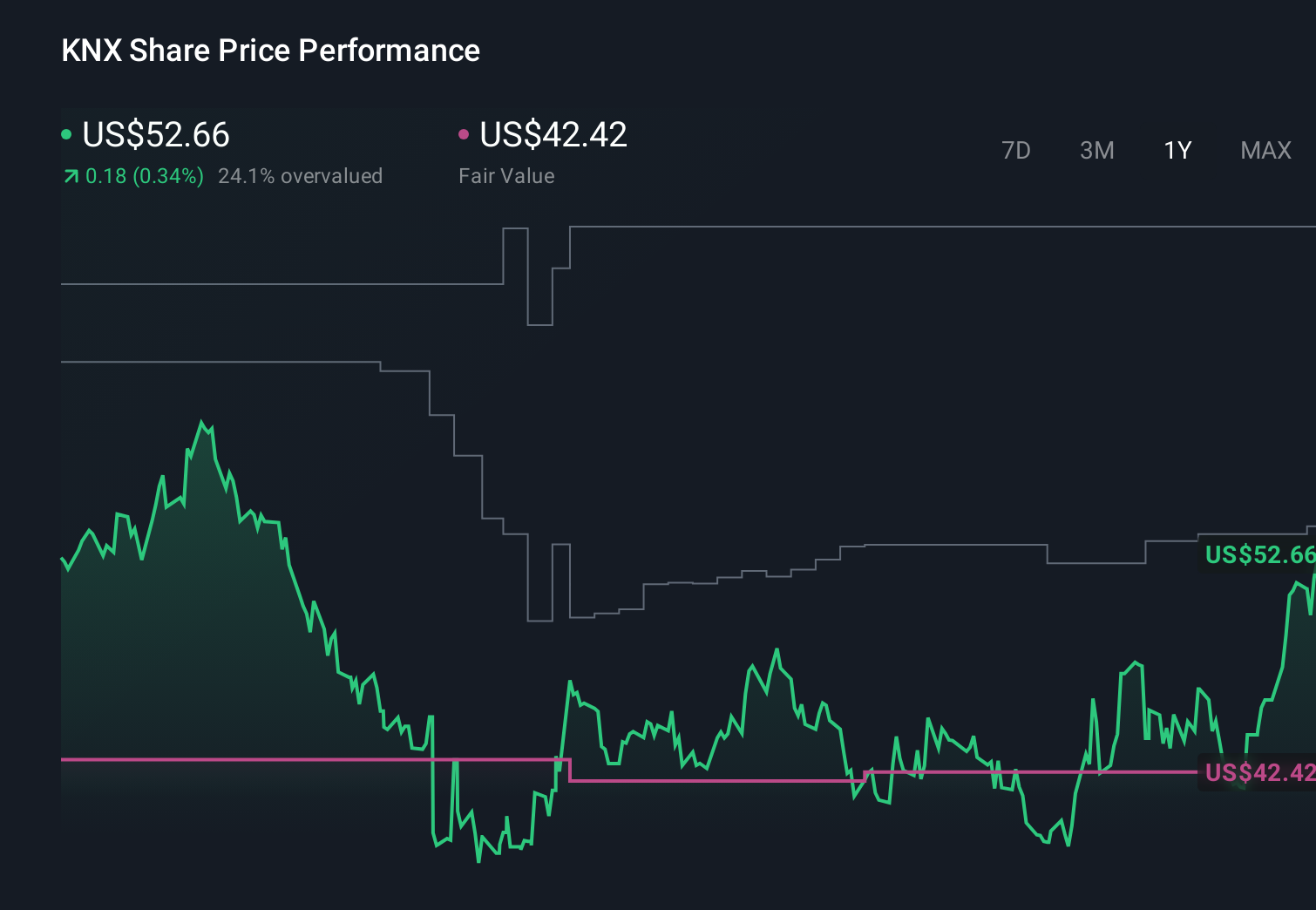
Some of the most optimistic analysts already saw tightening capacity as a potential long term tailwind, expecting revenue near US$9.8 billion and earnings around US$788 million, so this latest supply signal could either reinforce or challenge just how much upside you think is realistic.
Explore 3 other fair value estimates on Knight-Swift Transportation Holdings - why the stock might be worth as much as 41% more than the current price!
The Verdict Is Yours
Don't just follow the ticker - dig into the data and build a conviction that's truly your own.
- A great starting point for your Knight-Swift Transportation Holdings research is our analysis highlighting 3 key rewards and 3 important warning signs that could impact your investment decision.
- Our free Knight-Swift Transportation Holdings research report provides a comprehensive fundamental analysis summarized in a single visual - the Snowflake - making it easy to evaluate Knight-Swift Transportation Holdings' overall financial health at a glance.
Looking For Alternative Opportunities?
Early movers are already taking notice. See the stocks they're targeting before they've flown the coop:
- The future of work is here. Discover the 31 top robotics and automation stocks leading the charge in AI-driven automation and industrial transformation.
- Invest in the nuclear renaissance through our list of 89 elite nuclear energy infrastructure plays powering the global AI revolution.
- Uncover the next big thing with 33 elite penny stocks that balance risk and reward.
This article by Simply Wall St is general in nature. We provide commentary based on historical data and analyst forecasts only using an unbiased methodology and our articles are not intended to be financial advice. It does not constitute a recommendation to buy or sell any stock, and does not take account of your objectives, or your financial situation. We aim to bring you long-term focused analysis driven by fundamental data. Note that our analysis may not factor in the latest price-sensitive company announcements or qualitative material. Simply Wall St has no position in any stocks mentioned.