

How Best Buy’s New Points-Based Membership Rewards Push Will Impact Best Buy (BBY) Investors
Best Buy Co.,Inc. BBY | 0.00 |
- In early May 2026, Best Buy announced that starting June 4 it will add a points-based rewards system to its My Best Buy Plus and My Best Buy Total paid memberships, offering 1% back in rewards on eligible purchases and 6% back when using the My Best Buy Credit Card, alongside a price increase for the Total tier.
- This move signals a stronger push to lock in recurring membership revenue while incentivizing higher-spend, credit-card-using customers with richer benefits.
- We’ll examine how Best Buy’s richer, points-based membership rewards could influence its cost discipline, service growth, and competitive pressures.
Invest in the nuclear renaissance through our list of 91 elite nuclear energy infrastructure plays powering the global AI revolution.
Best Buy Investment Narrative Recap
To own Best Buy, you have to believe its mix of stores, services, and financing can still matter in an electronics market where online rivals squeeze margins and traffic. The near term catalyst is whether membership, services, and marketplace gains can offset muted product demand and pricing pressure. The new rewards program and membership price hike look incremental rather than transformational, so they do not materially change the biggest risk today of further gross margin pressure from promotions and category mix.
The CEO transition announced on April 22, 2026 is the most relevant backdrop here, because incoming CEO Jason Bonfig has deep roots in merchandising, e‑commerce, supply chain, and marketing. As Best Buy leans harder into paid memberships, credit cards, and its retail media network, investors may watch closely how this leadership change interacts with the membership revamp and whether it reinforces or complicates the existing catalysts around marketplace expansion and cost efficiency.
But while membership perks are getting richer, investors still need to be aware that...
Best Buy's narrative projects $43.1 billion revenue and $1.5 billion earnings by 2029. This requires 1.1% yearly revenue growth and about a $0.4 billion earnings increase from $1.1 billion.
Uncover how Best Buy's forecasts yield a $72.50 fair value, a 27% upside to its current price.
Exploring Other Perspectives
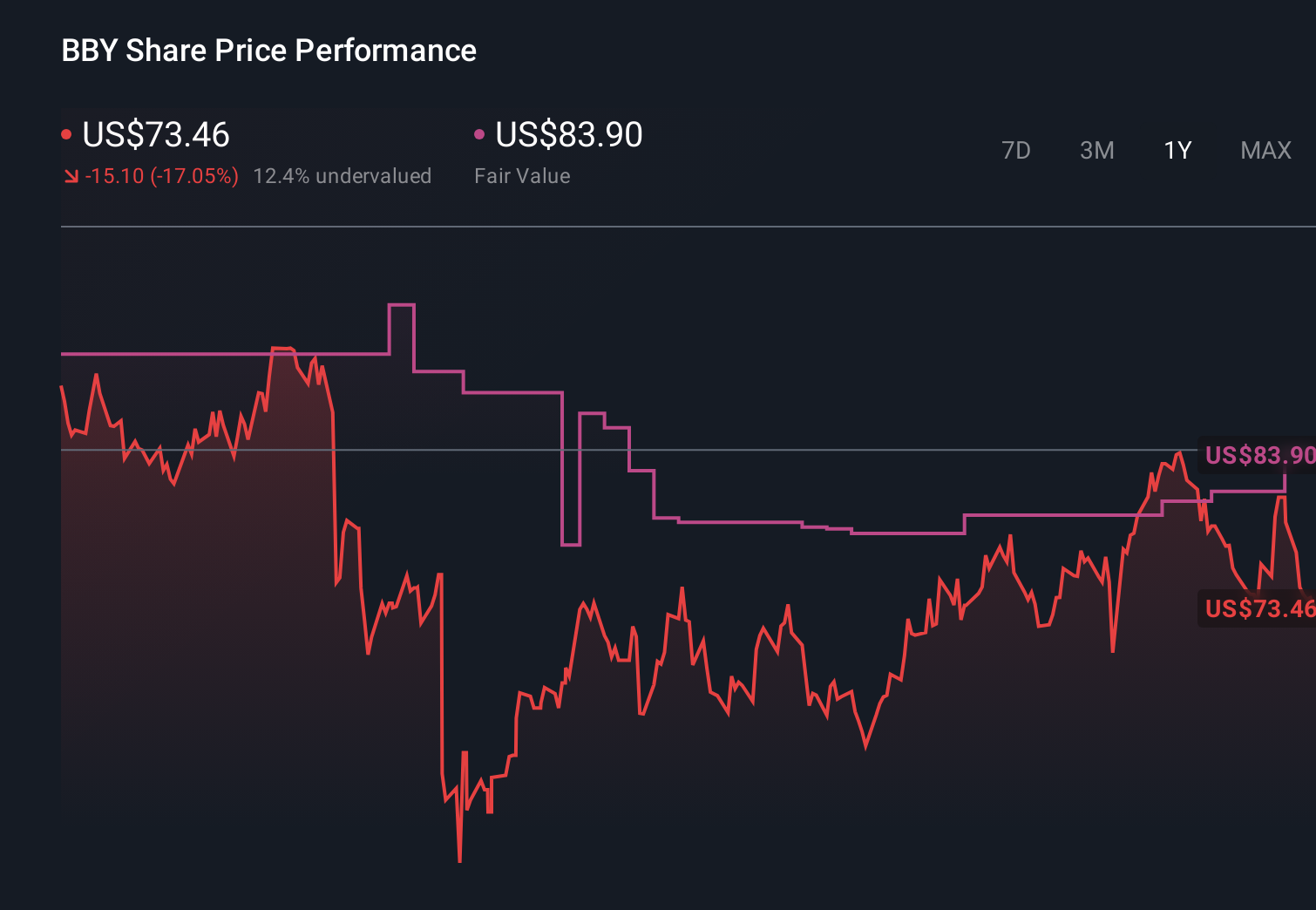
Some of the lowest estimating analysts were already expecting slightly shrinking revenue and only about US$1.5 billion of earnings by 2028, so if you worry more about tariffs and inflation than membership growth, you might see their more pessimistic view as a useful counterweight to the consensus and a reason to examine how this new rewards push fits into those assumptions.
Explore 5 other fair value estimates on Best Buy - why the stock might be worth just $72.50!
The Verdict Is Yours
Don't just follow the ticker - dig into the data and build a conviction that's truly your own.
- A great starting point for your Best Buy research is our analysis highlighting 6 key rewards and 2 important warning signs that could impact your investment decision.
- Our free Best Buy research report provides a comprehensive fundamental analysis summarized in a single visual - the Snowflake - making it easy to evaluate Best Buy's overall financial health at a glance.
Contemplating Other Strategies?
Every day counts. These free picks are already gaining attention. See them before the crowd does:
- Find 51 companies with promising cash flow potential yet trading below their fair value.
- AI is about to change healthcare. These 35 stocks are working on everything from early diagnostics to drug discovery. The best part - they are all under $10b in market cap - there's still time to get in early.
- This technology could replace computers: discover 26 stocks that are working to make quantum computing a reality.
This article by Simply Wall St is general in nature. We provide commentary based on historical data and analyst forecasts only using an unbiased methodology and our articles are not intended to be financial advice. It does not constitute a recommendation to buy or sell any stock, and does not take account of your objectives, or your financial situation. We aim to bring you long-term focused analysis driven by fundamental data. Note that our analysis may not factor in the latest price-sensitive company announcements or qualitative material. Simply Wall St has no position in any stocks mentioned.