

How Best Buy’s RGB LED TV Exclusivity Push Will Impact Best Buy (BBY) Investors
Best Buy Co.,Inc. BBY | 0.00 |
- In June 2026, Best Buy introduced RGB LED TVs nationwide through exclusive partnerships with Samsung, Sony, LG, TCL and Hisense, backing the rollout with more than 15,000 specially trained staff plus free delivery, installation, mounting and haul-away on most purchases.
- This move effectively turns Best Buy into a destination for next-generation home theater at a time when millions of households are approaching their typical TV replacement window.
- Next, we’ll examine how becoming the only national retailer for RGB LED TVs could influence Best Buy’s existing investment narrative.
Explore 26 top quantum computing companies leading the revolution in next-gen technology and shaping the future with breakthroughs in quantum algorithms, superconducting qubits, and cutting-edge research.
Best Buy Investment Narrative Recap
To own Best Buy, you need to believe the company can convert its physical and digital footprint into higher-margin tech experiences, not just hardware sales. The RGB LED TV launch reinforces that thesis by deepening vendor partnerships and driving premium home theater traffic, but it does not fundamentally change the key near-term catalyst in computing upgrades or the largest risk around pressure on gross margins from intense category and price competition.
The most relevant recent development alongside the RGB LED rollout is the planned CFO transition in July 2026. A new finance leader will inherit responsibility for managing category mix, capital spending, and profitability as Best Buy leans harder into experiential home theater and marketplace initiatives, and any change in financial discipline or priorities could influence how effectively these product launches translate into earnings over time.
Yet behind the showroom glow of RGB LED TVs, investors should also be aware of...
Best Buy's narrative projects $43.1 billion revenue and $1.5 billion earnings by 2029. This requires 1.1% yearly revenue growth and about a $0.4 billion earnings increase from $1.1 billion today.
Uncover how Best Buy's forecasts yield a $72.50 fair value, a 7% downside to its current price.
Exploring Other Perspectives
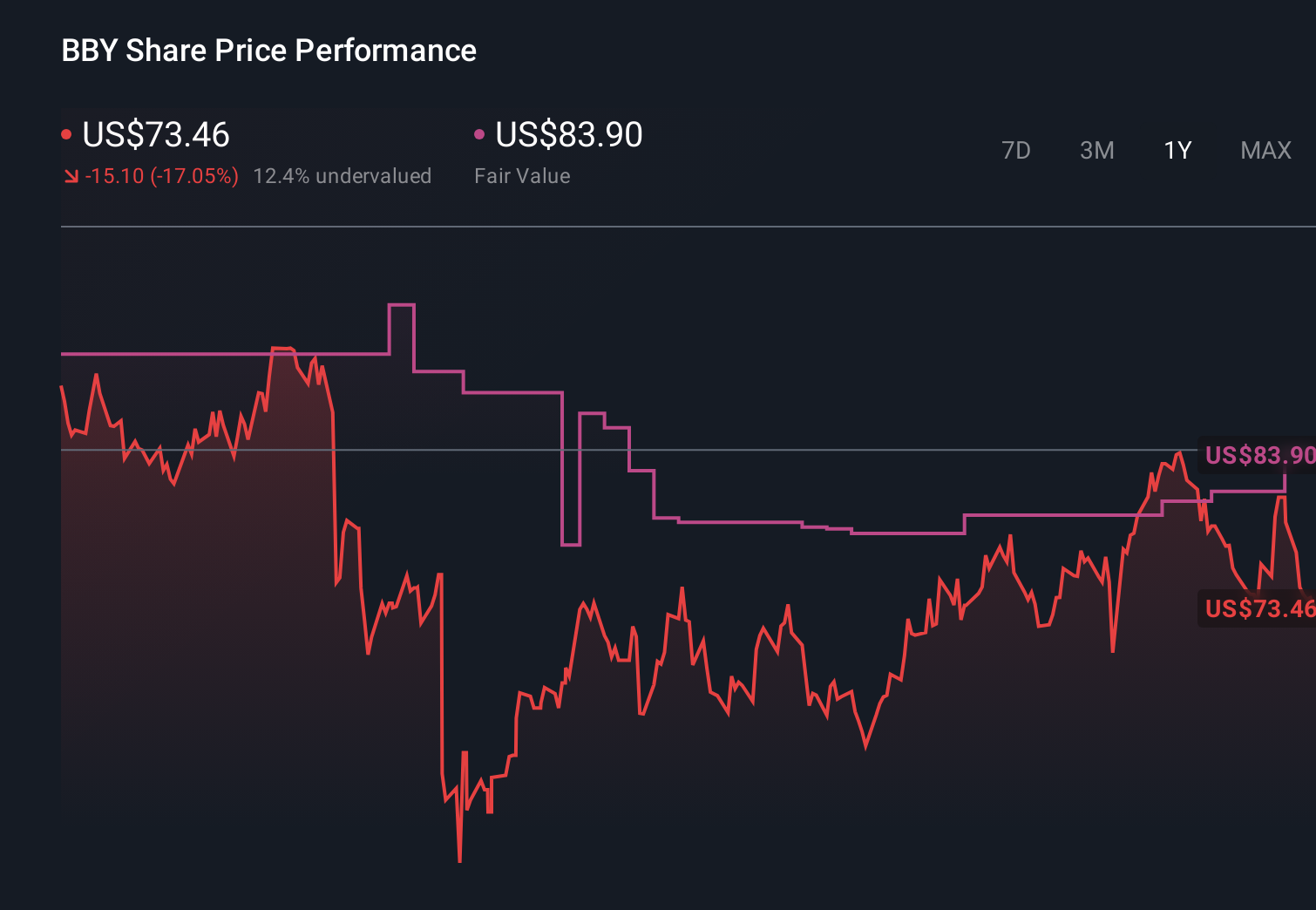
More optimistic analysts were already assuming revenue could reach about US$44.1 billion and earnings US$1.6 billion by 2029, so if you buy into that view, the RGB LED push and marketplace expansion might look like confirmation rather than upside, while tariff and Best Buy Health risks still leave plenty of room for those expectations to shift.
Explore 5 other fair value estimates on Best Buy - why the stock might be worth 7% less than the current price!
Decide For Yourself
Disagree with existing narratives? Extraordinary investment returns rarely come from following the herd, so go with your instincts.
- A great starting point for your Best Buy research is our analysis highlighting 5 key rewards and 1 important warning sign that could impact your investment decision.
- Our free Best Buy research report provides a comprehensive fundamental analysis summarized in a single visual - the Snowflake - making it easy to evaluate Best Buy's overall financial health at a glance.
Interested In Other Possibilities?
Markets shift fast. These stocks won't stay hidden for long. Get the list while it matters:
- Capitalize on the AI infrastructure supercycle with our selection of the 52 best 'picks and shovels' of the AI gold rush converting record-breaking demand into massive cash flow.
- AI is about to change healthcare. These 40 stocks are working on everything from early diagnostics to drug discovery. The best part - they are all under $10b in market cap - there's still time to get in early.
- Rare earth metals are the new gold rush. Find out which 31 stocks are leading the charge.
This article by Simply Wall St is general in nature. We provide commentary based on historical data and analyst forecasts only using an unbiased methodology and our articles are not intended to be financial advice. It does not constitute a recommendation to buy or sell any stock, and does not take account of your objectives, or your financial situation. We aim to bring you long-term focused analysis driven by fundamental data. Note that our analysis may not factor in the latest price-sensitive company announcements or qualitative material. Simply Wall St has no position in any stocks mentioned.