

How CoreCivic’s Shift Into Value‑Defensive Indices Will Impact CoreCivic (CXW) Investors
CoreCivic, Inc. CXW | 0.00 |
- On 27 June 2026, CoreCivic, Inc. was removed from several Russell growth benchmarks and simultaneously added to the Russell 2000 Value-Defensive and Russell 2000 Defensive indices, marking a formal shift in how index providers classify the stock.
- This reclassification highlights a move away from a growth profile toward a more defensive and value-oriented perception, which may gradually reshape CoreCivic’s investor base and how its risk‑return characteristics are viewed.
- We’ll now examine how CoreCivic’s move into value‑defensive indices affects the existing investment narrative built around federal detention demand.
The future of work is here. Discover the 29 top robotics and automation stocks leading the charge in AI-driven automation and industrial transformation.
CoreCivic Investment Narrative Recap
To own CoreCivic today, you need to believe that elevated federal and state detention needs, backed by multi‑year funding, will keep facilities meaningfully utilized and support earnings, despite policy and ESG headwinds. The shift into value‑defensive indices does not materially change the near term catalyst, which still centers on contract wins and facility activations, but it does underline the key risk that a more income and risk‑aware shareholder base may focus harder on policy dependence and balance sheet pressure.
The recent expansion of CoreCivic’s share repurchase authorization to US$700 million, alongside ongoing buybacks that have retired over 25% of shares under the current plan, is particularly relevant here. A value‑defensive label may reinforce attention on how much of the equity story now leans on capital returns and earnings per share support, just as the business is taking on an incremental US$100 million term loan to fund growth, activations and acquisitions tied to detention demand.
Yet behind the reclassification, investors should be aware that concentration in federal contracts still...
CoreCivic's narrative projects $3.0 billion revenue and $219.4 million earnings by 2029.
Uncover how CoreCivic's forecasts yield a $33.00 fair value, a 9% upside to its current price.
Exploring Other Perspectives
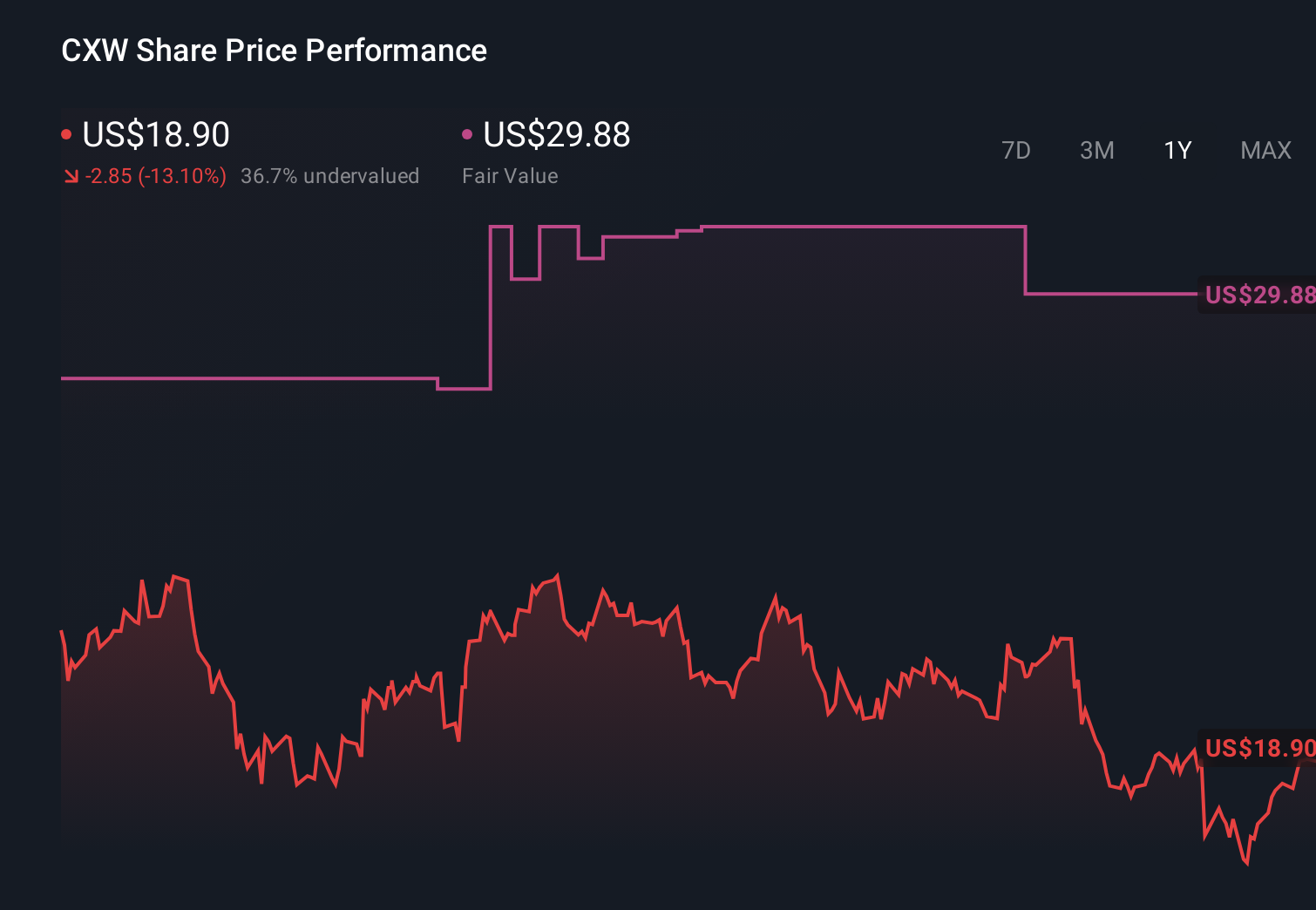
While consensus treats CoreCivic as a gradually improving, policy sensitive operator, the most optimistic analysts once penciled in US$3.1 billion revenue and US$246.3 million earnings by 2029, assuming higher margins and share count reduction, which may look very different in light of a value defensive rebranding and the added leverage and idle bed risk you now need to weigh.
Explore 3 other fair value estimates on CoreCivic - why the stock might be worth less than half the current price!
Reach Your Own Conclusion
Don't just follow the ticker - dig into the data and build a conviction that's truly your own.
- A great starting point for your CoreCivic research is our analysis highlighting 2 key rewards and 2 important warning signs that could impact your investment decision.
- Our free CoreCivic research report provides a comprehensive fundamental analysis summarized in a single visual - the Snowflake - making it easy to evaluate CoreCivic's overall financial health at a glance.
No Opportunity In CoreCivic?
These stocks are moving-our analysis flagged them today. Act fast before the price catches up:
- Outshine the giants: these 15 early-stage AI stocks could fund your retirement.
- Find 43 companies with promising cash flow potential yet trading below their fair value.
- Uncover the next big thing with 22 elite penny stocks that balance risk and reward.
This article by Simply Wall St is general in nature. We provide commentary based on historical data and analyst forecasts only using an unbiased methodology and our articles are not intended to be financial advice. It does not constitute a recommendation to buy or sell any stock, and does not take account of your objectives, or your financial situation. We aim to bring you long-term focused analysis driven by fundamental data. Note that our analysis may not factor in the latest price-sensitive company announcements or qualitative material. Simply Wall St has no position in any stocks mentioned.