

How Do Lending Curbs and ESOP Moves Reframe TPG (TPG)’s Private Credit Risk Profile?
TPG Inc Class A TPG | 0.00 |
- Earlier this month, TPG Inc. filed a US$282.34 million shelf registration for 6,383,349 Class A shares tied to its employee stock ownership plan, while the firm also contended with sector-wide stress after JPMorgan Chase moved to restrict lending to private credit providers and TPG limited redemptions on key funds.
- At the same time, TPG’s climate platform completed a complex exit from Intersect to Google, reshaping its exposure to fast-growing data center and clean power infrastructure through the creation of new grid-focused operator IPX Power backed by TPG Rise Climate.
- Against this backdrop, we’ll now examine how JPMorgan’s lending pullback to private credit providers could reshape TPG’s investment narrative and perceived risk.
Find 48 companies with promising cash flow potential yet trading below their fair value.
TPG Investment Narrative Recap
To own TPG, you need to believe its diversified alternatives platform can keep growing fee-based earnings despite fundraising headwinds and market stress in private credit. Right now, the biggest near term risk is confidence in liquidity and valuations across private credit, which JPMorgan’s lending pullback has put in focus. The ESOP shelf registration looks manageable in that context, but the redemption limits on key funds are more relevant to how investors assess near term risk.
The Intersect sale to Google and creation of IPX Power matter here because they highlight how TPG is recycling capital and reshaping exposure toward power hungry data centers and grid infrastructure. This type of realization event can support fee and carry economics at a time when sector sentiment is under pressure, and it sits alongside newer growth efforts like the Jackson partnership and insurance platforms as potential offsets to private credit concerns.
Yet against that backdrop, you should also be aware that funding pressure and tighter credit could quickly amplify concerns about TPG’s redemption limits and...
TPG's narrative projects $2.3 billion revenue and $827.7 million earnings by 2028. This requires a 16.5% yearly revenue decline and roughly an $807.5 million earnings increase from $20.2 million today.
Uncover how TPG's forecasts yield a $68.87 fair value, a 70% upside to its current price.
Exploring Other Perspectives
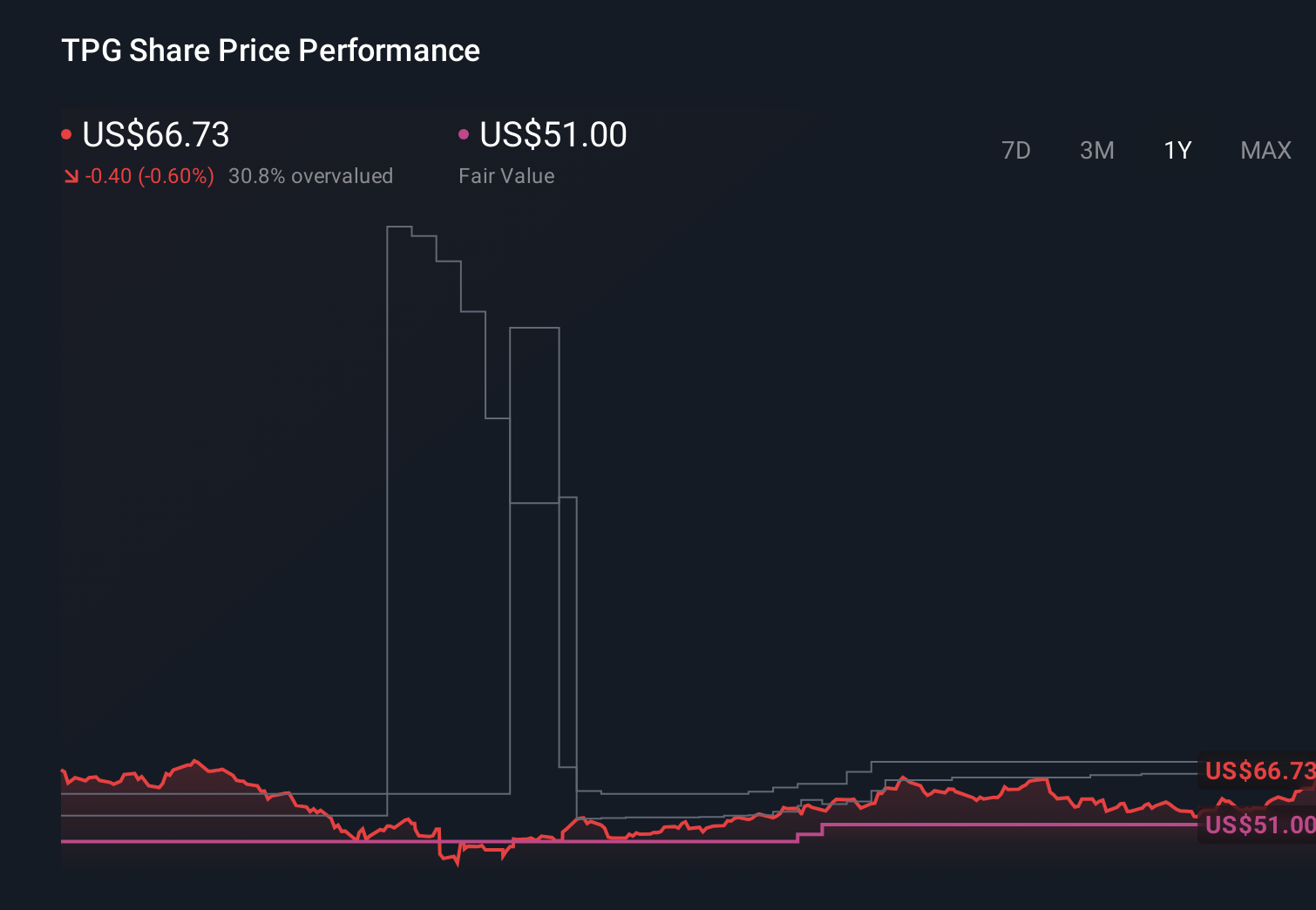
Some of the lowest rated analysts were already more cautious, assuming TPG’s revenue would fall to about US$2.5 billion by 2028 even as earnings climbed toward roughly US$554 million, and the fresh stress from JPMorgan’s lending pullback may either reinforce or challenge that view depending on how credit markets evolve and how you weigh the risk that tighter regulation could further constrain TPG’s fund structures.
Explore 2 other fair value estimates on TPG - why the stock might be worth as much as 70% more than the current price!
Reach Your Own Conclusion
Don't just follow the ticker - dig into the data and build a conviction that's truly your own.
- A great starting point for your TPG research is our analysis highlighting 4 key rewards and 1 important warning sign that could impact your investment decision.
- Our free TPG research report provides a comprehensive fundamental analysis summarized in a single visual - the Snowflake - making it easy to evaluate TPG's overall financial health at a glance.
Interested In Other Possibilities?
Markets shift fast. These stocks won't stay hidden for long. Get the list while it matters:
- Invest in the nuclear renaissance through our list of 87 elite nuclear energy infrastructure plays powering the global AI revolution.
- Uncover the next big thing with 32 elite penny stocks that balance risk and reward.
- The future of work is here. Discover the 30 top robotics and automation stocks leading the charge in AI-driven automation and industrial transformation.
This article by Simply Wall St is general in nature. We provide commentary based on historical data and analyst forecasts only using an unbiased methodology and our articles are not intended to be financial advice. It does not constitute a recommendation to buy or sell any stock, and does not take account of your objectives, or your financial situation. We aim to bring you long-term focused analysis driven by fundamental data. Note that our analysis may not factor in the latest price-sensitive company announcements or qualitative material. Simply Wall St has no position in any stocks mentioned.