

How Does Voyager Technologies Stack Up After AI Chip Partnership and 14.5% Rally?
Voyager Technologies VOYG | 0.00 |
If you are watching Voyager Technologies stock right now, you are far from alone. After a rollercoaster few weeks, it is natural to be wondering whether now is the right time to step in, sit tight, or look elsewhere. From a short-term dip of 6.0% last week to a healthy jump of 14.5% over the past month, Voyager’s $33.17 closing price has caught the eye of plenty of market watchers. Year to date, though, the stock is still down 41.3%, so there is no denying that the past year has tested investors’ patience and risk tolerance.
What has been moving the needle lately? The stock’s comeback this month seems to align with recent headlines around Voyager's expanded partnerships in autonomous driving research and increasing institutional interest in its AI chip technologies. While not every headline packs a punch, these developments have signaled to some investors that sentiment may be shifting, or that the growth story here is far from over. However, with only 1 out of 6 key value checks currently showing Voyager as undervalued, it is clear the market remains cautious about its core valuation.
So, how does Voyager stack up across a range of classic valuation methods? Before we dive into the details of its price-to-earnings, book value, and other go-to ratios, let us consider not only what these numbers suggest, but also an even better way to put Voyager’s valuation into perspective at the end of this article.
Voyager Technologies scores just 1/6 on our valuation checks. See what other red flags we found in the full valuation breakdown.
Approach 1: Voyager Technologies Discounted Cash Flow (DCF) Analysis
The Discounted Cash Flow (DCF) model estimates a company's intrinsic value by projecting its future cash flows and discounting them back to present value. It considers what Voyager Technologies is expected to earn in Free Cash Flow (FCF) over the coming years, adjusts those figures for time and risk, and provides an estimate of what the business may be worth today.
Voyager’s latest reported Free Cash Flow is -$37.35 million, indicating a business still burning cash to support growth. Analyst estimates suggest that while FCF remains negative through 2027, a significant turnaround to positive territory is projected by 2028, with FCF reaching $160.90 million and peaking at $130.20 million in 2029. Beyond the analyst forecast horizon, Simply Wall St extrapolates additional modest gains through to 2035, though these projections naturally carry more uncertainty the further out they extend.
Based on all these projections and discounting them back to today, the DCF model arrives at an intrinsic value of $16.18 per share. When compared to the current trading price of $33.17, this suggests that Voyager Technologies is approximately 105.1% overvalued by this measure.
Result: OVERVALUED
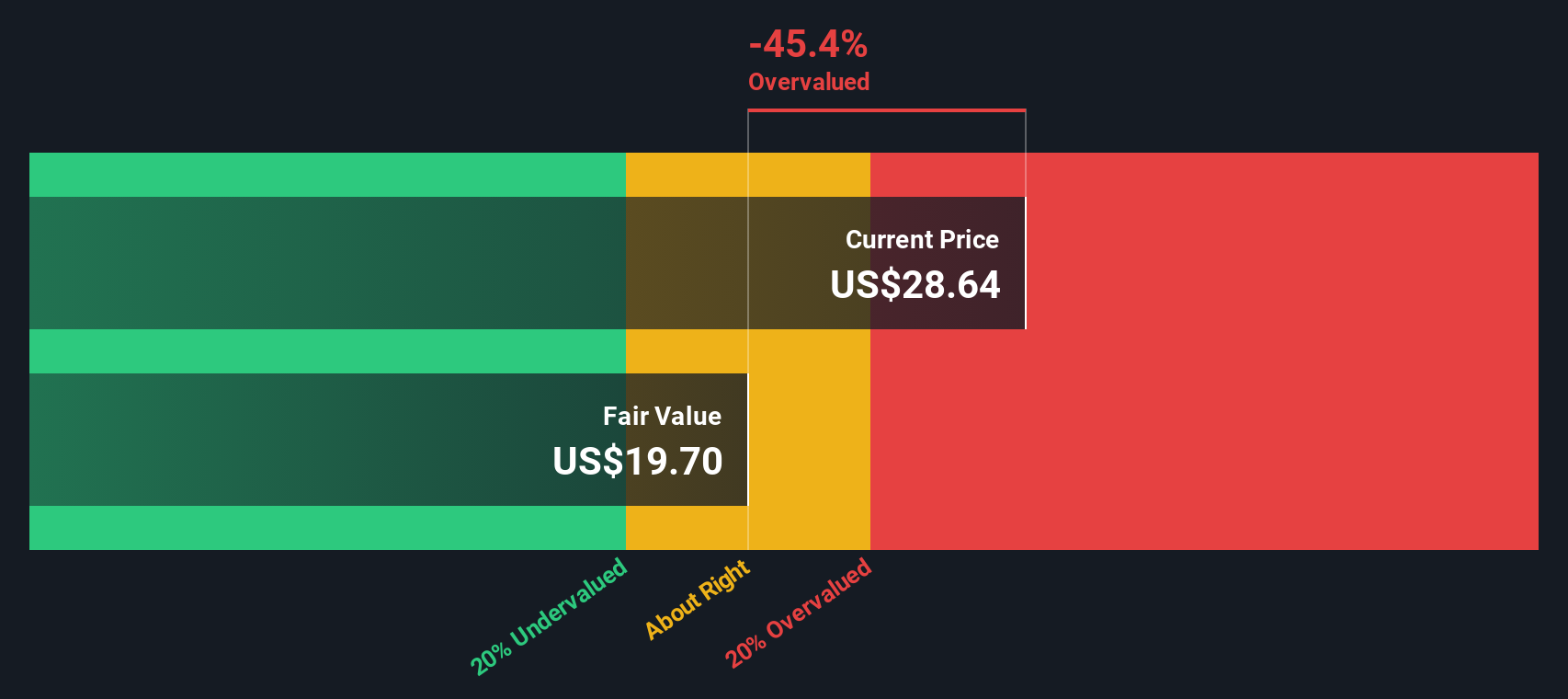
Our Discounted Cash Flow (DCF) analysis suggests Voyager Technologies may be overvalued by 105.1%. Find undervalued stocks or create your own screener to find better value opportunities.
Approach 2: Voyager Technologies Price vs Sales
The Price-to-Sales (P/S) ratio is often the preferred valuation metric for companies like Voyager Technologies, where profitability may still be some time away but revenue traction is notable. The P/S ratio tells investors how much they are paying for each dollar of the company's revenue, making it useful for evaluating growth firms with significant sales but little or no current earnings.
What is considered a "normal" or "fair" P/S ratio is shaped by factors such as market expectations for future growth, competitive position, and perceived risk. Rapidly expanding companies with strong sales prospects may justify a higher P/S, while slower growers or those in riskier industries tend to trade at lower multiples.
Currently, Voyager Technologies trades at a P/S ratio of 12.42x. This is well above the Aerospace & Defense industry average of 3.14x and its peer average of 3.02x. At face value, that sizable premium might look excessive, but P/S ratios do not reflect key differences in growth outlook, margins, or risk profile.
This is where Simply Wall St’s proprietary “Fair Ratio” comes in. The Fair Ratio incorporates a wider set of factors including Voyager’s earnings growth, profit margins, market capitalization, sector and company-specific risks, to estimate a more bespoke benchmark for valuation. By capturing more nuance than a simple peer or industry average, the Fair Ratio gives investors a more useful point of comparison for today’s share price.
In Voyager Technologies’ case, the P/S ratio is significantly higher than both industry and peer averages, and also stands notably above the Fair Ratio. This suggests that, based on expected growth, risk, and company-specific traits, the stock is overvalued using this lens.
Result: OVERVALUED
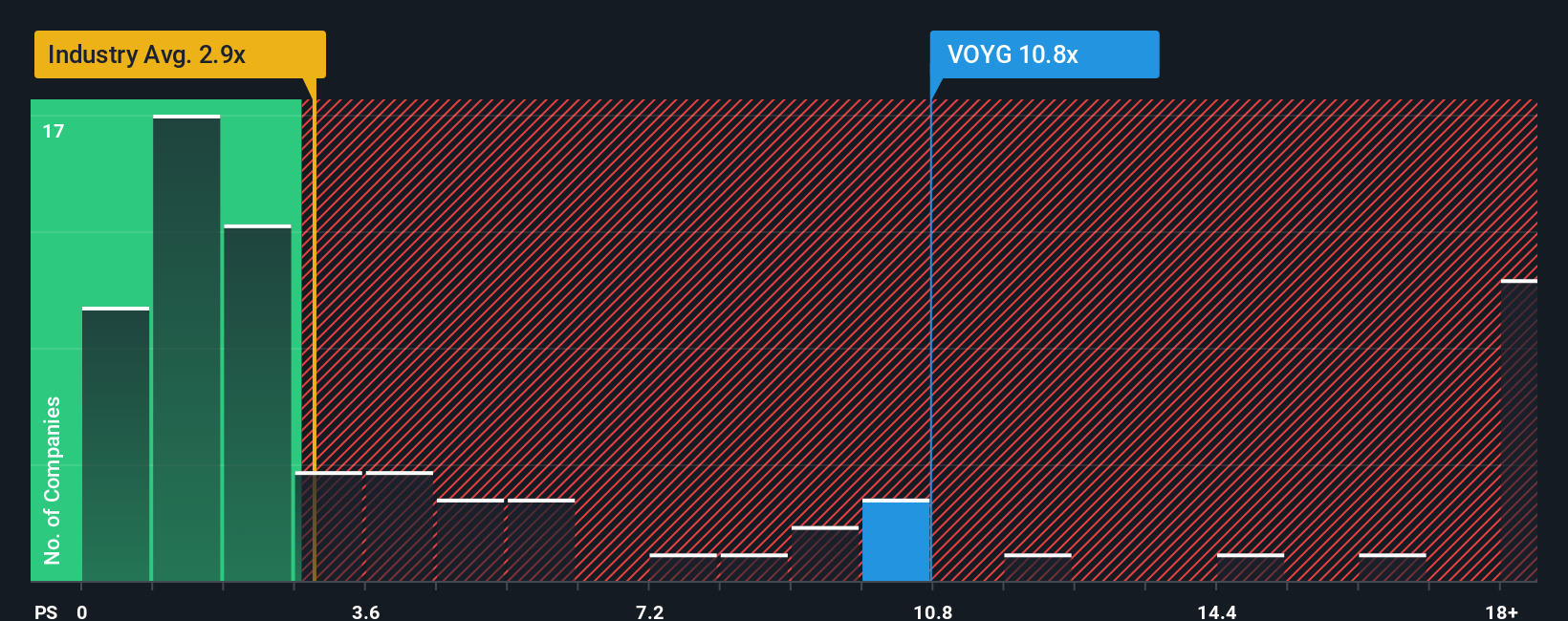
PS ratios tell one story, but what if the real opportunity lies elsewhere? Discover companies where insiders are betting big on explosive growth.
Upgrade Your Decision Making: Choose your Voyager Technologies Narrative
Earlier we mentioned that there is an even better way to understand valuation. Let us introduce you to Narratives. A Narrative is simply your story, connecting what you believe about a company, like Voyager Technologies, with your assumptions for its future revenue, earnings, and margins to calculate your own fair value. Instead of just relying on numbers or ratios, Narratives make it easy to link the company’s journey to a personalized financial forecast and then see how your fair value compares to the current price.
Narratives are available on Simply Wall St’s Community page, where millions of investors share their perspectives. They are a simple, accessible tool that update dynamically as new news or earnings emerge, so your analysis always reflects the latest information. Narratives empower you to confidently decide on your investment actions by tracking the difference between your fair value and the market price. For example, on Voyager Technologies, some investors’ Narratives might project a much higher fair value based on optimism for new partnerships, while others set a lower fair value if they are concerned about ongoing losses.
Do you think there's more to the story for Voyager Technologies? Create your own Narrative to let the Community know!
This article by Simply Wall St is general in nature. We provide commentary based on historical data and analyst forecasts only using an unbiased methodology and our articles are not intended to be financial advice. It does not constitute a recommendation to buy or sell any stock, and does not take account of your objectives, or your financial situation. We aim to bring you long-term focused analysis driven by fundamental data. Note that our analysis may not factor in the latest price-sensitive company announcements or qualitative material. Simply Wall St has no position in any stocks mentioned.