

How Illumina’s Billion Cell Atlas Expansion Could Reshape Eli Lilly’s (LLY) Drug Discovery Edge
Eli Lilly and Company LLY | 0.00 |
- In July 2026, Illumina announced that its Billion Cell Atlas alliance, originally launched with AstraZeneca, Merck, and Eli Lilly, had expanded to include three additional AI‑focused drug developers and surpassed 350 million sequenced cells across more than 200 disease‑relevant cell lines.
- This rapidly growing CRISPR-based dataset, targeting one billion cells and generating several petabytes of genomic data, could materially enhance Eli Lilly’s ability to uncover new drug targets and understand disease mechanisms.
- We’ll now explore how participation in Illumina’s Billion Cell Atlas, alongside expectations for Mounjaro and upcoming earnings, may reshape Eli Lilly’s investment narrative.
Capitalize on the AI infrastructure supercycle with our selection of the 55 best 'picks and shovels' of the AI gold rush converting record-breaking demand into massive cash flow.
Eli Lilly Investment Narrative Recap
To own Eli Lilly today, you generally have to believe its obesity and diabetes portfolio, led by Mounjaro, can justify a rich valuation despite payer and pricing risks. The Illumina Billion Cell Atlas alliance mainly reinforces Lilly’s long term research engine; it does not materially change the near term focus on Mounjaro uptake and guidance on August 5, or the key risk of concentrated exposure to a handful of metabolic drugs.
Among recent announcements, Lilly’s April 30 guidance raise to US$82–US$85 billion in 2026 revenue is the most relevant reference point. Consensus attention is locked on whether upcoming earnings and Mounjaro performance support that upgraded outlook. The Illumina alliance adds a powerful discovery tool in the background, but the immediate catalyst for sentiment still sits with obesity and diabetes revenue trends and how sustainably Lilly can support its higher revenue and margin profile.
Yet investors should also be aware that concentrated exposure to a few GLP 1 products could become a problem if...
Eli Lilly's narrative projects $114.2 billion revenue and $46.1 billion earnings by 2029. This requires 16.5% yearly revenue growth and a roughly $20.8 billion earnings increase from $25.3 billion today.
Uncover how Eli Lilly's forecasts yield a $1270 fair value, a 6% upside to its current price.
Exploring Other Perspectives
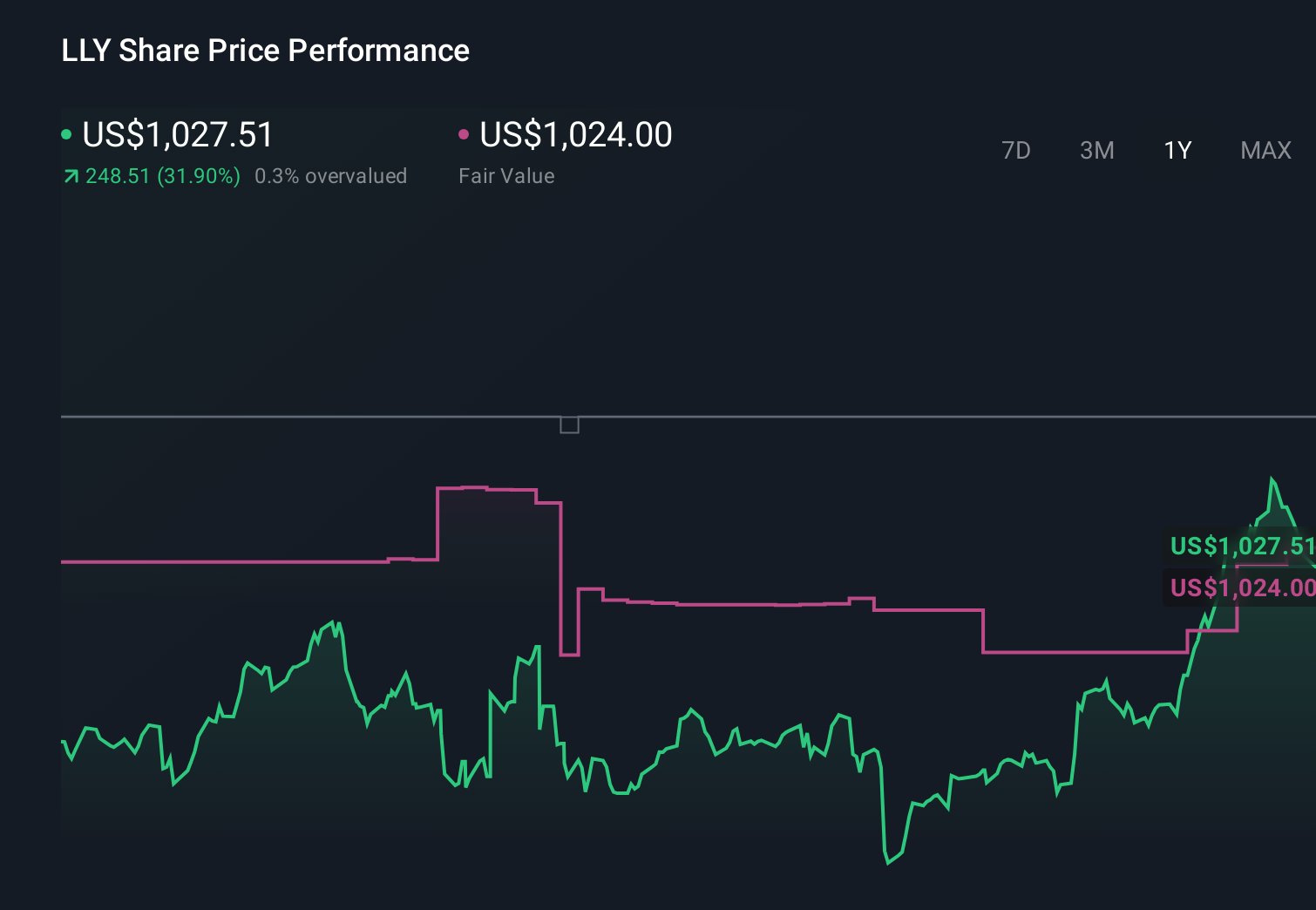
More cautious analysts were already assuming about US$102.4 billion of revenue and US$40.2 billion of earnings by 2029, which is far less upbeat than consensus, so this new Illumina data partnership could either soften that pessimism or reinforce concerns about whether Lilly’s pipeline really reduces its dependence on obesity drugs over time.
Explore 19 other fair value estimates on Eli Lilly - why the stock might be worth as much as 38% more than the current price!
Decide For Yourself
Disagree with existing narratives? Extraordinary investment returns rarely come from following the herd, so go with your instincts.
- A great starting point for your Eli Lilly research is our analysis highlighting 3 key rewards and 2 important warning signs that could impact your investment decision.
- Our free Eli Lilly research report provides a comprehensive fundamental analysis summarized in a single visual - the Snowflake - making it easy to evaluate Eli Lilly's overall financial health at a glance.
Ready For A Different Approach?
Early movers are already taking notice. See the stocks they're targeting before they've flown the coop:
- Rare earth metals are an input to most high-tech devices, military and defence systems and electric vehicles. The global race is on to secure supply of these critical minerals. Beat the pack to uncover the 29 best rare earth metal stocks of the very few that mine this essential strategic resource.
- We've uncovered the 8 dividend fortresses yielding 5%+ that don't just survive market storms, but thrive in them.
- Uncover the next big thing with 21 elite penny stocks that balance risk and reward.
This article by Simply Wall St is general in nature. We provide commentary based on historical data and analyst forecasts only using an unbiased methodology and our articles are not intended to be financial advice. It does not constitute a recommendation to buy or sell any stock, and does not take account of your objectives, or your financial situation. We aim to bring you long-term focused analysis driven by fundamental data. Note that our analysis may not factor in the latest price-sensitive company announcements or qualitative material. Simply Wall St has no position in any stocks mentioned.