

How Intuit’s AI-Native ERP Push With Citrin Cooperman (INTU) Has Changed Its Investment Story
Intuit Inc. INTU | 0.00 |
- Citrin Cooperman Advisors LLC recently announced the rollout of Intuit Enterprise Suite to its middle-market clients, pairing its digital services practice with Intuit’s AI-native ERP platform that unifies multi-entity financial management, business intelligence, payments, payroll, HR, and marketing in a single cloud system.
- An interesting element is Intuit’s co-built AI agents with Citrin Cooperman’s BPO team, which automate receivables collections, financial package preparation, and accounts-payable decisioning, signaling a deeper push into AI-driven back-office automation for mid-sized enterprises.
- We’ll now examine how Intuit’s AI-native Enterprise Suite for mid-market clients could influence the company’s broader investment narrative and outlook.
AI is about to change healthcare. These 43 stocks are working on everything from early diagnostics to drug discovery. The best part - they are all under $10b in market cap - there's still time to get in early.
Intuit Investment Narrative Recap
To own Intuit, you need to believe its AI driven, end to end platform can keep deepening relationships with consumers, small businesses, and mid market firms while maintaining healthy profitability. The Intuit Enterprise Suite rollout with Citrin Cooperman reinforces the mid market growth catalyst but does not fundamentally change the near term focus on execution in AI products and the key risk that heavy AI investment may outpace actual customer adoption.
The most directly related development is Intuit’s expansion of Intuit Intelligence across QuickBooks Online Advanced and Enterprise Suite, including Intuit Intelligence Chat. Together with the Citrin Cooperman rollout, this points to a tighter push into AI powered ERP and back office automation for mid market customers, which ties closely to the consensus catalyst around platform consolidation and AI agents, but also heightens the risk if adoption or ROI for these capabilities proves slower than hoped.
Yet behind Intuit’s AI push, investors should also recognize the risk that heavier exposure to money products and credit linked revenue could...
Intuit's narrative projects $29.2 billion revenue and $6.8 billion earnings by 2029.
Uncover how Intuit's forecasts yield a $488.17 fair value, a 46% upside to its current price.
Exploring Other Perspectives
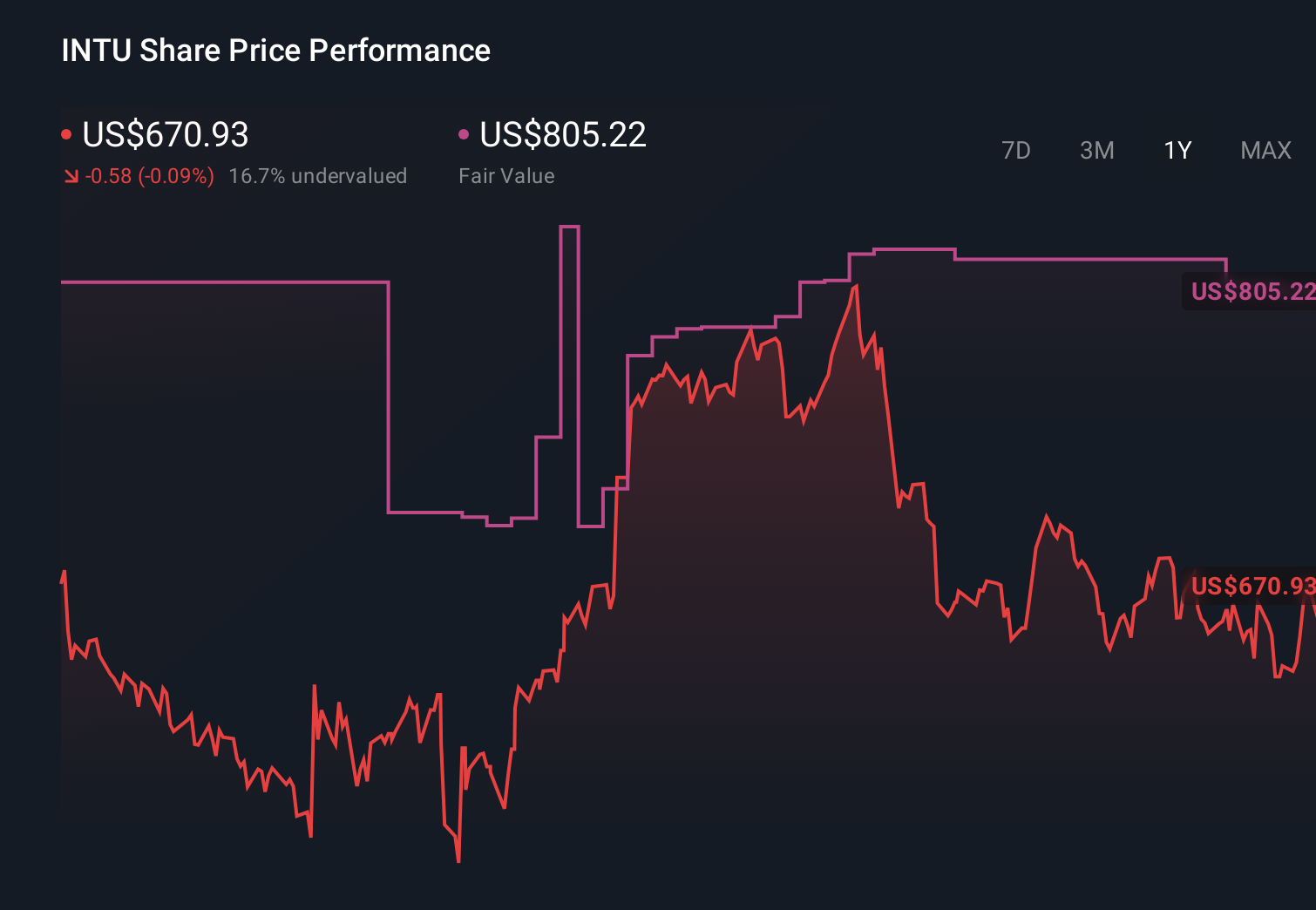
Some of the lowest analysts were already cautious, assuming revenue of about US$28.5 billion and earnings of US$6.5 billion by 2029, and they see Intuit’s heavy AI and mid market push as a double edged sword that could lift growth or leave margins under pressure if larger ERP deals and AI adoption take longer to land, so it is worth comparing their more pessimistic view with the recent Enterprise Suite news before you decide where you stand.
Explore 21 other fair value estimates on Intuit - why the stock might be worth just $390.00!
Form Your Own Verdict
Don't just follow the ticker - dig into the data and build a conviction that's truly your own.
- A great starting point for your Intuit research is our analysis highlighting 5 key rewards that could impact your investment decision.
- Our free Intuit research report provides a comprehensive fundamental analysis summarized in a single visual - the Snowflake - making it easy to evaluate Intuit's overall financial health at a glance.
No Opportunity In Intuit?
These stocks are moving-our analysis flagged them today. Act fast before the price catches up:
- Capitalize on the AI infrastructure supercycle with our selection of the 56 best 'picks and shovels' of the AI gold rush converting record-breaking demand into massive cash flow.
- We've uncovered the 9 dividend fortresses yielding 5%+ that don't just survive market storms, but thrive in them.
- The future of work is here. Discover the 39 top robotics and automation stocks leading the charge in AI-driven automation and industrial transformation.
This article by Simply Wall St is general in nature. We provide commentary based on historical data and analyst forecasts only using an unbiased methodology and our articles are not intended to be financial advice. It does not constitute a recommendation to buy or sell any stock, and does not take account of your objectives, or your financial situation. We aim to bring you long-term focused analysis driven by fundamental data. Note that our analysis may not factor in the latest price-sensitive company announcements or qualitative material. Simply Wall St has no position in any stocks mentioned.